Chilling out as agents of change…

PeasHow does one address ill-fitting and unjust systems in family, church and community while maintaining a calm disposition? Isn’t there a necessity for the passion of a prophet, the zest of a zealot, the tenacity of a teacher, the resilience of a reformer to effect change?

When the Apostle Paul counsels the household slaves in the troubled church of Corinth to “remain in the condition you were called?” is he suggesting that they should not rock the boat? (See 1 Corinthians 7:17-24) 

Change is constantly necessary if human society is to function as it ought. Paul seems to be addressing where it begins – deep in each human soul. Unless we are free within ourselves, even under the direst circumstances, we are unable to connect sufficiently with others in order to bring about external change.

Immediately – right now, if not sooner!

alarm-clock-3872x2592_74121I’m a born procrastinator. I need time to think things through. “Immediately” is not a word that appears often in my working vocabulary.
It occurs twice and insistently in the text from today’s reading in Mark’s gospel. 

Four men instantly drop their work to go around with one who has just taken up the baton of his politically assassinated cousin. Critical moments call for instant decisions, I suppose. And let’s not de-politicise what was at stake here – it was the proclamation of an alternative empire to that of Rome.  ἡ βασιλεία τοῦ Θεοῦ· is more correctly translated as “empire of God” than “kingdom of God.”

I would like to think that as one who is absolutely sold on the “empire of God” as proclaimed by Jesus that I would be as immediate in my response to claims by alternative empires, especially the dominant western one that claims my allegiance now and whose political masters brand many like me unloyal and unpatriotic when we measure their claims against his.

There was nothing rash or immediate about Jesus’ proclamation, however. It was 40 days in the making and rejected easy fixes to get to the nub of what mattered. Perhaps that’s why it evoked such an immediate response.

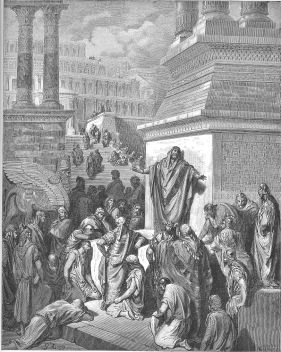
Jonah – the reluctant persuader

138.Jonah_Preaches_to_the_Ninevites
Gustave Doré [Public domain], via Wikimedia Commons
Is it possible to sell a product you don’t believe in? How motivated does one have to be to persuade a client, be it one individual or indeed a whole nation with a message in which you have zero confidence?

Well, apparently Jonah pulled it off! (See Jonah 3:1-10) 

Admittedly, Jonah’s message is full of the fire and brimstone vitriol that matches his disposition but, apparently, the Ninevites believed they deserved it and responded fully to the action point that Jonah put to them!

Which just goes to show you can catch some flies with vinegar if you don’t want to give away your honey!

The Nourishing Tomb of the Fish

jonah-whaleImagine surviving the innards of a fish. The gastric juices alone would do wonders for the skin!

The tale of Jonah is not interested in this detail (see Jonah 2:1-10). Ancient and forever symbolism holds before us the mystery of dark entombment as a liminal place between life and death, crucifixion and resurrection.

With Love To The World quotes Joan Chittister who says:

Darkness deserves gratitude. It is the alleluia point at which we learn to understand that all growth does not take place in the sunlight.

and Barbara Brown Taylor who reflects, “I have learned things in the dark that I could never have learned in the light. I need darkness as much as I need light.”

In dire circumstances, the recalcitrant Jonah draws on his reserve of spiritual resources and comes to a place of self-abandonment to God’s path of wholeness.

The fish-tomb is temporary. It spews Jonah onto the beach ( and no doubt swam off to tell it’s fish-friends about the “one that got away!”

Jonah – more than a Whale of a Tale!

Jonah_and_the_Whale,_Folio_from_a_Jami_al-Tavarikh_(Compendium_of_Chronicles)
Folio from a Jami al-Tavarikh (Compendium of Chronicles) circa 1400

… and there is no whale – the text refers to a “large fish” which is only incidental to the hermeneutical thrust of the story!

It is considered that the story of Jonah is a corrective cautionary tale to the purists of the era of Ezra and Nehemiah and the reestablishment of the Hebrew nation following return from exile (from 538 BCE), where it was required that all foreigners be removed from the reclaimed territory, even wives and children of non-Jewish stock.

Jonah was called to proclaim God’s message to Nineveh (a symbol of the evil empire that had held theJews in captivity). Jonah the purist baulks and flees by boat in the opposite direction.  Today’s text finds Jonah being quizzed by fellow passengers and crew in the midst of a raging storm. It seems important to know who is who and, ironically, Jonah finds himself submitting to multicultural reality and placing himself at their compassionate disposal, even to the possible cost of his life. In short, with reluctance on the part of his travelling companions, he is chucked overboard!

Maybe in our fear-driven political climate, we can work out where we are in the boat that is fleeing Tarsus.

And maybe there’s a large fish somewhere waiting to rescue us!

My current running commentary on biblical texts is based on the Australian published With Love To the World: a daily Bible reading guide based on the Revised Common Lectionary. Many in my congregation are using it regularly. 

“I see you”

Avatar
“I see you.” This meme from the movie Avatar did the rounds for a few months. It seemed to be nourishment for a collective hunger in a world which had descended into anonymity and a penchant for the kind of efficiency that codes citizens by number rather than name.

It was a kind of epiphany – an understanding of something deeply significant in order to be fully human.

The Gospel passage by the Revised Common Lectionary for Sunday (John 1:43-51) has two key “I see you” moments.

Philip is first “seen” by Jesus as he begins to gather his close disciples. Philip knows he is “seen” as he immediately goes with Jesus and soon after recruits Nathanael, who is apparently reluctant to acknowledge that “anything good can come out of Nazareth.” Jesus acknowledges and praises his scepticism and “sees” his potential.

Nathanael typifies our natural human response. We fear gullibility within ourselves and develop a protective mask that is only removed when trust is established. The mutual  “I see you” epiphany that then takes place between Nathanael and Jesus reveals a trust for which the world starves.

Troubled times … fresh resources.

“Crisis always comes with opportunity,” suggests the Chinese pictogram. How this relates to the current ascension of the greed of the few and the corresponding upward spiral of cost to the many is elegantly demonstrated in this video clip:

Human history seems to reveal a default trend of societies devolving from the most altruistic ideals to the rule of a powerful elite. There will always be a counterforce of opportunity to redress the balance.

This was no less true in the biblical accounts of the development of Israel as she sought to move from tribal confederacy to monarchy so that they could be “like other nations.” The move to monarchy and its attendant dangers was inevitable. What was also inevitable was a “holy subversion” to keep such dangers in check. The call of Samuel as the first in a long line of prophets related to Israel’s monarchy begin a tradition of strong interface between the natural human inclination to power and control and the bigger picture for the common good.

The nuances of the latter are pointed out in the involvement of “the least” elite. Commenting on the call of Samuel while still a young boy, the Rev’d Dr Keith Rowe (With Love To The World) says:

An easily overlooked group become vehicles of newness – an elderly mother, a near blind priest troubled by the anti social behaviour of his sons, and a fragile child with acute spiritual sensitivity.

When despairing over the latest revelation of greed and abuse of power in high places, look for the Samuels and Hannahs in our midst. There are the opportunities. There lies our hope

Wooing the one who jilted you …

door of hopeWho would want to?

The Hebrew prophet Hosea – that’s who! Initially, he nurses the pain of anger when Gomer leaves him for a polyamorous dalliance with others. The patriarchal law of his time and place would have allowed his claim on her life. Instead, we see a tender wooing back, prompted by an insight into YHWH’s yearning for his wayward people,

In a tender love poem, Hosea once again courts Gomer. (Hosea 2:14-23) 

The Rev’d Dr Keith Rowe contrasts the harsh history of the valley of Achor and “a door of hope” (v15).

As much as I baulk at the uncompromising retribution in the face of the greed of Achan described in the above link, I cannot ignore the parallel suffering of the vulnerable caused by today’s uncompromising focus on greed. The “door of hope” that Hosea so eloquently espouses matches much of our yearning for the cessation of violence, comprehensive care for others and nurture of the natural environment.

The contemporary gift of Hosea is a reframing of the context for the frustration and powerlessness experienced by many who seek to act for change against uncompromising commercial and political forces – our valley of Achor. A shift of perspective that focuses on our love (God’s love) for uncomprehending and fickle game-changers will unlock the “door of hope.”

Marriage in the air…

wedding-rings-949106_960_720
CC0 Public Domain – https://pixabay.com/en/wedding-rings-before-rings-wedding-949106/

News programs highlight that yesterday, the first Monday after New Year’s Day, is the day that typically peaks for relationship breakdown and in particular marriage separation and demands for divorce.

Today is the first day that same-sex couples are able to legally tie the knot under Australian law.

Synchronistically, today’s set text is from the Hebrew prophet Hosea, whose love for his estranged wife, Gomer, becomes a model describing God’s yearning for God’s people. Writing for “With Love to the World,” the Rev’d Keith Rowe claims Hosea’s insights are valued

because they provide a language for later believers wanting to think and speak about human fragility and divine compassion.

Whether it’s in the fraught area of vulnerable human relationships or wider public policy, we need to learn how to speak more of this language. Within our own household circles is a good place to start.  Many will find social media to be a good place for practice. Who knows where the ripples going out may reach?

Life and marriages will still be messy, but more caring and compassionate. Ask Hosea!


That strange in between time when Epiphany bursts forth

suspension bridgeSome call it the silly season. Its those first few weeks of a southern hemisphere January. The office is quiet. I’m at work making use of the downtime from the regular weekly program to engage in some tidying up and planning for what must take place in my final six months here – and beyond. There is a kind of relaxed urgency about all this.

Here is the call of great things to come – both for those we must leave behind and for us as we move into uncharted territory.  And the season of Epiphany has burst upon us.  Between now and mid-February we are reflecting and responding to the explosion of understanding that the self-revealing of God through the Christ thrusts upon us.

Yet it is an understanding that opens up just how much more territory there is to explore!

Psalm 63:1-8 catches the sense of an awakened thirst seeking satisfaction. These January days are pregnant with expectancy seeking fulfilment because of what is known and what is understood.