Australia & the World Pray for the UK & Ireland

Many countries deserve our thoughtful prayers from week to week and we are certainly mindful of the dramatic events affecting millions of people in Egypt right now. Focused attention on troubled and changing regions does not deplete a disciplined and planned approach to prayer, however.

Ireland and the  United Kingdom comprising England, Northern Ireland, Scotland, Wales are the countries featured on the Ecumenical Prayer Cycle this week.

The Church of Christ at Wembley Downs participates by featuring the week’s countries in newsletter, feature wall and Sunday morning intercessions. Groups and individuals are encouraged to pray for these countries through the coming week. The following prayers are from the featured web page.

Intercessions

Give thanks for:

The witness of saints and missionaries, who faithfully proclaimed the gospel to these and other lands.
Ecumenical initiatives to bring Christians closer together.
The work for justice and peace in which Christians join with others to imagine a better world.
Centres of Christian renewal.
Tartans, bagpipes and boys’ choirs singing in ancient cathedrals.
Poetry and song.

Pray for:

Immigrants and asylum seekers who seek a better life in these countries.
Reconciliation and an end to enmity between peoples.
Strength for those who combat racism.
Churches which try to be faithful to Christ in the midst of secularization and change.
Those who feel they have been left behind: the homeless and unemployed, those whose education seems inadequate or their skills out of date, and those who are long-term patients in mental hospitals.
Those whose industry has been ravaged: the coal miners and slate workers who know of pit and quarry closures and who suffer emphysema and pneumoconiosis, the farm and land workers who have lost their livelihoods and have seen their communities changed dramatically, the factory workers who have lost their jobs, the young who cannot find work, and the elderly who depend on support in residential homes.
Prayer

Lord, you made the world and everything in it;
you created the human race of one stock
and gave us the earth for our possession.
Break down the walls that separate us and unite us in a single body.

Lord, we have been divisive in our thinking,
in our speech, in our actions;
we have classified and imprisoned one another;
we have fenced each other out by hatred and prejudice.
Break down the walls that separate us and unite us in a single body.

Lord, you mean us to be a single people,
ruled by peace, feasting in freedom, freed from injustice,
truly human, men and women,
responsible and responsive
in the life we lead,
the love we share,
the relationships we create.
Break down the walls that separate us and unite us in a single body.

Lord, we shall need ever new insights into the truth,
awareness of your will for all humanity,
courage to do what is right even when it is not allowed,
persistence in undermining unjust structures until they crumble into dust,
grace to exercise a ministry of reconciliation.
Break down the walls that separate us and unite us in a single body.
Lord, share out among us the tongues of your Spirit
that we may each burn with compassion for all
who hunger for freedom and human dignity;
that we may be doers of the word and so speak with credibility about the
wonderful things you have done.
Lord, direct us in ways we do not yet discern and equip us for the service of reconciliation and liberation in your world.


Would the Beatitudes work in Egypt?

The famous opening lines of Matthew’s account of Jesus’ Sermon on the Mount come up this Sunday. (Matthew 5:1-12).

Contextually, they form the foundation of the manifesto for “the Kingdom of Heaven” that is at hand and announced successively by John the Baptist and Jesus. More contemporary language might replace “Kingdom” terms with the “all-pervading consciousness of the presence of God” that begins within one’s self and one’s community and begins to transform the world in ever increasing circles.

Jesus begins his movement of raising this new but continuous phase of God-awareness in Galilee’s lake district amongst the indentured fishing industry. His appeal is largely to crowds dependent on subsistence economy.

Consequently the Beatitudes are not a summons to behaving in a particular way, as religious leaders of the time may have urged, but a recognition and affirmation  of the poor circumstances in which the peasantry of Galilee lived and the call to a new orientation of how they perceived their circumstances – not as victims of Herod’s oriental hierarchy in collusion with the heavy footed might of Rome, but as God-cherished denizens of a new society operating to selfless yet self-affirming standards of behaviour. These principles will be outlined further as the Sermon unfolds.

Food for thought as the Middle East experiences uprisings in Tunisia, Egypt and Lebanon against systems of rule widely perceived as tyrannical. One might be tempted to ponder how the orientation of the Beatitudes might apply in such circumstances (getting past the fact that many within the crowds are calling for the Islamification of government rule). One recalls the tremendous show of solidarity by the Egyptian populace with the beleaguered Coptic community in the wake of the New Year bombing in Alexandria. However, the call is to recognise the proximity of the Kingdom of Heaven to us. We can only respond from ourselves and not the distant neighbour, no matter how closely we hold them. This response however, ultimately embraces all. See a previous post on how prayer works.

Still pondering, but this is a start!

Wondering about Wisdom

For my edification, I am reading Stephen S Hall, Wisdom: from philosophy to neuroscience.(University of Queensland Press, 2010).

As a science writer, the author is particularly keen to explore potential new insights provided by the emerging neurosciences without jettisoning  more conventional understandings of wisdom. In fact, he conjectures, wisdom is a phenomenon that cannot really be grasped without standing back and appreciating the multi-cultural, multi-disciplinary, multi-faceted contributions of generations of human existence. One early observation, however, is that it is most often conveyed, not in the rarefied atmosphere of academia or sanctum, but among and within the human population at large.

Without daring to deign a definition, he does lay out some tentative principles associated with wise behaviour before launching into his investigation:

  • wisdom requires an experience-based knowledge of the world
  • wisdom requires mental focus, reflecting the ability to analyse and discern the most important aspects of acquired knowledge on a case by case basis.
  • wisdom requires mediating between conflicting inputs of emotion and reason, self-interest and social interest, instant rewards and future gains
  • wisdom expresses itself through a social vocabulary of interactive behaviour
  • wisdom is marked by a fundamental sense of justice and commitment to social well-being beyond the self
  • wisdom is able to defer immediate self-gratification to achieve the greatest amount of good for the greatest number of people.
Not a bad check list! We’ll see how it unfolds. Right now I would like to line it up alongside the text of the Beatitudes which comes up this Sunday. This text opens the Sermon on the Mount, Matthew’s distillation of the teaching (and the wisdom) of Jesus. Hall’s book provides an opening for discourse between wisdom anciently and newly discerned.
Incidentally, Stephen Hall blogs on wisdom right here.

We acknowledge Aboriginal Australia

Today I join many others in saluting the first nations of our land.

An excellent coloured poster size map (small or large) depicting the language, tribal and nation groups of Australian Indigenous peoples is available for purchase from the Australian Institute of Aborigine and Torres Strait Islander Studies. The map does not claim precision, but relies on published works to depict the multi-faceted mosaic of human habitation in this land for thousands of years before European settlement.
Copyright restrictions prevent the map from being represented here, but a visit to the site will give you an idea of the nature of the map and how to purchase it.


Why Wattle Day should be our national day – Eureka Street

Paul Newbury argues for wattle as a potentially powerful unifying symbol for the journey of reconciliation in Australia.
Why not move our national day to September 1st – Wattle Day?

Why Wattle Day should be our national day – Eureka Street.

Something Oprah missed …

… on her pilgrimage Down Under.

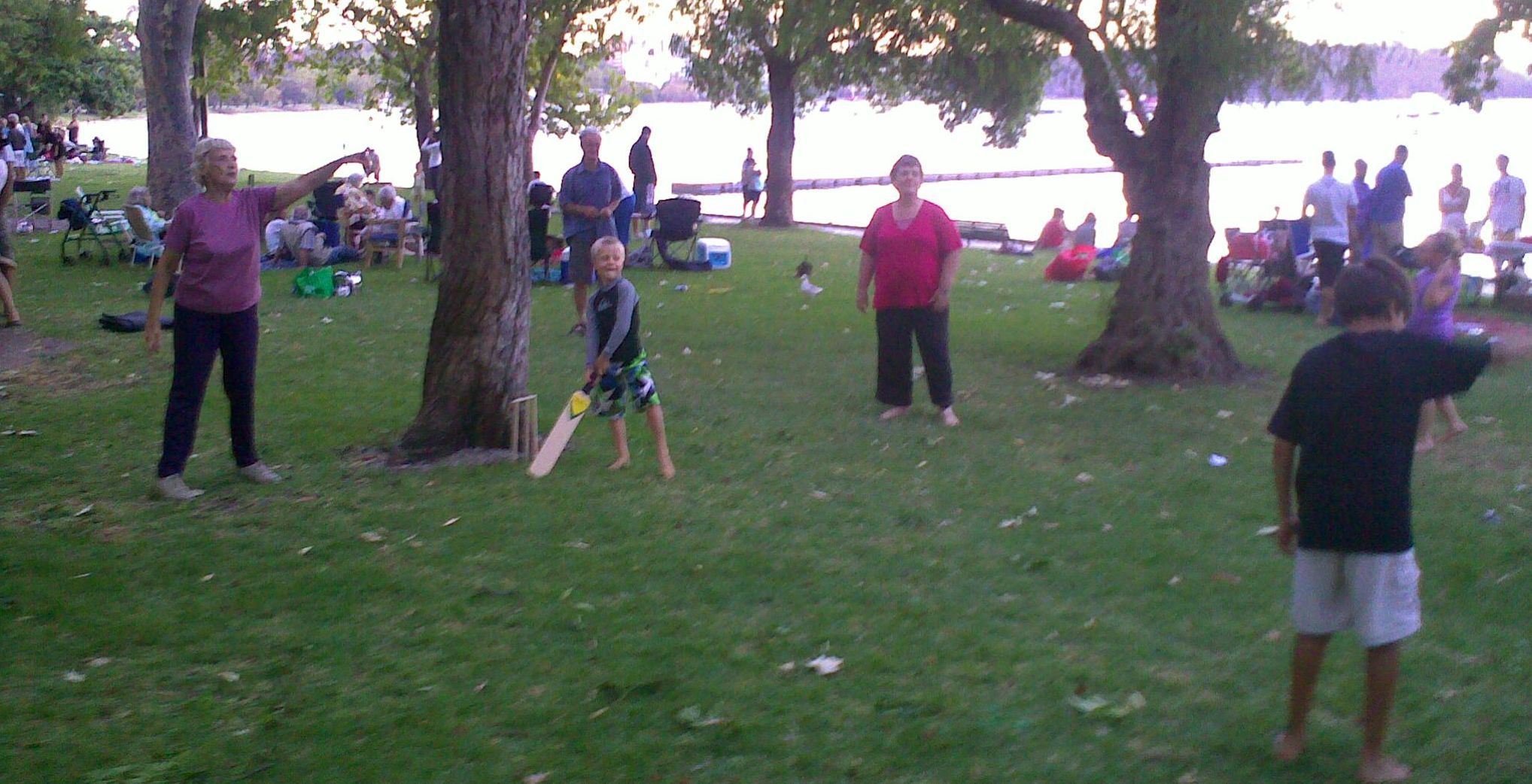
The joys of beach cricket at twilight on Matilda Bay, Perth. Mild summer’s day, gentle breeze, the gathering of several generations, shared goodies to eat, ambient conversation, bocce, paddling and cricket. A great way to kick off the year as several churches gather to share this annual event.

Teaching disciples to suck eggs

Some may find it strange to be talking to veteran congregations about discipleship, as today’s texts lead me. Most have been making the journey a lot longer than I have, and I’m getting a bit long in the tooth. Yet, once again I will address what I have come to call the magnetic summons of Jesus and I anticipate this annual revisitation will revive impulses in veteran and novice alike to stretch a little further along the road of learning to live in the spirit and character of Jesus. Of course, most of the inspiration will come from the congregation itself. Many individuals, though they be unaware, have demonstrated insights into matters of discipleship of which I would not otherwise have been aware. Grace in difficult family issues, courage and generosity while grappling with debilitating illness, serenity in failed enterprise, forgiveness when grievously wronged – these all reflect the spirit of Jesus and are evidence of attentive awareness of his transforming work. So perhaps the morning harangue will be a celebration instead!

The Summons

This Sunday’s text (Matthew 4:12-23) considers the magnetic call of Jesus of Nazareth to those around him – a summons that has extended down the centuries with ever-increasing pulling power.
This is one of our favourite songs at Wembley Downs. I love the lyrics! It’s by John Bell of the Iona Community in Scotland and is published by Wild Goose Publications. (We sing it at a quicker tempo than this!)

Christ Has No Online Presence but Yours

Have a look at and consider this worthy 21st Century adaptation of St Teresa of Avila‘s work. Click on Christ Has No Online Presence but Yours.

The original text of this 16th century Carmelite mystic reads:

Christ Has No Body

Christ has no body but yours,
No hands, no feet on earth but yours,
Yours are the eyes with which he looks
Compassion on this world,
Yours are the feet with which he walks to do good,
Yours are the hands, with which he blesses all the world.
Yours are the hands, yours are the feet,
Yours are the eyes, you are his body.
Christ has no body now but yours,
No hands, no feet on earth but yours,
Yours are the eyes with which he looks
compassion on this world.
Christ has no body now on earth but yours.

Stories of rebuilding after the floods – Eureka Street

This morning’s Eureka Street article throws out a challenge. Following the stories of heroism, resilience and community cohesion during the peak of the flood crisis. Andrew Hamilton observes that the media will follow form and find few inspiring stories to engage us in the long hard process of assessment and reconstruction. Instead, the press will focus on the conflict and tensions that arise. He looks to Scripture for examples of genres and frameworks for story making during such times.

Stories of rebuilding after the floods – Eureka Street.