Have been reconnecting with several colleagues from the last millennium as we arrange a college reunion. One has drawn my attention to the work of John Dear SJ. I googled him and I like the stuff, as a non-violent peace activist, he writes. Here’s an example
Government Funding for School Chaplaincy
The Prime Minister recently announced a huge multi million dollar funding package to place chaplains in high schools. As someone who has been involved in funding and supporting chaplains, I think this is a bad idea. Its a job for the church, not government, and I see compromise and bureaucracy edging its way in to what has been a very worthwhile programme.
I am in full agreement with Doug Hynd, Lecturer in Theology, St Marks Institute, Canberra, when he writes:
The sting in the tail of the Prime Minister’s proposal to provide funding for chaplaincies is that an effective veto power over appointment will be held by the Government. This will require bureaucratic vetting and Ministerial decision. The integrity of any faith community lies in its authority to call and approve its leaders and teachers. The government proposal in principle challenges the exercise of this authority. Churches have had to fight long and hard to assert their independence from state power in the west, that is what the separation of church and state is all about. Mr Howard may deny it or downplay the significance of what he is proposing but as announced the program will cross the line between church and state that has been drawn with much pain and at substantial cost by faithful Christians throughout the centuries. Indeed, Churches are still having to fight government attempts to control their life and witness in so many countries across the world. Governments ruling on the suitability of people to act in any role on behalf of a faith community is a thoroughly bad idea, As my mother would say “It will end in tears before bed time.” This sort of control over the suitability of religious figures for public roles has normally been a practice engaged in by governments of more totalitarian tendencies. The churches should refuse to participate in efforts to obtain this funding and boycott the program. If chaplaincy and pastoral care placements in schools are sought by the local community then churches should raise the money themselves and work with the local community to that end. That way the Christian community will retain the integrity of their identity and mission as a community that is not subservient to governments of whatever political persuasion. Action with the community at a local level will avoid the stigma that will be associated with receiving funding under this program, a stigma that will hinder the engagement and witness of the church in substantial sections of the Australian community. It will also build stronger connections with the community and be a more faithful witness to the way of Jesus than accepting government funding under conditions that make the church subservient to the government.
Aghast
That’s what I am at the realisation that it’s almost a month since I last posted. The spirit is indeed willing but the flesh is overcome with many things. So this post is a “foothold” to nag me to pay attention to my blogging. Don’t know why it’s important, but it seems to be.
Revisiting Aquachurch
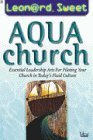 This book (by Leonard Sweet) was probably one of the most influential in getting this aging baby-boomer to begin thinking outside the square when it comes to organising and leading churches through change. It comes to light again as I travel with my congregation through a Church Life Review process. Many of our learnings are reflecting the challenges in this book – the need for fluidity rather than rigidity in our planning and organisation. I find this a particular challenge as churches join other community organisations in responding to the need to tighten internal structures in terms of governance and duty of care. There is a tension between the call to creating spaces for spontaneous response to the movements of the Spirit and the careful administrative oversight to which church leaders are increasingly summoned. Whether it is a creative tension remains a moot point.
Pope Benedict XVI – that speech
Much has been written in the media concerning an excerpt from Pope Benedict XVI’s recent speech at Regensburg which cited a medieval Byzantine emperor’s less than favourable view of the Islamic practice of “conversion by the sword.” I don’t propose to discuss this, but merely to point a very thoughtful treatment by Gil Baillie of the speech and the reaction it has provoked. It is on his blog at http://cornerstone-forum.blogspot.com/ ( now archived under September 15th, 2006).
Gil Baillie is the author of the ground-breaking work, Violence Unveiled, applying the insights of the anthropologist, Renee Girard, to the implications of the applied gospel of Jesus Christ.
Riding the Apocalypse with Bob

According to artist, Robert Brittain, the last book in the Bible is best understood as a visual and visceral experience. The Apocalypse, or the Revelation of John, comprises a vision revealed to the early church pioneer while a prisoner on the Mediterranean island of Patmos around AD90.
Last Sunday at the Church of Christ Wembley Downs, Robert Brittain unveiled a frieze depicting the vision in twenty four scenes. Robert presented the broad sweep of the vision, focusing on key events inspired by the words from the Lord’s Prayer, “on earth as in heaven.” The following question and answer session revealed a high level of interest and engagement on the part of the congregation.
Two lasting impressions were the power of the integrity of the work and the responses elicited by some of the images. Earlier in the week, as the frieze was being laid out to be set up, passers-by offered similar spontaneous reactions. It is a compelling work that invites participation with a body of scripture that is rarely engaged because it is considered overwhelming, threatening and too difficult to understand.
“What is different about this is its lightness – and obvious joyful, hopeful outcome,” said one visitor.
Another starkly notable feature was the prominence of the victim’s suffering negating evil design, first in the depiction of the slain Lamb, and then in all who were blessed through participating in him.
Robert Brittain is available to present his work on enquiry through the Wembley Downs Church of Christ, 9245 2593 or djr@cisp.com.au 
Coffe Cup Quote
Someone sent this quote found on the side of their coffee mug:
“It’s tragic that extremists co-opt the notion of God, and that hipsters and artists reject spirituality out of hand. I don’t have a fixed idea of God. But I feel that it’s us — the messed-up, the half-crazy, the burning, the questing — that need God, a lot more than the goody-two-shoes do.”Mike Doughty, musician.
Part of me resonates deeply with this!
Vox Congo
Vox Congo is an African band based in Melbourne and comprising asylum seekers waiting for decisions on their applications for residence in this country. Mark Riessen and his church at Knoxfield have been heavily involved in supporting them. It is great to see and hear of their pro-active and positive stance in circumstances that have defeated so many in similar circumstances. They now run a blog, with Mark’s assistance. Visit it at http://www.voxcongo.blogspot.com/
My "deep mystery of the universe question" for the week.
 Latte! A great way to enjoy good coffee without having to be overly concerned about kilojoules. But – someone tell me – why is it always served in a glass and usually without a handle? The glass is usually scalding hot and there must be a suave way of holding it without wrapping it up in a dozen serviettes.
Book sales
The University of WA Book Sale is on its second to last day and I managed to get there. Had to park a good kilometer away and I had nothing to carry books with so assigned myself the task of buying no more books than I could carry under my arm 1km on a warmish day. Ton’s of books to browse through – but I was stretched to find some I could use. The theology section was full of titles I already had or that I had already jettisoned. Ended up with some general Aussie folk-lore stuff – I usually enjoy grazing on such. How’s this for taciturn?
Two swagmen who had been mates for a long time were tramping out west in the wheat country. There were good young crops on either side of them. Harry took his pipe from his mouth and pointed to one of the paddocks.
“Nice crop of wheat,” he grunted.
Five hours later, when they were seated by their campfire, Bill broke the silence.
“Wasn’t wheat. ‘Twas oats.”
Then he rolled out his blanket and went to sleep. The sun was well up next morning. Harry and his swag were gone. Bill found a roughly scribbled note under a stone at the foot of the nearest tree.
“Too much b—– argyment in this here camp,” it said.


