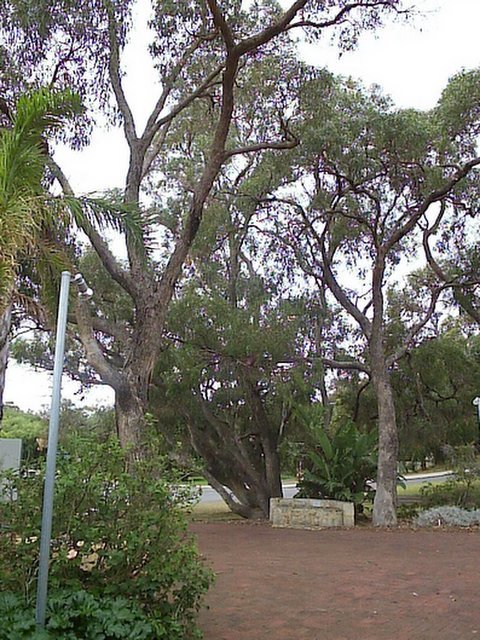
Eucalyptus


It’s the name of a book by Murray Bail that I’m reading at the moment. It’s also what the stand of tuarts around the church are saying after this morning’s loppings – “You clipped us!” (Sorry, can’t help it!). Tuarts are a very hardy species of eucalyptus, peculiar to this part of Australia. Bail’s book is the story of a widower who acquired a rural property and planted at least one of every known species of eucalyptus. He raised his daughter there, and, when of age, she attracted many suitors. By Dad’s decree, only the suitor who correctly named each species of tree (at least 700) on the property would win her hand.
Sounds like an ocker version of Rumpelstiltskin. I wouldn’t normally read books like this, but for the book club here. Should make for some interesting discussion. I’ve also learned it’s due to hit the silver screen before long, with Crowe and Kidman taking the starring roles. Funny how focus on something as ordinary and ubiquitous as a gum tree can change the way you perceive it! Posted by Picasa

Grand Opening of Universal WC

A little piece of doggerel to commemorate the opening of a universal WC at the Wembley Downs Church of Christ

Now its here! Now its done!
A toilet that all can access –
the halt and the lame, the gent and the dame
may “go” with all speedy success.

“Let’s have a grand opening!”
the Board Chairman declared,
“and let the Lotteries rep be invited.”
So to Open House the hordes repaired –
all anticipatory, ready and excited.

Now how does one open a new WC
with appropriate flair and not rush?
Does one cut a ribbon? Unveil a plaque?
Or press a button and flush?

The Good Book provided a verse or two
to inspire some imaginative work
“Drink from your own cisterns,”
was the advice it put forth –
but methinks the connection a quirk!

Speeches were made, and thanks were expressed
To Lotteries and donors alike,
No ribbon was cut, no button depressed –
Morning tea was served instead!

World Cup vs World Vision?

How many Aussies will be late for work tomorrow having stayed up in the still small hours to watch the Socceroo-Croatia contest?

And now this from http://www.ekklesia.co.uk/

World cup anti-poverty advert is banned The UK Broadcast Advertising Clearance Centre has banned an advert by a Christian relief agency which contrasts the £49 million it has cost to sponsor the England World Cup football with the 60p a day it costs to support a child in a poor community.According to the BACC the problem is that the agency concerned, World Vision, has not yet got the required permission from the England team and the Football Association, who are both mentioned in the film – which features former Doctor Who film star Paul McGann doing a voiceover.The one-minute advert was filmed by a young boy called Masidi from Malawi. He makes a ball out of maize to kick around with his friends because it is the nearest thing to a proper football which he can get hold of as a member of an impoverished community. World Vision says it has now had to spend more money to get an alternative advert shown. Though the ostensible issue is the technical matter of referring to third parties, the development organization thinks that the image of the message may have had something to do with it too – though the BACC denies this.“In our eyes, the advert is in no way anti-World Cup or anti-football. It simply uses the common language of football to point out the difference between Western world affluence and developing world resourcefulness,” says Rudo Kwaramba, who is responsible for advocacy, communications and education at World Vision.The purpose of the advert is to promote child sponsorship programmes as a way of supporting children in developing countries. Other agencies, such as Christian Aid and Oxfam, prefer to channel resources to communities and organisations rather than singling out individuals or families.But they have also had their advertising problems. A Make Poverty History television advert they and other groups put together was banned last year because mentioning trade and debt was deemed ‘political’. Actor Paul McGann is not impressed by this latest bar on a campaign he was supporting: “Does one laugh or cry? An advert describing how 60p a day might help a child in a developing country is pulled in order to spare the image of corporate sponsorship in a couple of rich ones. You couldn’t make it up.”

World Cup Blues

Members of my congregation were somewhat exercised that Brazil appeared on yesterday’s list for intercessions under the Ecumenical Prayer Cycle. Within 14 hours, Australia’s Socceroos were due to play Brazil, the top contenders for the World Cup. How do you intercede for a nation with which one’s own is in contest, even only recreationally? We all know how deeply sporting competitions affect the passions in the psyche, possibly sublimating those used to maintain balance in ancient inter-tribal rivalry. So how do we pray for the opposition?

Honestly!  We first confessed our perplexity given the coming face-off. Then we offered thanksgiving for the vibrancy and joie de vivre that is Brazil’s gift to the world. We prayed for Brazil’s national leadership, particularly in striving for outcomes of justice and mercy for the poor and dispossessed of that nation. We prayed for the church of Brazil in all its expressions and with all its challenges.

The outcome of the match is now well-known. We lost 2-0. Brazil showed why it is Number One, but the newcomers, the Socceroos, revealed a stamina and determination that did us proud. And Aussies love a good party. Nothing could keep them away from participating in Brazil’s celebrations. Better than the riots and destruction sometimes expressed by supercharged fans.

So ends a somewhat narrowly self-focused reflection on the phenomenon of the World Cup as it touched us yesterday.  The phenomenon of the World Cup raises a whole lot of other issues for reflection, but more on that later.

A Christian Peacemaker reflects at Easter

“Christ teaches us to love our enemies, do good to those who harm us, pray for those who persecute us. He calls us to accept suffering before we inflict injury. He calls us to pick up the cross and to lay down the sword.
We will most certainly fail in this call. I did. And I’ll fail again. This does not change Christ’s teaching that violence itself is the tomb, violence is the dead end. Peace won through the barrel of a gun might be a victory but it is not peace. Our captors had guns and they ruled over us. Our rescuers had bigger guns and ruled over the captors. We were freed, but the rule of the gun stayed. The stone across the tomb of violence has not been rolled away.”

– Christian Peacemaker Teams member James Loney, in an Easter reflection published by the Toronto Star about his 118-day captivity by Iraqi militants and rescue by British special forces troops.

As cited in Sojomail, the weekly newsletter published by Sojourners. See www.sojo.net for more information on how to subscribe. The editor, Jim Wallis, is an alternative Christian voice in America while still identifying strongly with the evangelical scene. He recently visited Australia.

The Gospel of Judas

Easter must be drawing near. The media is getting hysterical over another “latest discovery” guaranteed to scuttle the Church’s battered barque once and for all. This time it is the release of info relating to the discovery of documentary fragments purporting to belong to “The Gospel of Judas”, where it is claimed that Judas, rather than betraying Jesus, colluded with him in his demise.

(Yawn)

Knowledge of the Gospel of Judas, along with many other extant writings from diverse groups within early Christianity, has been around a long time. Irenaeus, a well-known and influential Church leader of the 2nd century, refers to it and dismisses it rather curtly. Not that the assertion in the Gospel of Judas makes much difference to the essential themes of the Christian gospel. But such details are important to some.

For details visit http://www.earlychristianwritings.com/gospeljudas.html

But what of Judas as presented to us in the canonical gospels? I find him an enigmatic figure. It is very easy to project all the worst that is in us onto him and he becomes our scapegoat. I don’t think this is what the gospel is about. Some helpful reframing questions might be, “Is the gospel of Jesus for Judas along with eveyone else?” “If so, what are the implications for me when I accuse myself of being beyond the pale?”

Tom Fox: martyr

Tom Fox was found dead in a Baghdad suburb a few days ago. He was one of four Christian Peace Makers Team members kidnapped three months ago. His voluntary role in Iraq was to act in liaison between detainees and their families and to escort medicines to clinics. He was always aware that such involvement could end in his death. It is most pertinent that his death occurred as many of us around the world were preparing to speak on the set gospel text, Mark 8:31-38, where Jesus says, “Whoever would gain their life will lose it, and whoever loses their life for my sake and the gospel’s, will find it.”
Tom Fox wrote in his web log in October 2004:

If I am not to fight or flee in the face of armed aggression, be it the overt aggression of the army or the subversive
aggression of the terrorist, then what am I to do? “Stand firm against evil” (Matthew 5:39, translated by Walter Wink)
seems to be the guidance of Jesus and Gandhi in order to stay connected with God. Here in Iraq I struggle with that second form of aggression. I have visual references and written models of CPTers standing firm against the overt
aggression of an army, be it regular or paramilitary. But how do you stand firm against a car-bomber or a kidnapper? Clearly the soldier disconnected from God needs to have me fight. Just as clearly the terrorist disconnected from God needs to have me flee. Both are willing to kill me using
different means to achieve he same end–that end being to increase the parasitic power of Satan within God’s good
creation. It seems easier somehow to confront anger
within my heart than it is to confront fear. But if Jesus and
Gandhi are right then I am not to give in to either. I am to
stand firm against the kidnapper as I am to stand firm against the soldier. Does that mean I walk into a raging battle to confront the soldiers? Does that mean I walk the streets of Baghdad with a sign saying “American for the Taking?” No
to both counts. But if Jesus and Gandhi are right, then I am asked to risk my life, and if I lose it to be as forgiving
as they were when murdered by the forces of Satan.
Standing firm is a struggle, but I’m willing to keep working at it.

 Posted by Picasa

Push-ups, Palamas and Prayer

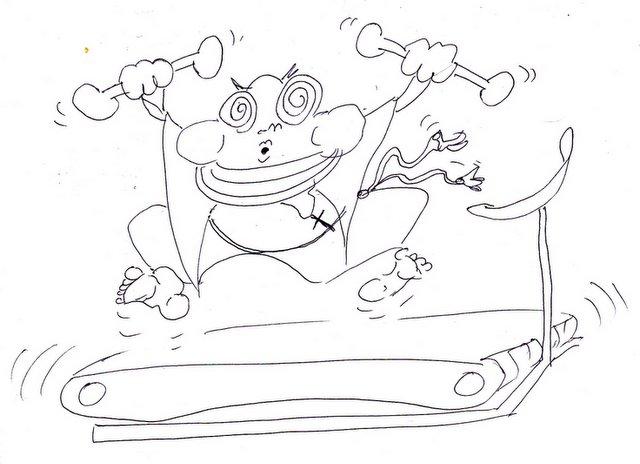
My doodle of a Benedictine monk exercising speaks of a convergence of thoughts. My post middle-aged frame is now being subjected to regular workouts at the local gym (under the wise eye of a personal trainer, I hasten to add!) I’m also attending to the continuous development of Dayspring’s coursework in the practice of prayer. I’ve seen an article by Ralph Eibner, ‘Gregory Palamas: The Body in Prayer and Spiritual Transformation” in Presence (Volume 11, No. 4, December 2005). Presence is an international journal of spiritual direction published by Spiritual Directors International .

Gregory Palamas is a fourteenth century Greek Orthodox theologian whose writings challenge the familiar stereotype of the duality of flesh and spirit – a uniquely western phenomenon. The simplified notion that matter is evil and spirit is good gave rise to some pretty bizarre prayer practices far removed from the spirituality of prayer practiced by our Hebrew and early Christian forbears.

Palamas offers reflection on the combination of the silent prayer that is the basis of the hesychastic tradition in orthodoxy, and the infusion of spirit and body. Prayer posture is thus a key element in his writings, not as a means of expressive gesture, but as part of the very essence of prayer.

Eibner says, “The integration of the body in prayer and spiritual formation that we are seeing in contemporary spirituality is simply a practical application of the kind of incarnational theology and spirituality that Palamas indicated.”

Think on that next time you’re at a charismatic praise service! All those raised hands may have a greater historic significance than we have been prepared to countenance! Posted by Picasa

A good read

How does Christian faith, based on a unique revelation, relate to other world faiths? Depending on one’s comfort zone, this might be experienced as either a stimulating question on the one hand, or irritating and threatening on the other.

Within the Christian confession, there is widely accepted typology of three dominant views set out by Alan Race (1993)

From within Christian faith, one can take an exclusivist stance in relation to other belief systems – that is the Christian tradition is the only effective purveyor of religious truth and holds the only path to salvation.

Another perspective is the inclusivist view. This affirms the availability of saving faith in other traditions because God who acts most decisively and fully in Christ is also redemptively available in those other traditions.

Finally, there is the pluralist view, maintaining that some other belief systems are independently valid paths to salvation and Christ is irrelevant to those following those traditions, but serving Christian believers as their means to the same end.

The ongoing debate seems to wind backwards and forwards through this typology. S. Mark Helm, in The Depth of the Riches: a Trinitarian Theology of Religious Ends (Eerdmans, 2001), bypasses this typology by suggesting different ends for different belief systems. When differing faith systems are in dialogue with each other, they ultimately discover the difference in their goals. From a Christian point of view, not all have Christian salvation as an end. So why not simply acknowledge engage in mutual exploration of the end in question?

As Helm says, “The question is not ‘Which single religious tradition alone delivers what it promises?’ Several traditions may be valid in that sense. If that is so, the truly crucial questions become ‘Which religious end constitutes the fullest human destiny?’ and ‘What end shall I seek to realize?'” (p4).

The rest of his book explores these questions through the lens of a trinitarian theology. A good read for all missiologists. Posted by Picasa

Synchronicity strikes again!

I was at a planning meeting today where the lyrics of this song were posited as evidence of the contemporary individual’s inner search for meaning (“Wake me up inside”). At the end of the day, when I opened my e-mail, there were the same lyrics in a message from halfway around the world, part of an e-mail discussion that had arisen on pop music as a vehicle for expressing the faith. Is there anything significant in this coincidence? The lyrics themselves seem to speak of an impact of a more romantic nature. Some contemplatives, however, note the strong connection between “eros” and “agape.” Others think that’s drawing a rather long bow. Here are the lyrics, so consider your verdict!

“Bring Me To Life” by Evanescence(feat. Paul McCoy)

how can you see
into my eyes like open doors
leading you down into my core
where I’ve become so numb
without a soul
my spirit sleeping somewhere cold
until you find it there
and lead it back home

(Wake me up)Wake me up inside
(I can’t wake up)Wake me up inside
(Save me)call my name and save me from the dark
(Wake me up)bid my blood to run
(I can’t wake up)before I come undone
(Save me)save me from the nothing I’ve become

now that I know what I’m without
you can’t just leave me
breathe into me and make me real
bring me to life

(Wake me up)Wake me up inside
(I can’t wake up)Wake me up inside
(Save me)call my name and save me from the dark
(Wake me up) bid my blood to run
(I can’t wake up)before I come undone
(Save me)save me from the nothing I’ve become

Bring me to life
(I’ve been living a lie, there’s nothing inside)
Bring me to life
frozen inside without your touch
without your love darling
only you are the life among the dead
all this time I can’t believe I couldn’t see
kept in the dark but you were there in front of me
I’ve been sleeping a thousand years it seems
got to open my eyes to everything
without a thought without a voice without a soul
don’t let me die here
there must be something more
bring me to life

(Wake me up)Wake me up inside
(I can’t wake up)Wake me up inside
(Save me) call my name and save me from the dark
(Wake me up) bid my blood to run
(I can’t wake up) before I come undone
(Save me) save me from the nothing I’ve become
(Bring me to life) I’ve been living a lie, there’s nothing inside
(Bring me to life)