Movie Dipping

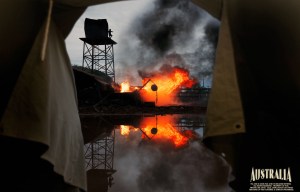
How could two films be so different yet so similar? I saw them randomly and almost back to back (give or take a week or two). Both drama/comedies, both dealing with the paradoxical art and escapism of cinema, both unconsciously aware that the “acting out” before the camera mirrored the real life dramas of the central characters, both reflecting narrative movements from alienation through conflict to reconciliation and resolution, and both focused on that iconic war of the late 20th century in Vietnam. Yet one was a spoof (that was hardly worth the ticket) and the other a warm-hearted “feel-good” that lingers. I remarked in yesterday’s sermon that the cinema is a good indicator of the mood of the age. Some films are discerning a cultural yearning for the reclamation of community building and reconciliation in the face of the enmity and rancour that has embittered and dehumanised the community since 9/11. Maybe two seemingly disparate stories are using archetypes with a contemporary face to give expression to the reality behind Peter’s question in Matthew 18:21. Jesus’ reply is even more shocking and compelling.

Oh! – the films are Tropic Thunder and Son of Rambow . Visit MRQE for a host of reviews

Despair by chocolate

I sit at the desk opening mail while tucking into a Father’s Day chocolate – a delicious indulgence. My eye falls on World Vision’s Action News – the lead article takes the chocolate industry to task for failing to meet yet another deadline to meet certain measures to curtail the use of child labour in the production of cocoa in West Africa. This was a voluntary deadline self-imposed under the Harkin-Engel Protocol which aims to set standards of public certification that ensure cocoa production in Ivory Coast and Ghana is free of forced labour and the worst forms of child labour. The industry failed to meet its own deadline of July 2005 and the extended deadline of July 2008. World Vision is calling on the industry to have a full and detailed plan for action ready by 1 December 2008.

I’m not quite choking on my chocolate, but I think I’ll do as they suggest and sign the petition supporting World Vision’s call at donttradelives.com.au

The morning after polling day in Western Australia

So here we sit with an undetermined result – neither major party has sufficient seats to form government in its own right. Minor parties and independents will have a major say in how WA’s next government is formed. This is parliamentary democracy at work. In the end a small portion of the electorate will ultimately determine how political power will be wielded over the next four years.  The test of the effectiveness of democracy has always been how the majority treats the minority. It will be interesting to see if the reverse is true. The next few days should be most informative.

So – who are you going to vote for?

Elections are in the air. Campaigning has moved into high gear in the USA as Barak Obama and John McCain begin to slug it out. We go to the polls here in WA this Saturday. Will we vote for more of the same last eight years or take a gamble on a hastily revamped opposition? Or will we protest again by voting for a minority party or independent?

Should church leaders seek to influence how those within their orbit should vote? Political parties of all brands are recognising the significance of what they call the “Christian” vote. Note the singular – as if there is such a thing as the mono-morphous Christian vote. Certain parties and lobby groups appear to target church leaders in the hope they will use their influence, powers of persuasion and authority to help voters see political reform through their particular lens.

I wll not reveal how I intend to vote, nor seek to persuade another in any electoral direction. It behooves each individual to ensure they are well enough informed on the many issues that have a multiplicity of colours that apply in different ways to different parts of the community. As a preacher under the rule of the God who is fully revealed in the Way of Christ, I can hold up a prism that displays these colours, but it’s up to each voter to use their powers of reasoning and discernment to decide how these colours fall on the choices they make.  I can be no more directive than that. 

And why should any voter’s responsibility stop after the poll? Recent times have seen the growth of online grass-roots movements that seek to monitor the activities and decisions of those who represent us. Rather than list them here, for all have biases that could leave me exposed to charges of favouring either the left or the right, I will simply point out one, Open Australia, which simply provides a very direct means of accessing and monitoring the parliamentary speeches of your representative in both houses of Federal Parliament and giving their contact details.

There is plenty of scope for Kingdom oriented learners of Christ’s way to test their understanding and influence in dialogue with their parliamentary representatives – no matter which way the vote falls on Saturday.

The Enneagram – my take

I’ve just linked to Dave’s Enneagram Blog. Since the early 1980s I have been fascinated with the enneagram system, used primarily for identifying and exploring personality styles in both secular and Christian spiritual direction circles. There are many instruments out there for identifying temperament behaviour in vocational, management and therapeutic settings, some better known than others. The danger of all such instruments is the tendency to predetermine and reduce one’s likely behaviour – “Oh, I’m a (insert label) so I am doomed to act or behave in this way when this thing happens.”

What I like about the enneagram (which is also prone to being abused in this way) is it’s full dynamic. “Yes, when under stress I habitually use this coping strategy, but there are a number of options that are also open to me which, according to my choice, either enhance or diminish my growth and enjoyment.”

Exploring the enneagram system has certainly enhanced my capacity to understand how I and others tick, even helping us to work together more effectively. It is a strong aid in contemplative prayer, as each habitual coping pattern has it’s attendant traps and giftings, and the contemplative traditions are replete with experience in integrating all of these in our journey into the fullness of God (which, for the follower of Jesus’ way, is revealed most strongly through Christ’s example and presence).

Sustainable September

It being the first day of Spring, a PeaceChurch sojourner draws my attention to Sustainable September, a Western Australian initiative involving church and community groups.

Earlier discussion here revealed several correspondents who have reservations about climate change discussions. Whichever side of the debate we fall on, and whether we believe the cause of climate change is natural or human or some of both, careful stewardship of natural resources is part of the biblical shalom for which many on all sides of the discussion yearn.


So let me give three cheers to all who seek to be informed, discerning, and a friend of the Creation God has given.

Cryptic Crosswords

It’s hard to imagine that, around 4 weeks ago, I was languishing in Los Angeles International Air Terminal, waiting for a plane to begin the long journey home to Perth. A souvenir of the 9 hour wait sits on my desk, staring accusingly at me. It’s a book – The New York Times think outside the box crosswords. It is folded open to number 9 (out of 75) , which is half-done (I think that’s when my plane was called!) The first eight were completed with agonising mental gymnastics and a lot of help from the “solutions” pages.

Cryptic crosswords have never been my strength, and I stand in awe of those people I know who knock one out every day. All the skills of lateral thinking, deductive detective work, general knowledge and wordsmithing are called for – not to mention much patience. I know those who are more disciplined than I (or who don’t have access to a “solutions” page) will often leave a vexing clue and wake up the next morning with the answer. Such is often the right-hemisphered, subliminal and intutive process of arriving at the correct solution.

Never fear if you are logically determined and left-hemisphere dominated, however. Wikipedia suggests no less than fifteen different types of possibilities to explore in solving a clue. It helpfully advises, “In essence, a cryptic clue leads to its answer as long as you read it in the right way. What the clue appears to say when read normally (the surface reading) is almost never anything to do with the answer and is there as a distraction. The challenge is to find the way of reading the clue that leads to the solution.”

How like our normal conversations and every day relationships! Take the typical chaotic hour of fellowship following Sunday morning worship. Hundreds of conversations and interactions are taking place. Expressions, tones of voice, anecdotes, postures, gestures and groupings send out hundreds of clues about our dreams, disappointments, hopes, visions and desires. Often these are like cryptic crossword clues to one another, and the more aware go home to lunch pondering “Now what was that all about?” Sunday afternoon phone calls, emails and visits begin to unravel the clues and deeper meanings emerge amongst us.

This is the Spirit work of the church and it often transpires unseen and unremarked upon. Just thought I’d point it out!

Book Review: There, Where the Pepper Grows

 Bem Le Hunte, There, Where the Pepper Grows, (HarperCollins, 2005) is a compelling read, tracing the story told by protagonist Benjamin, a Polish Jew who, fleeing Nazi occupation with wife and childhood sweetheart (circumstances of wartime survival inform us these are not the same person), ends up in Calcutta. Here, with attendant complications, they make their life together. Benjamin is well on in years as he tells his story; it is post 9/11, and his life experiences that embrace – up close and personal – the horrors of World War II, the partitioning of India and Pakistan and the aftermath of the destruction of the World Trade Centre well qualify him to reflect on the counter-balance of interfaith harmony at a grass-roots level. His story is not so fanciful when one considers that the author, born in Calcutta (Kolkata), bases her characters on real situations and events. It was the contemporary circumstance of Australia’s stance on mandatory detention for asylum seekers that prompted the writing of this story, however. In this context, it is a great compliment to India and a sobering rebuke to more well-off countries who, in recent times, have responded with fear driven mean-spiritedness when faced with refugees seeking a safe home.

Barton Stone rocks!

Some of you already know that each post here can have “tags” (single words describing the nature of the content – usually found at the end of each post). I’ve been a bit slack in the past, not bothering with them. Here, I find that I can take a tag, something like “Restoration Movement”, click it, and up pops a whole range of blog links on the same topic. Since revisiting Barton Stone territory I had the feeling that this 19th century church reformer and founder would have been quite at home in today’s “post-everything” environment – intelligent, unorthodox, passionate, forward-focused yet still able to link up with the more conventional and intellectually austere Campbell side of the movement for mutually beneficial outcomes. This tag I clicked on at least tells me I’m not the only one thinking this way about Stone’s contribution. Must start reading up a bit more about him.