Teach, don’t preach: how to do religion in schools – ABC Religion & Ethics – Opinion

I’ve made my own arguments along similar lines. Ronald Noone, chaplain at Melbourne Grammar, adds some interesting points that, in my view, have potential to de-polarise the debate and de-wedge the issue.

Teach, don’t preach: how to do religion in schools – ABC Religion & Ethics – Opinion.

School chaplaincy – sacred or secular?

The wedge drives even deeper as the school chaplaincy debate continues.
This morning’s Eureka Street article and the array of comments is illustrative.

There was a time when “religious” and “secular” were complimentary terms, rather than opposed. Some of the rub off of this was seen in a letter in this morning’s West where an opponent to the National School Chaplaincy program opined that even if chaplains did not overtly express their faith their nice and kind character would, nonetheless, unduly influence vulnerable children! Heaven forbid! Perhaps we better screen teachers in state schools whose Christian faith expressed through a “nice and kind” character have the same unfortunate effect.

“Secular” never meant opposed to “religion”. The most succinct distinction I can grab at the moment is from Wikipedia:

Secular and secularity derive from the Latin word saecularis meaning of a generationbelonging to an age. The Christian doctrine that God exists outside time led medieval Western culture to use secular to indicate separation from specifically religious affairs and involvement in temporal ones. This meaning has been extended to mean separation from any religion, regardless of whether it has a similar doctrine.

This does not necessarily imply hostility to God or religion, though some use the term this way (see “secularism”, below); Martin Luther used to speak of “secular work” as a vocation from God for most Christians.

Using this distinction and given that a lot of the work of chaplaincy has to do with negotiating temporal affairs and the day-to-day challenges of their charges, their work can be described in a historical context as “secular” (confined to this era). Of course, because Christians cherish a perspective that transcends the temporal, this work is also “sacred” and therefore approached with the appropriate degree of reflection.

All this shifts the goalposts for the debate and the High Court challenge, however, so I don’t expect to see much public discussion on these finer points.

When knowing works backwards…

I like this quote from writer John Shea:

We need an understanding of God that blows our mind.

St Anselm created the ontological argument for God to remedy the ennui of monks. Without going into detail, the ontological argument states God is that than which nothing greater can be thought. If you carry out this experiment in thinking, you will always be approaching God without ever arriving. It will only dawn on you in retrospect that it is the incomprehensibility of God that brings consolation. Despite what we may think, we are not calmed by knowing-for-sure. Our hearts relax through a process of profound not-knowing that leads to trust.

Another way of saying this is: we dwell in essential mystery. Accidental mystery is something we do not presently know but will know someday. Essential mystery is the experience of “the more we know the more mysterious it is.” Increased knowledge does not end essential mystery; increased knowledge increases mystery. Spiritual and theological traditions value this type of knowledgeable not-knowing because it safeguards both the transcendence of God and the human capacity to acknowledge the divine without fully comprehending it. When our minds dwell in this rarified atmosphere of knowing and not-knowing, the smaller fears that normally terrorise us loses some of their power. It is not that they go away, but that we see through their menacing masks. Better said, they are taken up into larger truths that provide a meaning more in accord with love.

The more our minds entertain larger truths about God, the more we are personally and existentially in a relationship of trust…

Rain – the good, the bad and the ugly

Heavy soaking rain…

It is good that this parched part of the country is getting some long awaited H2O.
It is good that our empty reservoirs may begin to not look so empty.
It is good that the cycles of nature have not completely abandoned our poor stewardship.

It is bad that I can hear emergency vehicle sirens in the distance.
It is bad that road users must contend with dangerous conditions.
It is bad that a new roof leak has emerged right over my office desk.
It is bad that even our new gutters can’t contend with the huge flow of water.

It is ugly that the rain is too late for some who make their living off the land.
It is ugly that drought drives the rural suicide rate ever higher.

But there is hope. Today’s rain is its sign. And even rural Australia knows a secret.
Here is a bush poem by Murray Hartin (Muz)

One of those days…

… when technology gangs up on you. Trying to create a PDF out of combined Word, Publisher and Adobe documents and send out via email. Had to make separate PDFs and find away of merging them, Found an online service – resulting file too big to send. Find ways to reduce and combine. Free licence won’t allow merge. Fin another way. Guys arrive to install solar panels on roof. Power goes off. Aaaaaarrrrgh! (Finally succeeded – whole day gone!)

Just a short one today…

Feeling a bit weary but satisfyingly so. From brief holiday to church camp to annual ministers’ retreat – and now some looming presentations and workshops to prepare. It’s been fairly people intensive for a few days – stimulating yet taxing for an introvert like myself. Need some still time and space to process connections, awareness and continuing responses. See you tomorrow!

Dilemma dealing

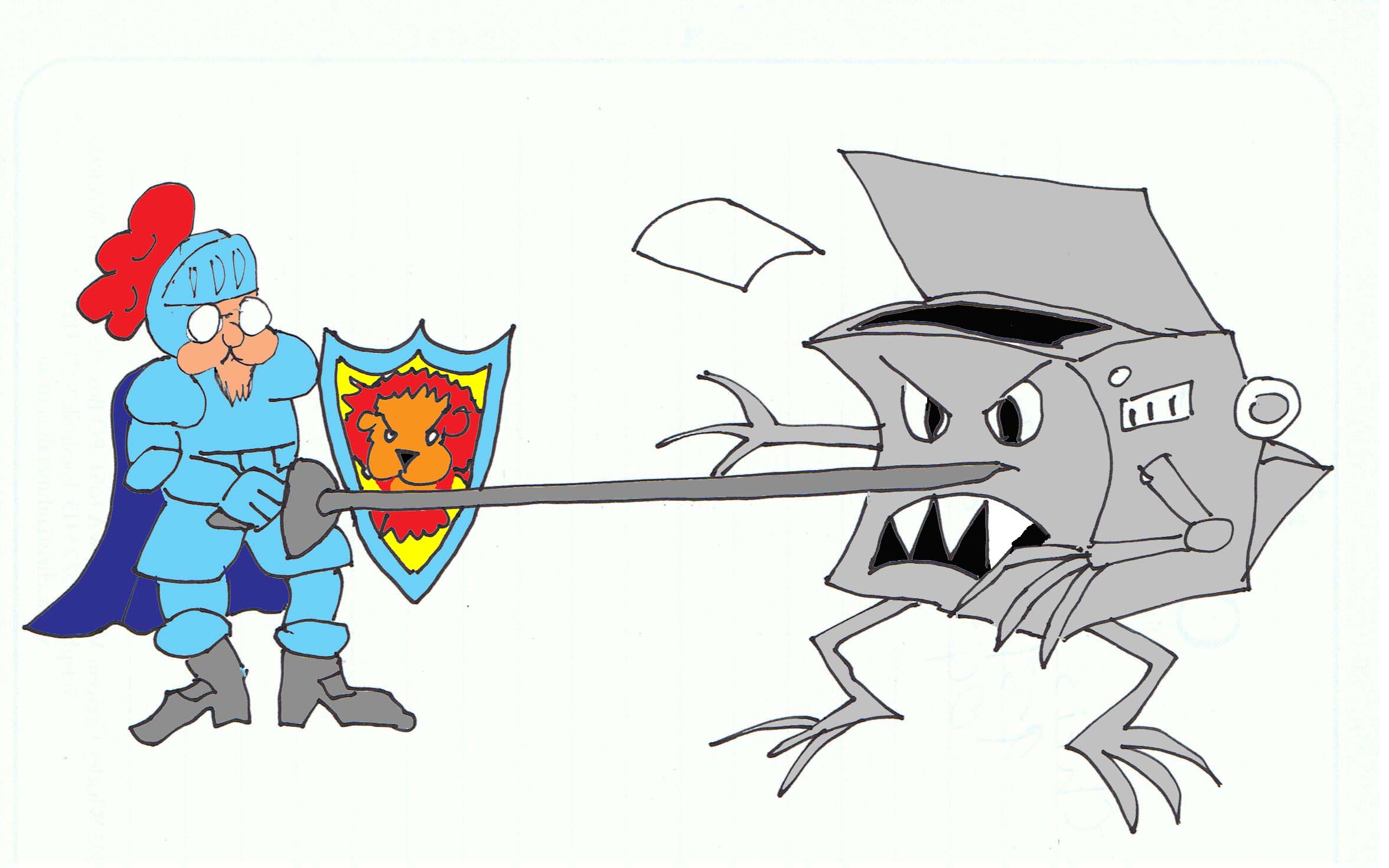
Here is a renewed attempt at cartooning. It is replicated from an adolescent memory of a cartoon I saw in some forgotten magazine. Of course, the caricature caught in unflattering circumstances is myself!

I think it denotes my native predisposition. Black and white solutions to complex issues rarely satisfy me, especially when they are the easiest option. Many people find this personality trait very annoying, but I tell them tolerating me is good for their soul and gives them opportunity to practice patience. The caricature of the dilemma I find quite appealing. In spite of the dangerous horns, fangs and claws, the monster looks confused and in need of some TLC. At least while I’m dangling there I can offer it some companionship and, ironically, a dose of my other annoying trait – optimism!

Oh by the way, A dilemma (Greek: δί-λημμα “double proposition“) is a problem offering at least two possibilities, neither of which is practically acceptable. (Wikipedia)