Psalm 22: Jesus’ cry from the cross echoes a universal lament – the lonely beginning works toward a triumphant conclusion
the ramblings of a perambulent and often distracted sojourner
Psalm 22: Jesus’ cry from the cross echoes a universal lament – the lonely beginning works toward a triumphant conclusion
Novelist Peter De Vries recalled his religious upbringing thus:
“We went to church five times a week, three times on Sunday; I wasn’t allowed to play ball on Sunday. We were force-fed a lot of doctrine. The two main beliefs were in the total depravity of man and the divine grace of God. I only believe in one of them now.”
Tantalisingly, that’s where the interview ends, and we are left wondering “which one?”
The introspection that so often dominates the Lenten journey may have us entertaining the idea that he chose “the total depravity of man.” Mainline media fixation on the worst of current affairs and some of our own experiences of deprivation, disappointment and suffering may feed our perceptions and lead us spiralling down into the pit of despair.
If we are walking the Lenten journey purposefully and hopefully, however, we will, while aware of human idiosyncrasies and limits, be aware of the “divine grace of God,” for we are an Easter people and know how the story transcends the road to Calvary and beyond, even while we walk it.
A bit of googling (and perhaps some knowledge of his writing) answers the question about which side of the line Peter De Vries falls.
Our Lenten challenge right now, however, is to answer which side of the line do I habitually fall?
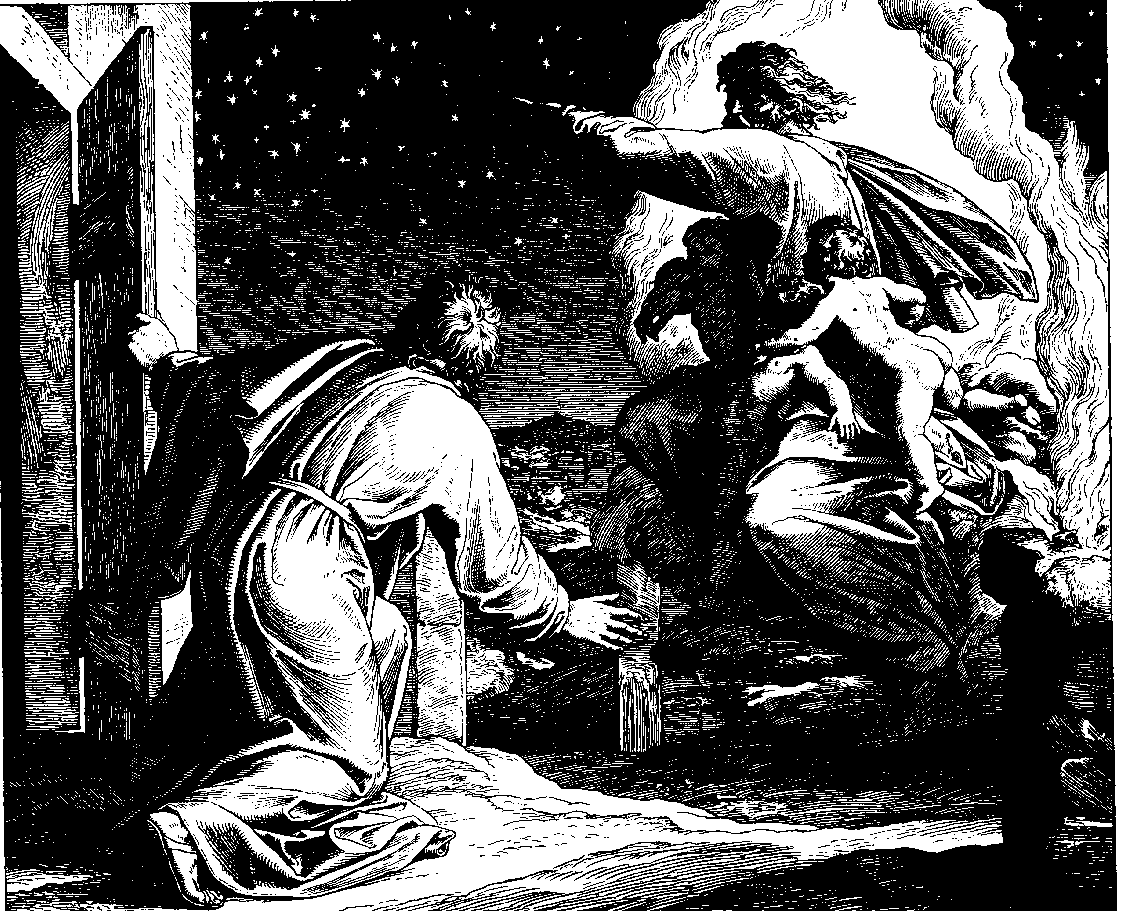
What’s your favourite version? The original Led Zepplin leads in Google hits. The lyrics are most evocative as we contemplate the Lenten journey – for on such a road we are often confronted with choices between the tantalising and immediate and the deeper and more reliable. Which is the true stairway to heaven? The image is based on Genesis 28:10-17. Jacob’s dream of a “stairway to heaven” interrupts his journey of choices. It will take a lifetime of pursuit of riches and power that leads him to a night of transformational wrestling that leads him to further choices. Maybe the “stairway to heaven” is part of the landscape of the Lenten journey to the self-giving of the cross and beyond.
As a teenager, I looked up the meaning of my first given name. My then prudish temperament was somewhat taken aback to see that it was associated with Dionysus, the debauched Greek god of revelry and wine.
Had I been raised as an ancient Hebrew, it could have been far worse, for names were given to reflect something of the inner nature and projected destiny of its bearer. Hence the story in Genesis 17:1-16, of Abram’s name becoming “Abraham” – the “progenitor of many nations.” The world’s three great monotheistic faiths – Judaism, Christianity and Islam – look to Abraham as the foundation of a covenantal relationship with the Divine.
The Lenten journey, then, travels through this reflection and realisation that we continue to be part of this unbreakable covenant relationship with the Creator.
Oh, and I discovered that Dionysius, in the Greek pantheon, is also a source of new life, but modesty forbids me to reveal that! (And there are several Saints Dionysius I can choose to relate to as well)
“I believe that the desire to please you does in fact please you.”
(Thomas Merton).
Today’s sermonic offering at the Downs Church….
 12And the Spirit immediately drove him out into the wilderness. 13He was in the wilderness forty days, tempted by Satan; and he was with the wild beasts; and the angels waited on him.
The wilderness … at the same time beautiful and dangerous.
The wilderness … a place of unfamiliarity, where daily routine is suspended, when the busy surface minutiae of life fades and the big questions come to the fore.
Why am I here?
What’s it all about?
Where are we going?
The wilderness can be anywhere – the outback dryness north and east of Kalgoorlie – the frozen wastes of Antarctica – the steamy jungles of the Amazon – the windswept streets of the Perth CBD – the wastes of the suburban landscape – even our own bed at 3am when we can’t sleep.
The wilderness… when the Spirit drives you there you can expect to be tested. You will meet the accusations of the Tempter. (Satan, translated, means “accuser.”)
You will be with wild beasts and waiting angels.
And sometimes it’s hard to tell them apart.
On Ash Wednesday, we meditated on Gay Byrnes viral interview with Stephen Fry. Here it is again:
We did not rise to take issue with Stephen Fry (as did another well-loved comedian, Russel Brand).
We did not try to defend God.
Neither did we seek to collude with Stephen Fry’s stance.
In the context of the threshold of the Lenten journey to the cross and beyond, we did what was most appropriate in response to big questions that challenge our human fragility and limited capacity to understand.
We simply received it. Job’s questions had found a fresh voice. It is a voice that one will often hear whenever the topic of faith or religious belief arises as a topic of conversation.
The strength of its stridency, passion and persuasiveness will determine whether it’s a voice that comes to us in our own wilderness.
It’s a voice of testing: we may hear an accusing tone.
Possibly we hear the roar of a wild beast, threatening to devour us.
Sometimes, when we are still, we will hear the whisper of a waiting angel.
The wilderness is where our faith and trust is tested – a place of encounter with self-accusation, wild beasts and waiting angels.
Stephen Fry’s challenge cries out for a response.
For Job the response came from an overwhelming encounter with the Divine in the form of a whirlwind.
Russell Brand, in his response seeks to evoke the whirlwind, and good on him.
I have found in my past conversations on faith, as theologically trained as I am, I have limited capacity to emulate the whirlwind.
In the wilderness, where Christ has gone before, what voices do I listen for? Which are the voices that will take me to the essence of reality and allow me to return from the wilderness to a life of service and clear vision in Christ’s name?
On Friday, I saw this on the Churches of Christ National FaceBook page, a quote from Karl Barth for Dummies (I’m going to quote it in full):
One of the greatest dangers of theology is to take the protest of atheism too seriously. If it were to make this fatal error then theology would be distracted from its true purpose which is to expose and bring down the errors of human religion.
For the man and woman of faith must agree with the protest of atheism. Human religion is a sham. It has brought untold misery upon the earth. It has been used too often to bring too few too much money and power. There is no god that can be proved to exist according to the standards of human science. There is no god that can be shown to be consistent with the assumptions of human philosophy who is worthy of our worship and devotion. There is no invisible friend for you to talk to. There is no sky daddy who will shelter you from the terrors of the night.
So far the man and woman of faith must agree with the protest of atheism. But the man and woman of faith must go further. For atheism cannot exist without its protest. It cannot let religion go. Like a parasite feeding on its host it cannot exist without religion. Without the errors of religion it has no crusade. Without the errors of religion it has no passion to fuel its ethics. Like a parasite it attacks its host and hurts it, but it cannot kill it. Nietzsche proclaimed, “God is dead,” but behind his back his disciples worshipped new and more dangerous gods. Atheism has won the intellectual battle in the secular universities. But in most of them it is still possible to study human religion as something strange, or something fascinating, or something powerful, something that has done great harm but is also capable of some good in society, like some vitamin that is beneficial in small amounts, but poisonous in larger doses.
The problem of atheism is not that it goes too far, but that it does not go far enough. Atheism sees that the emperor has no clothes. But all it can do is point and laugh. The task of theology is to remove the emperor from his throne.
The atheist and the religious person can confess their sins according to the last six of the ten commandments. All agree that it is wrong to steal, wrong to lie, and wrong to commit adultery. But the man and woman of faith must confess their sins according to the first four commandments. We have worshipped false gods. We have built idols according to our own imagination. We have misused the name of the Lord to pursue our own ambitions and in service of our own causes. We have profaned the Sabbath in the service of religion. Yes, even in service of our Christian religion of which we are so proud. We boast of the cathedrals and hospitals that we have built. We boast of the great benefit we have brought to society in the name of religion.
But confession of our sins must lead us to true repentance. We must forsake our religion, our futile attempt to control the powerful forces of the universe. We must forsake our pageants and our fasts by which we fool ourselves of our own self righteousness. We have given only token offerings and congratulated ourselves while keeping firm grasp of all that we hold dear.
The atheist is an iconoclast, content to throw a few stones through the stained glass windows. But the man and woman of faith must bring the whole edifice down. In their mind, in their heart, in their life, and in the Church most importantly of all. For the atheist is our friend, our brother, even though we pity him. We share his rage against the sin and pride of humanity which has created its gods in its own image. But we cannot afford to keep the host alive on which atheism feeds. And we cannot afford to take the protest of atheism too seriously. Because human religion is our true enemy.
For it is only when we have renounced our religion, it is only when we have stopped laughing at the naked emperor of religion and brought him to justice for his crimes, that we are ready to receive by faith alone the true and living God who reveals himself in his Son Jesus Christ. Anything else, anything less is not only a crime against humanity, our own humanity, but a sin against God.
Out in the wilderness, vision is clearer.
We can join those who see that the Emperor has no clothes.
But the real task is to dethrone the Emperor, the false structures and systems that serve lesser purpose than the Way of Jesus.
Over recent years we have seen a groundswell of younger generations abandoning some of the forms and structures of being church that my generation has championed.
In the 60s and 70s we believed we were doing a great job of tearing down obsolete frameworks that divided church and society and that prevented the communication of the Christian story.
We replaced these frameworks with our own shibboleths and hoops that people had to jump through if they were to be a part of our cause.
We saw ourselves as a denomination preserving a particular (“peculiar” we called it!) contribution to the Body of Christ at large, rather than a dynamic movement enabling all to give expression to the living spirit of Christ.
14Now after John was arrested, Jesus came to Galilee, proclaiming the good news of God, 15and saying, “The time is fulfilled, and the kingdom of God has come near; repent, and believe in the good news.”
Increasingly, young and old generations are now rising to the occasion and through their practical service, compassionate risk–taking and sacrificial advocacy for the needy – we hear voices that would normally echo Stephen Fry, Richard Dawkins and Christopher Hitchens declare, “We haven’t changed our stance, but we are in step with what we see.”
The accuser is silenced, the wild beasts retreat, and the waiting angels bring healing balm and nourishing sustenance.
Medieval Passion plays made much of the visit of the crucified and triumphant Jesus to rescue the trapped ancestors from Hell. It is the ultimate “in your face” to the defeated powers of oppression, chaos and annihilation. Hell has no lasting power.
It’s in 1 Peter 3:18-22. The Lenten journey to Good Friday will always be tempered by the knowledge of resurrection and new creation.
Meditate on this.
 Kingsman: The Secret Service – is a rip-roaring enjoyable spy spoof lightly touching on some tangible everyday challenges – climate change, bullying, coming of age, redemption.
The genre, of course, draws on unflinching, totally dedicated, sacrificial service, epitomised by agents given to Her Majesty’s Service (or His Majesty, when the Kingsman private spy agency was born). The Apostle Paul appeals in the same way to the recalcitrant Corinthians, calling on them to emulate his ambassadorship and the “James Bond” lengths to which he is prepared to go that they and others will be reconciled to God and one another. They and all who follow the Way of Christ, he summons to be his protégés. See 2 Corinthians 5:20-6:10.
The Lenten journey is focused on reconciliation – and it takes ambassador-like dedication to ensure application and accomplishment.
The first day of the Lenten journey involves some healthy introspection.
Psalm 51 (50 in some translations) is a penitent prayer that is bold in its confidence and trust in the One petitioned. The Orthodox tradition through the centuries has been a thorough exemplar of this combination of strong trust and humility.
Listen and pray along with the words you hear.
 Ash Wednesday is not really part of my church’s tradition. Dark and sombre with an emphasis on the dreariness of death, it does not sit comfortably with a movement whose focus is on new creation borne on the vitality and inspiration of resurrection life.
Yet we will observe Ash Wednesday, the beginning of the season of Lent, in a service tonight. There will be prayers, reflective visuals and music, communion and the daubing of ashes on the forehead. Why?
One cannot embrace the fullness of life without confronting the reality of our mortality and finiteness. Jesus himself modelled the balance, providing purpose for both that which pulls us toward abundant living and that which he calls people to give over willingly, sacrificially, “losing life” and thus, paradoxically, gaining it. Indeed, it is the theme that runs all the way through Lent to Passion week, Good Friday and the Day of Resurrection.
And lest one still believes the whole journey of Lent is too sombre for a vital movement, remember the metaphor that completes the phrase “from the ashes…”

