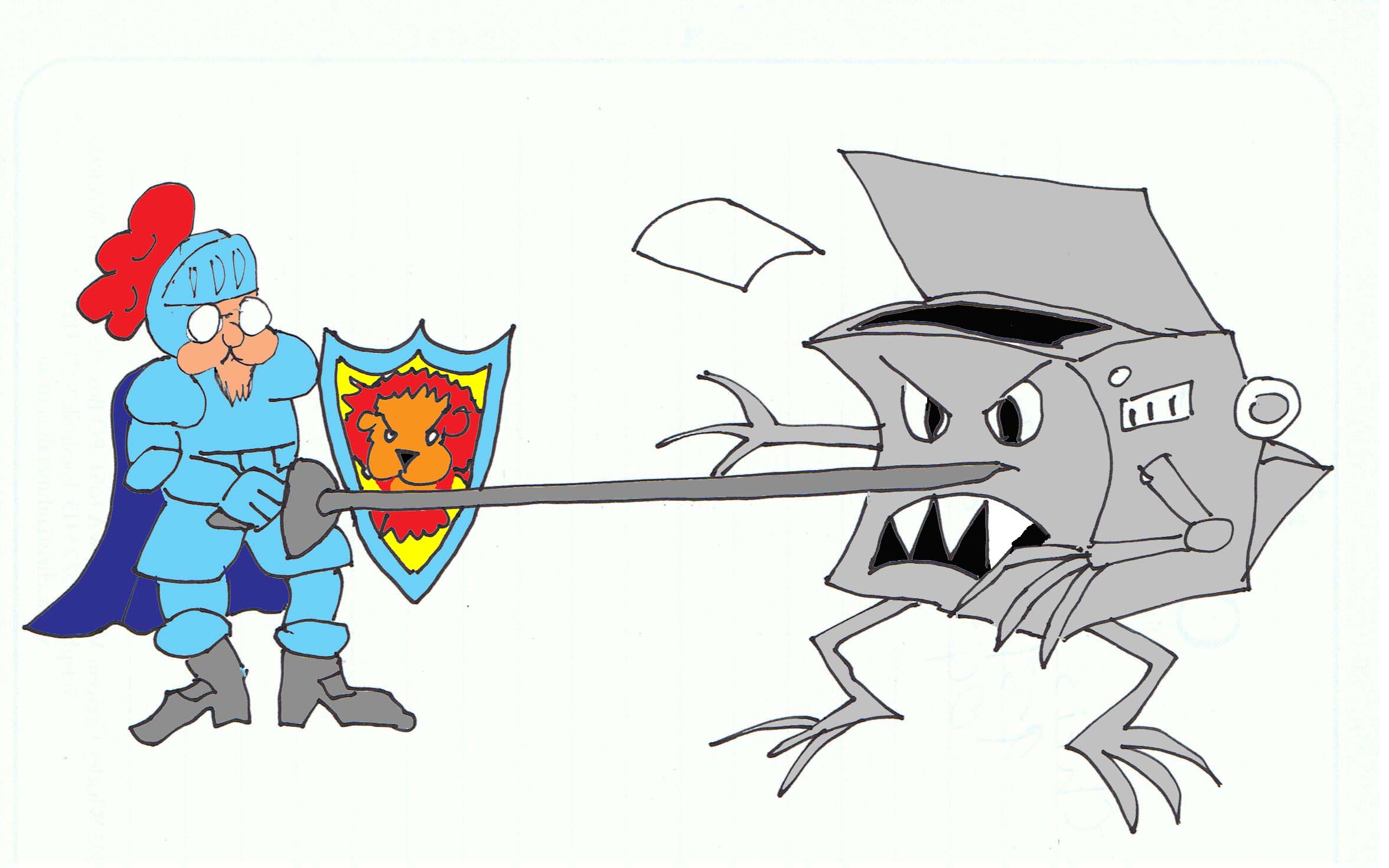
Dragon Printers

PhotocopierThe church copier has been at me again. “Replace Toner Cartridge” it insists. I go through the routine of swapping it over. The machine whirrs, clicks and grinds. The little green screen flashes a message at me – “Replace Toner Cartridge”.

Grrr, I’ll show it who’s boss! I press the reboot and wait.  “Replace Toner Cartridge” it insists. Oh well, must be a crook cartridge. I repeat the routine and wait.

“Replace Toner Cartridge”

I give up. Next day, I try again, hoping the machine has relented.  “Replace Toner Cartridge” “Replace Toner Cartridge”.

After researching manuals both hard copy and online, I am flummoxed. Why not just type the problem into Google? Up comes a video that shows me a fix. In one minute the printer is purring like a kitten.

I send out an email informing everyone the printer is now fixed (I coyly make some mention of my genius!)

The next email arrives in my Inbox – completely unrelated – but headed “There is no magic manual…

Monday Musings

Our country’s politics have taken us to the brink of an interesting shift over the weekend. The tactics of the extreme conservative wing driven by the ideals of dry economic rationalism appear to have awakened the sleeping giant. The dramatic results of Queensland’s state election may well prove to be the hinge on which Australia’s current political history swings. Science, education, health, welfare, immigration have all taken a big hit over the last 15 months. The implications are coming home to a large slice of our mainstream population. The remaining problem is that the other party in our predominantly two party preferred system does not offer significant hope for social improvement. Their policies will be less draconian and more socially oriented, but still under the so-called guiding light of economic rationalism. Contrary to a lot of current opinion, I think it is the minor parties and independents that can make the difference given the right circumstances. They played a significant role in the previous hung parliament which saw a large number of good policy legislation passed. Parliament did what it was supposed to do – parly and hammer out agreements. Compromise was not a dirty word, but ensured considerations were accommodated rather than summarily dismissed. I think we got a taste of win/win during that brief period, before predators from both sides evoked and enforced the law of the jungle. Queensland on the weekend has brought some relief with its promise of change – like that light wind that blows in from the ocean after a particularly long heat wave. We shall see how the week unfolds.

The Books We Read – Fellow Pilgrims…

booksAstute followers of this blog will notice a page has been added. This follows the addition of the page that links to bloggers I follow … and is in some way related.

A pilgrim never travels alone. The “bloggers I follow” page acknowledges some fellow pilgrims along the way, some of whom march to the beat of a different drum, but, whose progress is nevertheless part of our great journey  together.

The new “books I’ve been reading” page is prompted by conversations on the WordPress Blogging101 course. Book authors are also fellow pilgrims and this little room in which I’m typing is crowded with about 1,500 of them (no wonder it’s never lonely here!). Many of then have been recorded on LibraryThing.

The new page promises a way I can keep track of conversations with these pilgrims – current, recent and memorable – for my own satisfaction, to meet my professional development requirements, and for the sake of sharing and seeing what conversations open up.

I’m not initiating reviews or discussions from that page – I will leave that to any reader who leaves a comment there. It may well prompt conversation that comes to the front page here.

Hopefully, it will simply be a stimulus to and a record of further thought and conversation around this business of wandering and wondering.

Invasion, Survival or Celebration: A Native Australian’s Day

Ted Witham with the most appropriate comments on this day that I have come across.. and it’s from this western side of the rabbit-proof fence..

Ted Witham's avatarMind Journeys

Ngaala kaaditj Noogar moort keyen kaadak midja boodja

We acknowledge Noongar people as the original custodians of this land. In particular, on this Australia Day in this place, Busselton, I acknowledge the Wardan people, the Noongar sea people, who have walked this part of Noongar boodja for tens of thousands of years.

Reconciliation Australia puts before Australians three options for marking January 26: for many Indigenous Australians, this date can only be remembered as the anniversary of the British invasion, with the arrival of the First Fleet at Sydney. For others, they celebrate the survivalof their culture despite every hostile attempt to destroy it. For others, it is a day of celebratingthe rich culture brought to this country by Europeans and shaped as well by indigenous and later migrant influences.

As a wedullah man, I tread carefully in this conversation. I am a native, but not indigenous…

View original post 672 more words

Straya Day

As this Australia Day weekend gets under way, I am conflicted. There is much to be grateful for in this country, but I don’t feel like celebrating. I have friends who have received this country’s highest awards; they have contributed great things to a community that I love and cherish, yet that same community is turning its back on its most vulnerable. Amidst all the cheering and flag- waving, I will be quietly avoiding the public party and reflecting on ways to positively address what this blogger points out in the style of the ancient prophets in their ministry of nay-saying.

archiearchive's avatarÆrchies Archive - Digital Detritus

I won’t be celebrating Straya Day this year.

Not while there are children being held in detention centres. Not because they committed a crime but because they came looking for help. Because their parents sent them in desperation, hoping they may have a safe life.

I won’t be celebrating Straya Day this year.

Not while my fellow Strayan men are killing our womenfolk at a rate of at least one a week. Yet we were terrified of one insane gunman who used terrorism as a cover for his madness.

I won’t be celebrating Straya Day this year.

Not while we have a Government which refuses to recognise the very real threat of Climate Change. Instead they choose to promote policies which increase the effects of this Global disaster.

I won’t be celebrating Straya Day this year.

Not while we hold asylum seekers in brutal concentration camps on the pretext of…

View original post 345 more words

One and All

9781742614250-197x300I have always enjoyed the offerings of Hugh Mackay, no less his current title The Art of Belonging, which I have just begun to read. His journal-like writing as a sociologist has always been most accessible.

This work is worth chewing on for anyone remotely involved in community work, especially faith communities. The struggle of the human need to elevate self-autonomy while voluntarily submitting to social cohesion finds many expressions in school canteens, tennis club committees, coffee klatches – and parish councils. I daresay we see the same dynamic alluded to in the New Testament correspondence of the Apostle Paul and his contemporaries.

In discussing the human need for social interaction, even in a highly individualistic culture, Mackay quotes another social analyst, Richard Eckersley, in a sidebar ‘Redefining the Self’ to a paper titled ”Whatever Happened to Western Civilization?” in The Futurist, (November-December 2012).

It has an inviting twist that excites my imagination. Here it is:

Redefining the Self

One specific example of how a cultural redefinition might take place—encouraging
self-interested, competitive individualists to become, instead, more altruistic and cooperative—is by changing how we construe the self.
When I was at school we were taught that the atom was made up of solid particles,
with electrons whizzing around the nucleus like planets orbiting the sun.
Now, we think of the atom as more like a fuzzy cloud of electrical charges. Similarly,
we currently think of the self as a discrete, biological being with various
needs it seeks to satisfy. Like atoms combining into molecules, we form and dissolve
bonds with other separate selves to create and terminate relationships. Sociologists
talk of modern society as one of “atomized” individuals.

What if we were to see the self not as a separate physical entity, but as a fuzzy
cloud of relational forces and fields? This would be a self of many relationships, inextricably linking us to other people and other things and entities. Some are close
and intense, as in a love affair or within families; some are more distant and diffuse,
as in a sense of community or place or national or ethnic identity; and some
may be more subtle, but still powerful, as in a spiritual connection or a love of nature.
These relationships can wax and wane, vary in intensity and charge (positive or
negative). Importantly, they never end—for example, the break-up of a marriage, or
the death of a parent or child, does not “end” the relationship, but just changes it.
Transforming how we see the self in this way—as a fuzzy cloud of relationships—would
change profoundly how we see our relationships to others and to the world. It would, for example, reduce Western culture’s fear of death, and all that means for well-being. It brings us closer to how indigenous people see the self, and represents one way that scientific and spiritual views can be compatible.
It would alter radically our personal choices and our social and political goals.

It seems to me that this reflects well the “dying to self in order to live abundantly” urge from Jesus. It also reminds me of the “body of Christ” metaphor that Paul employs to plead cohesion amongst the followers of Christ – yet it does not have to be confined to such. This is a Mary moment – something to be pondered.

Fishing for Stars in the Sea

4GqzI6z

I came across this poem by Roderic Quinn which, today, I thought I’d share just for its own sake.

I took a boat on a starry night
and went for a row on the water,
and she danced like a child on a wake of light
and bowed where the ripples caught her.

I vowed as I rowed on the velvet blue
through the night and the starry splendour
to woo and sue a maiden I know
till she bent to my pleading tender.

My painted boat she was light and glad
and gladder my heart was wishing,
and I came in time to a little lad
who stood on the rocks a-fishing.

I said “Ahoy!” and he said “Ahoy”!
and I asked how the fish were biting;
And what are you trying to catch my boy,
Bream, silver and red – or Whiting?”

“Neither”, he answered, “the seaweed mars
my line and the sharp shells sunder;
I am trying my luck with those great big stars
down there in the round skies under”.

“Goodbye!” from him and “Goodbye!” from me,
and never a laugh came after;
so many fishing for stars in the sea
that it’s hardly a subject for laughter

Quantum Physics meets the Mad Hatter

250px-MadlHatterByTenniel.svgThe Pastor and the Physicist continue to dialogue over matters of faith and science, prompted by feature articles in a pile of New Scientist magazines. Quantum physics has to make its appearance at some stage, and, sure enough the next lead story explores an experiment showing quantum particles that “lose their identity,” thus redefining reality.

Out walking through King’s Park the other day, I found my path taking me through the backdrop of an amphitheatre where Alice in Wonderland was playing. I inadvertently became part of the scenery of the Mad Hatter’s Tea Party scene as I ambled by.

I can see the Mad Hatter, wielding a teapot holding a dozy dormouse,  being quite at home in a discussion on quantum physics. The magazine piece itself, invites the Cheshire cat, grinning, and appearing and disappearing, purring with delight. How do we know what is real, and not just our own apprehension of reality? And, to what extent do we, as observers of reality, affect and transform the reality we believe we are perceiving?

I do not ken the intricacies of quantum mechanics, but the discourse fascinates me. Is it because it often has to resort to the language of paradox and metaphor that is home territory for my own faith discipline? After all, how does one definitively discuss the mysteries of apocalyptic literature, the many-layered Johannine corpus and the power of parables?

When it comes to groundedness in a universe of shifting perception, the Christian witness is of one reality to which faith points, the Alpha and Omega revealed in Revelation. And such a vision can contain the discoveries of the world of quantum physics.

Faith – Stop Picking on Science!

In sync with my current series as I trawl through a bundle of New Scientist articles thoughtfully loaned to me by a parishioner is this offering from today’s Facebook feed: Is your church still picking a fight with science?

My current congregation never has, but one sometimes gets the impression it’s one of a group of rogue ships in the ecclesiastical flotilla when the chips are down.

Today’s article makes the point that nostalgia for the past rather than preparedness to meet the challenge of the present drives the wedge between faith and science, thus perpetuating a false dichotomy. Many people of faith are also scientists at the peak of their disciplines, and it is the Church’s responsibility to nurture and encourage the inquiry they inspire. Instead, the public face of the Church highlighted across the media is of reactionary conflict rather than constructive dialogue.

Sometimes the conflict is legitimate. Scientific inquiry will, on occasion, be asked the Church’s valid question “Am I my brother’s keeper?” and it will be seen by some as unwarranted intrusion. Equally, scientists nurtured and respected by the non-reactionary faith community will be sympathetic to the ramifications of holistic perspectives in their fields of endeavour.

Today’s article finishes with four questions that any church community might thoughtfully consider.

  1. What does your church do to proactively let people know that science, and scientists, aren’t the enemy?
  2. How do you help to raise up young people who don’t see a conflict between the pursuit of an education and the faithful following of Jesus?
  3. Does your church work to help members to recognize, and appreciate, different ways of reading the Bible?
  4. Maybe we need a special Sunday to recognize and honor our scientists and their achievements; a hug a scientist for Jesus day, if you will. Is this something your church could do?

I don’t know if the scientists in my church want to be hugged – but they do know their work is respected!