Well, I’d like to review this movie but it’s hard without putting in a spoiler. Suffice it to say that it deals with themes of guilt and atonement and one has to stay with the confused plot line for almost 2 hours before all the pieces fall into place.
“Illegals” no more!
Media Release from SafeCom
West Australian Daily sets national tone on ‘Illegals Tag’
“The West Australian, WA Newspapers’ flagship, is setting the tone for the nation in the new year by firmly committing itself to scrutinise and edit Letters to the Editor so no references to “illegals”, “illegal immigrants” or “illegal refugees” will make it to its print or online editions, and it’s a long hoped-for and terrific initiative that came about on New Year’s Day last week,” WA Human Rights group said this morning.
“The move was confirmed on the first of January by the West’s Readers’ Editor David Hummerston in communication with Perth rights advocate and Project SafeCom member Ross Copeland, who was the initiator and catalyst of our long-term campaign dubbed “Catching Illegals Down Under”, which we started in 2003,” spokesman Jack H Smit said.
Last week Mr Copeland wrote to the West Australian:
“I am sure that the West Australian is aware that refugees and asylum seekers are not “illegal immigrants”. The right of anyone to come to Australia, regardless of how they arrive, and make a claim for refugee status is established under Australian and international law. It follows that asylum seekers, even boat people, are not illegal – they have breached no law.
“I am also sure that the West Australian is aware of the Press Council Guideline No 262 (June 2004) on this issue. In general, I believe that the West Australian complies with this guideline editorially and in its reporting. However this good work is severely undermined by regularly allowing letter writers to refer to asylum seekers as “illegal immigrants”. I don’t need to refer to particular letters as they appear almost daily.
“It would not be acceptable to categorise any other group in our community who have broken no laws as “criminals” which is what “illegal immigrants” implies. Why should it be accepted in the case of asylum seekers who comply with the law.
“I urge the West Australian to cease allowing letter writers to use the term “illegal immigrants” in published letters. Might I suggest also that you commission an op ed piece by an appropriate lawyer with experience in this area or by the Human Rights Commission which would set out clearly that asylum seekers are not illegal, which could be backed up by a policy decision by the West Australian that “illegal immigrants” will not be accepted in published letters.
In a reply on the same day, Readers’ Editor David Hummerston wrote to Mr Copeland:
“The editor, letters editor and I agree with you. We will ensure any future references to “illegal immigrants” in letters to the editor are changed to asylum seekers or boat people.”
The first of several pages connected with Project SafeCom’s campaign, in which many hundreds of human rights and refugee advocates took part, where they would write a letter of complaint to the journalist who fell foul of the error in their writings and call asylum seekers ‘illegal entrants’ or ‘illegal immigrants’, and send a copy of their complaint to the relevant Editor as well as the Secretary of the Australian Press Council, is here:
http://www.safecom.org.au/illegals.htm
The national campaign eventually resulted in Rulings and Adjudications by the Australian Press Council when complaints against a newspaper were eventually upheld.
“Coming to Australia by boat to seek asylum is never “illegal”, but the ghastly myth of vilification became widespread during the Howard years, and even now, several conservative MP’s and Senators who happily peddled this myth since the Tampa election in 2001 – such as WA Senator Don Randall – still firmly believe that Australian law stipulates that it is illegal to sail to our shores to seek asylum – incorrectly, because no such law exists,” Mr Smit said.
“We applaud the West on the initiative,” Mr Smit said, “which clearly seems to confirm a new direction that started when former editor Paul Armstrong was stripped of his editorial powers in December 2008: on the day Mr Armstrong was demoted, the West ran a front page story about the Christmas Island detention centre as well as a two-page spread detailing how John Howard’s politics of fear around asylum seekers was still playing out amongst the population of Christmas Island.”
“Clearly, the West is “normalising” its reporting on immigration issues and the place of boat-faring asylum seekers after years of not reporting – or reporting in such a way, that it seemed to support the notion that there is a notion of illegality, unlawfulness and “queue-jumping” attached to those asylum seekers who sail to our territories and do so using their international right to seek asylum.”
“This is a story of ‘How the West Was Won’, and the way The West Australian now deals with reportage on this as well as many other issues, may well erode the nickname the WA paper has held for a long time in the Eastern States, where the paper is often called “The Worst”, Mr Smit said. “We warmly congratulate our newspaper with its new directions.”
For more information:
Mr Ross Copeland, Carine WA, phone 08- 9447-1906
Jack H Smit, Project SafeCom Inc.
Office 08-9881-5651 | mobile 0417 090 130
Gaza
The conflict between Israel and Hamas and the terrible suffering in the overcrowded territory of Gaza is very much on our minds. As Trish and the Nazareth Work Party continue their voluntary maintenance work at Nazareth Hospital, we are aware of the terrible conditions with which the hospitals of Gaza are contending just a few hours’ drive further south.
Media blackouts in Gaza make it difficult to comprehend the enormity of what is taking place there, but a respected colleague has drawn my attention to a letter regarding the Anglican Ahli Arab Hospital in Gaza, addressed to its American supporters.
Dear Missioners,
I was able to speak to Suhalia Tarazi , Director of the Ahli Arab Hospital in Gaza this morning.
I took notes and I am sharing with you as best I can her situation in Gaza.
” The situation is terrible. The injured are in their homes and unable to get to the hospital and the International Red Cross can’t reach them. Gaza is now divided into three areas. 20% of the staff including 2 doctors are now unable to get to the hospital. Unfortunately a bomb went off in Jerusalem Square, right outside the hospital , only 30 meters away and it blew a hole in the hospital wall.
One of the aid’s husbands was unable to reach his children. Later he discover that 1 child died and other members are all injured because a bomb destroyed a neighboring building.
The 19 year old son of one of the surgeons volunteered to work in the government ambulance. He was killed when his ambulance was hit by a missile. Three ambulances have been hit by Israeli missiles , five have died.
There is no electricity and no water. Fortunately the International Red Cross has provided Ahli Hospital with some food.
It is terrible and not safe to walk on the street.
After the invasion , Ahli Hospital on Sunday received 17 cases. Twelve were admitted to the hospital and 2 to government hospitals.
Today Monday morning 5 cases were received with 4 admitted for surgery. One doctor has slept in the hospital for the last 4 nights. Our staff is now working 2 -12 hour shifts, two shifts no days off. Streets are covered with blood. – bloody time.
Staff members have taken people in their homes, with 20-30 people for refuge. The ambulance driver has 80 living in his home.
We all have received leaflets and telephone calls ” you have to leave your home, we will attack it” Where to go for the 700,000 people in Gaza City?”
I feel very fortunate and blessed to be able to speak to Suhalia and I have promised her that I will tell her story and the story of the innocents. Thank you for all you are doing to circulate these messages. Please feel free to forward them the family and friends.
I offer her hope and encouragement and our commitment to help, with prayers and financial support. Remember tax deductible gifts may be sent to the American Friends of the Episcopal Diocese of Jerusalem, PO Box 240, Orange, CA 92859, or on line at www.americanfriends-jerusalem.org
I will continue to keep you up to date on this catastrophe happening in Gaza. If I can be of help please don’t hesitate to call or email me.
Peace, Love and Joy ,
Charles
The Rev. Charles Cloughen, Jr.
President Emeritus, American Friends of the Episcopal Diocese of Jerusalem
Many people I speak to about this situation feel so utterly helpless. There is so much darkness and so few candles. Yet light the candles we must. For Trish, it is wielding a paintbrush in the name of peace. Others of us, far removed and remote, yet stirred deeply within, must find ways to light candles as well.
Christian fantasy – legitimate endeavour?
 This is not actually another book review – but a reflection provoked by Beckwood Brae, the first of a series by new Australia author, David H. Webb (High Way, 2008). David and I had contact through mutual interests on LibraryThing (you can see my and others’ reviews there) and I learned that his passion is to assist young people’s development toward emotional and spiritual maturity through the inspiriation and guidance of the Christian fantasy genre. With Tolkien, Lewis and the counselling philosophy of Larry Crabb in the background, but not dominating, David does a credible job of using this, his first book , to capture the imagination and weave connecting pathways between his powerful narrative style and the growing story of the young reader.
Some in my various circles have questioned the value of fiction used in this way, particularly as it has been translated in some instances to the big screen. Is it not some sort of escape from reality? And what value imagination when the cinema now does so much imagining for us? Well, we are discussing a book, not a film, and in my experience, whether by book or film, it is good narrative and story-telling that leads to deeper connections, insight and ultimate growth. Eugene Peterson speaks of one of the most important tasks of the church in its pastoral and missionary endeavour – practicing the art of story-making. This goes beyond mere story-telling. It is connecting the unique story of any individual to a story that has collective meaning. In these post modern times such collective stories or meta-narratives have to work hard to even suggest they have credibility – particularly the Christian story. Ironically, in many places, the warfare is being waged on propositional battle-fronts, where it is alleged that the very idea of God needs to be proved. But the pastoral art of story-making cuts deeper. There are personal and collective captivities and an Exodus and a promised land somewhere – even an exile, and the language of metaphor, fable, and fantasy are legitimate vehicles for releasing any and all of these stages of pilgrimage for further exploration.
I hope that David Webb and others like him continue to develop this genre.
Some books I’ve been reading…
Here’s two I’ve managed to complete in the Christmas New Year lull…
 The other Side of the Bridge by Mary Lawson (Chatto & Windus, London, 2006)
The tragic outcomes of sibling rivalry span two generations in a remote Canadian farming community – not too remote to be unaffected by unfolding world events such as the Great Depression and the Second World War however. A well written page-turner.
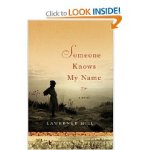 Someone Knows My Name by Lawrence Hill (Fourth Estate 2007)
Another Canadian author tells a story of an 18th century journey from slavery to freedom from a first person perspective. From initial capture in the unmapped interior of Africa, through a horrendous sea journey to captivity in South Carolina, escape to New York, promise of freedom first in Nova Scotia and then Sierra Leone, the female protagonist finally ends up in London as a totem for the abolitionist cause. A well-researched gripping read, given that some estimates of the trade in human traffic are at its most prolific today.
Movie Review: Frost/Nixon
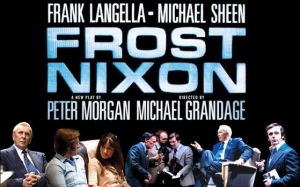 I was in my early twenties during the Nixon years, and being half a world away, was only vaguely aware of the implications of the Watergate scandal. Thirty years later, having viewed Frost/Nixon, I recognise having gained a certain amount of understanding through hindsight. The film takes some dramatic license as it describes some behind the scenes setting up of the series of interviews by David Frost with Richard Nixon. Essentially the interviews are presented from the historical records, yet the screenplay is not just documentary. Both David Frost and the ex-president are portayed as having high stakes in the inteviews, both in it for their own reasons, and thus the film becomes a fascinating character study, revealing the paranoia of Nixon and the ambition of Frost. Frost got his coup, the broken admission of Nixon of the crimes of Watergate. This was not a bad thing for Nixon, however. His confessions allowed the beginning of healing in varying measures for himself and the American people. The wounds and scar tissue remain however. If there was ever an era of innocence on the political scene under any regime anywhere, the Watergate affair blew it clean out of the water for some time to come.
Trish travels to Nazareth in the name of peace
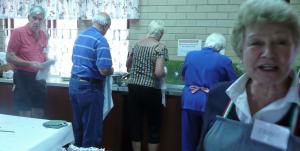
Trish supervising in our church kitchen
News from the Middle East is not all that good right now as Hamas and Israel hammer at each other again. But we’re in the business of celebrating small candles that light the way in the darkness.
Nazareth Hospital is one such candle – a Christian place of healing where both Jew and Arab are treated equally no matter what ideology or faith stance.
On Christmas Day we commissioned Trish Bevan for her return stint at the Nazareth Hospital and two other Galilee projects for some maintenance work. This feisty septuagenarian wields more than a paint brush. She is passionate about the cause of building peace amongst Jews, Muslims and Christians. Without fear and with sustained high energy, she immerses herself in the work parties that travel from Australia to to Nazareth under the guidance of Paul and Merrill Kitchen. Follow the unfolding news on the current project blog here.
The colossal carbon trading rip-off
Been quietly seething about the damp squib of a carbon trading scheme offered by our PM this week – 5% reduction by 2020 is a flea-kick. Then there’s a transparently deceptive attempt to get us all to put our shoulder behind the wheel to reduce it further. Scott Vawser spells it out here.
*sigh* – just when we thought we were turning the corner.
Christmas breaks in…

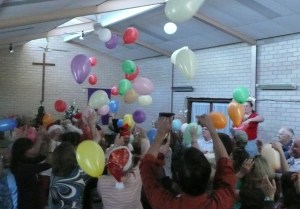 … see what I mean? There’s kind of a Mexican stand-off between Advent and Christmas observance. We had our annual community Christmas party last night – barbecue followed by games and carol-singing.
I used the epilogue to tell a story about “the angel in a gum tree”, sneaking in a flog for the Christmas Bowl Appeal.
Maybe Advent and Christmas weren’t in conflict; maybe they kissed!
It all comes together in the end!
‘Tis the Season to be Fasting…
 … fa lalala la, lala la la!
I usually feel like King Canute at this time of the year – raising my arms, seeking to hold back the relentless tide of Christmas festivities washing tsunami like over the beaches of Advent – the “little Lent” – the season of preparation, reflection and fasting. My church folk, Christmas decorations in hand, have regarded me quizzically when I go into one of my “It’s not Christmas yet” rants, shrugging their shoulders as if thinking “How odd – another one of his eccentricities!” as they set about decorating halls and singing carols. And me – I’m thick into the round of “end-of-year” parties (I refuse to call them Christmas parties ‘cos it’s not Christmas yet!) and – just to demonstrate my inconsistency – shamelessly promote The Christmas Bowl – a seasonal fund raiser for the aid arm of the National Council of Churches.
So this year I’ll mellow out a little. Some battles you throw in order to win bigger ones.
 Wondering Pilgrim