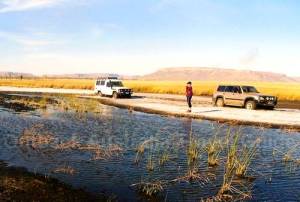
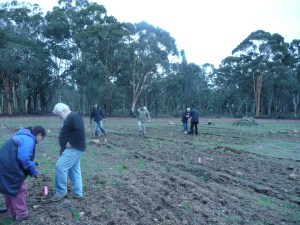
These are the species of tree we planted yesterday at Yaraandoo, a rural property and permaculture farm near Toodyay, about an hour’s drive from Perth. “Not endemic to the area,” we were told. In fact these trees are specific to the the abutting northern region, but changing climate may see them move southward. The exercise was part of a day long contemplative experience on creation spirituality and “the environment as a journey of faith”. Yaraandoo itself is a practical and continuously developing example of such a journey that has taken several decades. Ange and Jeff Sturman, the owners and our day’s hosts, have been developing the property for some time as a positive and proactive ecological statement since some time before the term “global warming” found popular currency. As a retired environmental scientist/engineer and Anglican priest, Jeff is well equipped to assist those attending their faith journey to expand awareness towards environmental challenges, offering a taste of a lifestyle that “has a Benedictine flavour, with Ignation lacings, and eco spirituality preservative!” You can see an article on Yaraandoo in the Anglican Messenger (March, 2009), page 20.
Mystery at Wembley Downs
The RAC traytop was off-loading my wife’s disabled Colt last night. It was behind the church, where she usually parks the car. The tray had just lowered the vehicle, when some loud shouts made us look up. Torch lights were bobbing towards us from the road reserve. Behind the lights loomed two characters, running full pelt toward us, shouting. We braced ourselves, not knowing what to expect – and they ran grunting straight past us – faces red, perspiring freely on this cold winters’ evening. They were in athletic singlets and shorts.
“You can’t get through that way” I shouted.
“This is private property!” my bride murmured.
No response – except about eight more characters, similarly attired, wheezed past us. Seeing our bemused faces, one cried out “Call the police!”
Now I was confused – were they chasing someone? There had been a burglary across the road earlier that day. Was he just having a lend of me? Why were they all dressed in athletics?
One called out “Found it!”
They turned and ran off in the direction they had come, disappearing into the dark. Who were these people?…
… next morning I found these chalk marks on the ground, leading me to pose several hypotheses


- They are alien markings, and our intruders are extraterrestrials in search of their lost space craft.
- They are portals to a secret chamber where stolen goods are secreted and this was a raid by undercover police disguised as athletes.
- They are markers for a local orienteering club out on a practice run.
Maybe, you, dear reader, can cast a light on this mystery. Or you may have an additional hypothesis as to what was really going on here. Feel free to share.
Thin Places Revisited

Once again some theologs and I met at King’s Park to explore a question that arises from a Celtic perspective of Christian spirituality – “Is King’s Park a Thin Place?”
The escarpment’s close proximity to the CBD of Perth combined with the beauty of it’s bushland setting create a popular tourist spot. It is a place where beauty natural and man-made meet. This can inspire or distract, the noise and sight of the freeway interchange below and the detail of the city skyline is sometimes jarring. In Aboriginal dreaming, where high ground meets water, it is a place of significant sacredness , something that the peregrinato, the early Celtic Christian monks would have quickly discerned and honoured because of a highly developed attentiveness to creation spirituality.
It is often a long journey from the myopia of our city-bound functional mindset to the inner quietness that awakens our awareness of the immediacy of the presence of the Creator around us. Places like King’s Park, plonked in the midst of our busyness, serve us well in pointing to that reality.
Three local churches join together for Pentecost communion
It’s a tradition in these parts now. Every Pentecost over the last four years we have joined with the Uniting Church at St Paul’s Anglican Church to celebrate Pentecost with an Anglican Eucharist. Everyone wears red and the sharing of communion is a highlight. Here’s the reflection I shared on John 15:27-16:4
As well as the Week of Prayer for Christian Unity that culminates today, we are in the middle of the Week of Prayer for Reconciliation that focuses on Aboriginal Australia. Some of us are involved in the process of planning a series of meetings involving indigenous liaison that includes a weekend retreat and some time away on a Kimberley field trip. We are calling it “Listening Journeys.” For those of us that are action focused, the planning and negotiating is a slow and frustrating process. Listening’s not our favourite game, we want to get in there and fix things. For those of us that are more reflective, it seems more appropriate to apply the brakes rather than the accelerator. We want to ask, why are we doing this? What is the best outcome for all? Should we even go if we are not invited?
Today’s celebration is helpful as we process and receive again the wisdom of the Word.
John’s Pentecost is not focused on a single invasive event as recorded by the writer of Acts. The coming of the Spirit is all pervasive, both at the same time anticipated and realised amongst those who fellowshipped with the pre-crucifixion Jesus and joined others in enjoyment of the companionship of the post resurrection Christ.
John’s writing draws on the memory of Jesus enfleshed – walking, talking, back-slapping, foot-washing, comforting and confronting – living, sleeping, eating and finally dying. But the Easter story tells us Jesus was raised so John’s gospel entices his community and ours to awareness of the same along-sidedness – the Holy Spirit, invoking the presence of the risen and ruling Christ, to encourage, protect, invoke, confront, rebuke and enfold all who are committed to his way.
The emphasis in Acts is, as the name suggests, on action. The events generated by the day of Pentecost set off a flurry of activity. The ministry and proclamation of an emboldened band of apostles draw crowds who are overwhelmed, converted and baptised – there are journeys and expeditions, persecutions, jailings, trials, confrontations – but all along the way churches are planted and universalised to include both Jew and Gentile. By the end of Acts, the presence of those who follow the Way has taken firm root throughout the Mediterranean.
The emphasis in John’s gospel, on the other hand, is on relationship – the intimacy of the presence of the Spirit. No spectacular crowd drawing visitation of wind and flames here. The risen Jesus quietly breathes upon his disciples in the privacy of a locked room, saying, “Receive the Holy Spirit.”
From John’s gospel we draw the assurance of God’s intimate involvement in every fibre of our living – yes, enhancing our unique and individual human contribution to the world by drawing us together into that expression of human community we call the Church.
No longer need we objectify God as someone who is out there that I must seek out, puzzle out, and somehow pacify through good works. It is about relationship. Not God and me, but as intimated by the medieval contemplatives, John of the Cross and Teresa of Avila, God in me and I in God.
This is the closeness of advocacy that John’s gospel speaks of when Jesus promises the coming of the Holy Spirit as a Comforter, an Advocate, a “come alongsider.”
Acts and John need each other. Action that is not guided and discerned by intimacy with the Spirit is simply spinning wheels in the mud and digging a rut. Internalising our whole attention within to the exclusion of acts of service and mission leads to irrelevant quietism that changes nothing and eventually shrinks to nothing.
The journey inwards is incomplete unless the journey outwards is engaged, and vice versa. Action needs reflection; reflection must lead to further action.
Breakfast with BJ

Part of the Saturday morning crowd with BJ and Chipo Mpofu (right)
Folk from over half a dozen Perth western suburbs churches gathered for an early Saturday morning breakfast with BJ & Chipo Mpofu.
Under his role as President of World Convention of Churches of Christ, BJ opened the proceedings with a celebration of the Lord’s Supper, a reflection of the anticipated Great Communion event on 4th October commemorating 200 years of the Stone Campbell movement around the world.
Later, BJ addressed the gathering, thanking them for their support of aid projects in Zimbabwe, where he and Chipo play an important role in leading and encouraging churches through ministry training and community development, including the negotiation and distribution of emergency aid.
Access to clean water has played a crucial role in protection from cholera, particularly in rural communities, BJ said. One had the impression that, while media reports from Zimbabwe highlight real and desperate problems, there is a positive will and strength within the churches to improve living standards and rebuild sound community structures.
BJ and Chipo, under the sponsorship of Global Mission Partners, continue their busy itinerary in Australia and then in the USA over the next two months.
200 years
Things are beginning to happen amongst the individual and diverse communities of what began to emerge 200 years ago as the Restoration Movement and ended up under a plethora of monikas covering most of the countries of the world – variously Churches of Christ, Disciples of Christ, the Christian Church, churches (small c) of Christ. This movement for Christian unity and church restoration has a chequered history, sometimes punching above its weight in its impact on the wider church scene, but often falling into the bitter divisiveness its origins abhorred. This is us warts and all!
This year sees calls from all streams of the movement to a rediscovery of our common roots and the passion evoked in the hope of a transformation of current vision. Study groups, web-sites and publications are beginning to appear – all with good stuff. It remains to be seen whether this anniversary will have any effect on our self-understanding as a whole. Will it pass like a summer storm with a bit of dampness but little lasting effect? Or will we see some drenching, saturating rains that will bring fresh, verdant growth and a fecundity of wisdom and understanding to contribute to the wider church and the world at large?
What might be possible in this year of The Great Communion?
Looks like the South Australians are kicking things off with a series of provocative essays.
On Saturday, we host a breakfast attended by B J Mpofu, Zimbabwe Churches of Christ leader and President of World Convention of Churches of Christ. Responses from a few churches are starting to come in. Maybe a cloud, the size of a man’s hand, is beginning to form on the horizon.
From the ashes
Seems like such a small thing after the devastating bushfires in Victoria, but around our streets it’s quite big.
We’re getting our shops back!
Chaotic hotels of radical hospitality
Disasters bring out the worst and the best in us. Have a look at Mark Riessen’s blog for a discussion and an exhortation. There is talk in the back rooms asking how local church communities can best respond to disasters that occur on such a large, gut wrenching and life altering scale. Disaster response strategies have their specially trained support personnel for community members and service providers and these include chaplains, but what about the otherwise unaffected who simply want to do something practical apart from donations and prayers? If you’re part of the affected community, (and who is unaffected now?) nothing can go past the “incarnational” presence, the shoulder to cry on, tle listening ear, and the practical thoughtfulness that can take respectful and non-intrusive initiatives.
Last night, I sat with a group of people and watched “The Spirit of St Paul’s” – on a DVD brought back by a traveller. It concerned the actions of the people of St Paul’s Chapel in the vicinity of New York’s World Trade Centre in the aftermath of the attack of 9/11. Ther church community became a “chaotic hotel of radical hospitality”, breaking all its rules and preconceived notions to respond to and provide what was needed for a devastated parade of rescue workers and survivors. Many found comfort, support and the ability to go on because of what ordinary people provided in the aforementioned “incarnation” of practical compassion. Maybe this is the stance local church communities should have at all times. Perhaps it’s those that do that come into their own when extra measures are called for.
Bushfires
Fire is one of the banes of this country. The nature of our landscape and weather patterns provides an ogoing banquet of fuel for this red marauding beast. Nevertheless, we live with it and many, over time, have died with it. It has ever been in the background of my awareness. As a kid I most enjoyed holidays with family in the Adelaide Hills. You could see the escarpment from our house down on the plain. Scarcely a year went by when you could not be aware of the smoke on the horizon and we would wonder if the fires were “anywhere near Uncle Ron’s place.” I recall leading a youth camp where fire from an exploding kerosene fridge leveled the kitchen and main hall in five minutes flat. Fate or fortune or providence had us all down at the river at the time. One bushfire we scarcely noticed was the one razing the mountain behind the Ainslie manse the day we brought our infant son home. We were somewhat preoccupied that day. The years we lived in Bridgewater – again in the Adelaide hills – had us well tuned into the fire season with our action plans ready to go if needed. My sister’s place a few ridges away came dangerously close to being burnt out one year.
The Victorian fires this weekend have a strange “here we go again” feel. Amongst the angst and the despair that is in the air, even on the West Coast that is as far from the fires as you can get on this big island, there is a sense of resignation. You can fight nature, but you can’t master it. One thing you can do is to tap into the community spirit that rises above the devastation and loss and seeks practical ways to give muscle to hope. Not Pollyanna “everything’s going to turn out alright” hope – but the kind that grants a due and respectful acknowledgemt to the grieving process that must yet unfold, a sifting of memories from which can be extracted the values and inspiration that have survived, and using these as building blocks for a new thing.
We’ve had a lot of experience in this land of doing just that. There’s no reason why it won’t happen again in the months and years ahead for the communities destroyed in the weekend’s fires.
Missional? Weasel word no longer?
Those who know me well are familiar with my curmudgeonally skepticism about the new fangled “missional” word (what’s wrong with “mission”?). I was rather taken, however, with the vision conjured by this “Missional Tale” and may find myself relenting – only slightly!