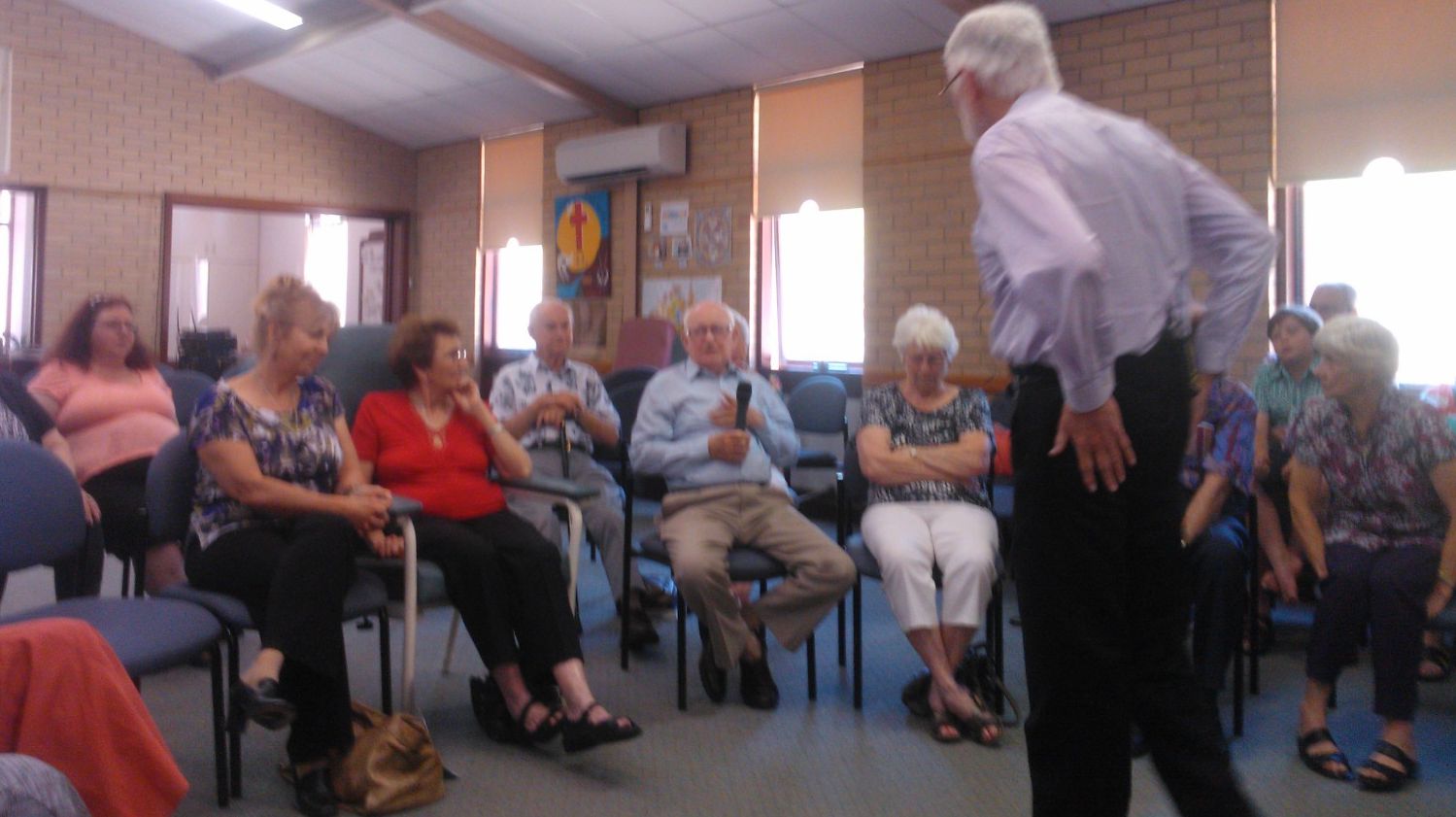
Church yesterday was an exercise in role-playing the 1st century church that met in the home of Philemon of Colossae. Creative imagination saw Philemon, his presumed wife Apphia and his presumed son and heir Archippus presiding over our regular congregation who had variously become the merchants, stewards and household slaves that met in Philemon’s atrium as a house-church.
The church meeting was in full swing when a messenger arrived bearing a letter from Philemon’s esteemed mentor, Paul. The porter was permitted to admit the messenger, who turned out to be Onesimus, a slave who had absconded Philemon’s household some time before.
Freeze-motion techniques enabled each group of participants to respond to what was about to unfold.
- Philemon is suddenly confronted with a householder’s shame – a runaway slave.
- Apphia presumably adhered to the strict Greco-Roman customs of managing the household. The absconding slave had disrupted the smooth manner of organising domestic arrangements.
- The household slaves glanced uneasily. Onesimus’ disappearance had caused them trouble and some shifting in the pecking order.
- Merchant guests and retinues forming the congregation were particularly interested in what was about to unfold. What would be the implications for their own household order?
Our role-players slipped into their roles as a forlorn Onesimus stood before Philemon clutching the scroll he had brought. Cat-calls, wise-cracks and incriminations filled the hall. Then Philemon commanded Onesimus to read the message aloud.
In faltering voice, Onesimus read the scroll which is the letter of Paul to Philemon. Interjections from the gathered church continued and then abruptly stopped. The person playing Onesimus had stopped reading and was weeping real tears. He had become Onesimus… and we had become the ones whom the apostle was directly addressing through Philemon.
It would have been easy to step in and halt the exercise. But no – now was the time to let the church be the church. The role play continued to its conclusion, but it was no longer a role play. It was church no longer separated by centuries, culture and tradition from its roots. The church in 1st century Collossae and 21st century Wembley Downs had become one.
The Onesimus in us all had become restored once more.
We could have explored further the issue of slavery and why it took 1700 years for Christians to raise a voice towards its abolition. Even now human bondage is deeply entrenched in our world community, deemed by multiple interests to be an economic reality that can’t really be completely dismantled (who made the clothes we wear right now, and under what conditions?). The Philemon exercise demonstrated unmistakably, however, the radical dimensions of communal transformation that can take place even within inequitable and oppressive systems. The quest to transform human identity in the way of Christ does not stop within the church community, but it certainly starts there – and is nurtured there.
This exercise was inspired by the work of Dr Greg Jenks, a presenter at the Common Dreams Conference, Canberra, 2013.