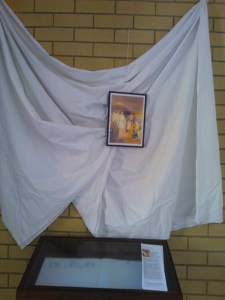
What’s your favourite version? The original Led Zepplin leads in Google hits. The lyrics are most evocative as we contemplate the Lenten journey – for on such a road we are often confronted with choices between the tantalising and immediate and the deeper and more reliable. Which is the true stairway to heaven? The image is based on Genesis 28:10-17. Jacob’s dream of a “stairway to heaven” interrupts his journey of choices. It will take a lifetime of pursuit of riches and power that leads him to a night of transformational wrestling that leads him to further choices. Maybe the “stairway to heaven” is part of the landscape of the Lenten journey to the self-giving of the cross and beyond.
Lenten Voices: It’s all in the name.

As a teenager, I looked up the meaning of my first given name. My then prudish temperament was somewhat taken aback to see that it was associated with Dionysus, the debauched Greek god of revelry and wine.
Had I been raised as an ancient Hebrew, it could have been far worse, for names were given to reflect something of the inner nature and projected destiny of its bearer. Hence the story in Genesis 17:1-16, of Abram’s name becoming “Abraham” – the “progenitor of many nations.” The world’s three great monotheistic faiths – Judaism, Christianity and Islam – look to Abraham as the foundation of a covenantal relationship with the Divine.
The Lenten journey, then, travels through this reflection and realisation that we continue to be part of this unbreakable covenant relationship with the Creator.
Oh, and I discovered that Dionysius, in the Greek pantheon, is also a source of new life, but modesty forbids me to reveal that! (And there are several Saints Dionysius I can choose to relate to as well)
Lenten Voices: Psalm 105
“I believe that the desire to please you does in fact please you.”
(Thomas Merton).
Lenten Voices: Into the wilderness…
Today’s sermonic offering at the Downs Church….
12And the Spirit immediately drove him out into the wilderness. 13He was in the wilderness forty days, tempted by Satan; and he was with the wild beasts; and the angels waited on him.
The wilderness … at the same time beautiful and dangerous.
The wilderness … a place of unfamiliarity, where daily routine is suspended, when the busy surface minutiae of life fades and the big questions come to the fore.
Why am I here?
What’s it all about?
Where are we going?
The wilderness can be anywhere – the outback dryness north and east of Kalgoorlie – the frozen wastes of Antarctica – the steamy jungles of the Amazon – the windswept streets of the Perth CBD – the wastes of the suburban landscape – even our own bed at 3am when we can’t sleep.
The wilderness… when the Spirit drives you there you can expect to be tested. You will meet the accusations of the Tempter. (Satan, translated, means “accuser.”)
You will be with wild beasts and waiting angels.
And sometimes it’s hard to tell them apart.
On Ash Wednesday, we meditated on Gay Byrnes viral interview with Stephen Fry. Here it is again:
We did not rise to take issue with Stephen Fry (as did another well-loved comedian, Russel Brand).
We did not try to defend God.
Neither did we seek to collude with Stephen Fry’s stance.
In the context of the threshold of the Lenten journey to the cross and beyond, we did what was most appropriate in response to big questions that challenge our human fragility and limited capacity to understand.
We simply received it. Job’s questions had found a fresh voice. It is a voice that one will often hear whenever the topic of faith or religious belief arises as a topic of conversation.
The strength of its stridency, passion and persuasiveness will determine whether it’s a voice that comes to us in our own wilderness.
It’s a voice of testing: we may hear an accusing tone.
Possibly we hear the roar of a wild beast, threatening to devour us.
Sometimes, when we are still, we will hear the whisper of a waiting angel.
The wilderness is where our faith and trust is tested – a place of encounter with self-accusation, wild beasts and waiting angels.
Stephen Fry’s challenge cries out for a response.
For Job the response came from an overwhelming encounter with the Divine in the form of a whirlwind.
Russell Brand, in his response seeks to evoke the whirlwind, and good on him.
I have found in my past conversations on faith, as theologically trained as I am, I have limited capacity to emulate the whirlwind.
In the wilderness, where Christ has gone before, what voices do I listen for? Which are the voices that will take me to the essence of reality and allow me to return from the wilderness to a life of service and clear vision in Christ’s name?
On Friday, I saw this on the Churches of Christ National FaceBook page, a quote from Karl Barth for Dummies (I’m going to quote it in full):
One of the greatest dangers of theology is to take the protest of atheism too seriously. If it were to make this fatal error then theology would be distracted from its true purpose which is to expose and bring down the errors of human religion.
For the man and woman of faith must agree with the protest of atheism. Human religion is a sham. It has brought untold misery upon the earth. It has been used too often to bring too few too much money and power. There is no god that can be proved to exist according to the standards of human science. There is no god that can be shown to be consistent with the assumptions of human philosophy who is worthy of our worship and devotion. There is no invisible friend for you to talk to. There is no sky daddy who will shelter you from the terrors of the night.
So far the man and woman of faith must agree with the protest of atheism. But the man and woman of faith must go further. For atheism cannot exist without its protest. It cannot let religion go. Like a parasite feeding on its host it cannot exist without religion. Without the errors of religion it has no crusade. Without the errors of religion it has no passion to fuel its ethics. Like a parasite it attacks its host and hurts it, but it cannot kill it. Nietzsche proclaimed, “God is dead,” but behind his back his disciples worshipped new and more dangerous gods. Atheism has won the intellectual battle in the secular universities. But in most of them it is still possible to study human religion as something strange, or something fascinating, or something powerful, something that has done great harm but is also capable of some good in society, like some vitamin that is beneficial in small amounts, but poisonous in larger doses.
The problem of atheism is not that it goes too far, but that it does not go far enough. Atheism sees that the emperor has no clothes. But all it can do is point and laugh. The task of theology is to remove the emperor from his throne.
The atheist and the religious person can confess their sins according to the last six of the ten commandments. All agree that it is wrong to steal, wrong to lie, and wrong to commit adultery. But the man and woman of faith must confess their sins according to the first four commandments. We have worshipped false gods. We have built idols according to our own imagination. We have misused the name of the Lord to pursue our own ambitions and in service of our own causes. We have profaned the Sabbath in the service of religion. Yes, even in service of our Christian religion of which we are so proud. We boast of the cathedrals and hospitals that we have built. We boast of the great benefit we have brought to society in the name of religion.
But confession of our sins must lead us to true repentance. We must forsake our religion, our futile attempt to control the powerful forces of the universe. We must forsake our pageants and our fasts by which we fool ourselves of our own self righteousness. We have given only token offerings and congratulated ourselves while keeping firm grasp of all that we hold dear.
The atheist is an iconoclast, content to throw a few stones through the stained glass windows. But the man and woman of faith must bring the whole edifice down. In their mind, in their heart, in their life, and in the Church most importantly of all. For the atheist is our friend, our brother, even though we pity him. We share his rage against the sin and pride of humanity which has created its gods in its own image. But we cannot afford to keep the host alive on which atheism feeds. And we cannot afford to take the protest of atheism too seriously. Because human religion is our true enemy.
For it is only when we have renounced our religion, it is only when we have stopped laughing at the naked emperor of religion and brought him to justice for his crimes, that we are ready to receive by faith alone the true and living God who reveals himself in his Son Jesus Christ. Anything else, anything less is not only a crime against humanity, our own humanity, but a sin against God.
Out in the wilderness, vision is clearer.
We can join those who see that the Emperor has no clothes.
But the real task is to dethrone the Emperor, the false structures and systems that serve lesser purpose than the Way of Jesus.
Over recent years we have seen a groundswell of younger generations abandoning some of the forms and structures of being church that my generation has championed.
In the 60s and 70s we believed we were doing a great job of tearing down obsolete frameworks that divided church and society and that prevented the communication of the Christian story.
We replaced these frameworks with our own shibboleths and hoops that people had to jump through if they were to be a part of our cause.
We saw ourselves as a denomination preserving a particular (“peculiar” we called it!) contribution to the Body of Christ at large, rather than a dynamic movement enabling all to give expression to the living spirit of Christ.
14Now after John was arrested, Jesus came to Galilee, proclaiming the good news of God, 15and saying, “The time is fulfilled, and the kingdom of God has come near; repent, and believe in the good news.”
Increasingly, young and old generations are now rising to the occasion and through their practical service, compassionate risk–taking and sacrificial advocacy for the needy – we hear voices that would normally echo Stephen Fry, Richard Dawkins and Christopher Hitchens declare, “We haven’t changed our stance, but we are in step with what we see.”
The accuser is silenced, the wild beasts retreat, and the waiting angels bring healing balm and nourishing sustenance.
Lenten Voices: The Harrowing of Hell
Medieval Passion plays made much of the visit of the crucified and triumphant Jesus to rescue the trapped ancestors from Hell. It is the ultimate “in your face” to the defeated powers of oppression, chaos and annihilation. Hell has no lasting power.
It’s in 1 Peter 3:18-22. The Lenten journey to Good Friday will always be tempered by the knowledge of resurrection and new creation.
Meditate on this.
Lenten Voices: On Her Majesty’s Service….
Kingsman: The Secret Service – is a rip-roaring enjoyable spy spoof lightly touching on some tangible everyday challenges – climate change, bullying, coming of age, redemption.
The genre, of course, draws on unflinching, totally dedicated, sacrificial service, epitomised by agents given to Her Majesty’s Service (or His Majesty, when the Kingsman private spy agency was born). The Apostle Paul appeals in the same way to the recalcitrant Corinthians, calling on them to emulate his ambassadorship and the “James Bond” lengths to which he is prepared to go that they and others will be reconciled to God and one another. They and all who follow the Way of Christ, he summons to be his protégés. See 2 Corinthians 5:20-6:10.
The Lenten journey is focused on reconciliation – and it takes ambassador-like dedication to ensure application and accomplishment.
Lenten Voices: Psalm 51
The first day of the Lenten journey involves some healthy introspection.
Psalm 51 (50 in some translations) is a penitent prayer that is bold in its confidence and trust in the One petitioned. The Orthodox tradition through the centuries has been a thorough exemplar of this combination of strong trust and humility.
Listen and pray along with the words you hear.
From the Ashes
Ash Wednesday is not really part of my church’s tradition. Dark and sombre with an emphasis on the dreariness of death, it does not sit comfortably with a movement whose focus is on new creation borne on the vitality and inspiration of resurrection life.
Yet we will observe Ash Wednesday, the beginning of the season of Lent, in a service tonight. There will be prayers, reflective visuals and music, communion and the daubing of ashes on the forehead. Why?
One cannot embrace the fullness of life without confronting the reality of our mortality and finiteness. Jesus himself modelled the balance, providing purpose for both that which pulls us toward abundant living and that which he calls people to give over willingly, sacrificially, “losing life” and thus, paradoxically, gaining it. Indeed, it is the theme that runs all the way through Lent to Passion week, Good Friday and the Day of Resurrection.
And lest one still believes the whole journey of Lent is too sombre for a vital movement, remember the metaphor that completes the phrase “from the ashes…”
The Giants Are in Town – a Transfiguration Reflection
(Today’s pep talk for Transfiguration Sunday)
The Giants are in Perth. Thousands have gone to meet them.
The Little Girl and the Diver have attracted crowds the size of which are often not seen in the CBD. Enthralled, they have watched the Giants sleep, wake up, shower, blink, walk, widdle and read.
Not only have they watched them, but they have also interacted with them. They have touched them, stroked them, followed them, and talked to them. They have laughed with them, cried in response to their wooden expressions, ridden on their arms and partied with them.
Children enjoyed Friday off from school to visit them in Wellington Square, and seemed to interact with them in the natural way one would expect. In the prolific TV interviews, however, it was the adult responses that were most illuminating. Many middle-aged men and women emotionally described their feelings of awe, joy, and (in one case) even sadness that they had become aware of something missing from their lives.
I suspect that, as the Giants slept at Langley Park last night, many bivouacked with them.
And what will happen later today as the Giants bid farewell? Will we see crowd hysteria as the people cry out, “Please don’t go!”
Will they say (like Peter on the Mount of Transfiguration), “let us build some booths here,” one for the Little Girl and one for the Diver? Let’s preserve this moment!
What is it about these Giants? These oversized wooden marionettes?
Giants have long fascinated us humans. They have populated our imaginations, fables and mythology for thousands of years.
Even in the Bible, you only have to get as far as Genesis 6 to find an allusion to mysterious giants, different from people but interacting with them and even marrying them. They are variously called the sons of God, heroes of old, the Nephilim. Unaccountably, we never hear of them again.
Size and stature on a grand scale have always been attractive to human beings.
Is it because, in our struggle for fulfilment, we are forever striving to be larger than ourselves? Aware of the flaws of circumstance, heredity, environment and human nature, we experience ourselves as diminished beings? Consider the giant in a form that we can touch, feel and interact with, however – and we are drawn from an experience of diminishment to a form of enhancement that gives us a glimpse of our larger self?
Now this is Ryle’s theory of Giant mania! What do you think triggers the appeal of the Giants that have come to town?
I test my theory against the wisdom of the internet and find few supporters!
Giants figure large in the mythologies of the world – they are archetypes of chaos, strength, and ancient wisdom – often associated with destruction.
Carl Jung: To summarize, the giants can be characterized as follows: they are chaotic, untamed, natural, instinctual creatures; insatiable and destructive in their carnal greed, if they are not reined in by the gods to be more benevolent.
Nevertheless – the City of Perth seems to be on a Mount of Transfiguration this weekend.
Except there is no voice from heaven declaring, “This is my Son the Beloved, listen to him.”
Now I don’t care whether Ryle’s theory of the appeal of Giants to the human psyche stands or not.
But it does with the Jesus revealed in the gospels.
Particularly in Mark’s gospel, the story of three disciples witnessing the transfiguration of Jesus unveils a summons to the full potential to which Jesus is calling those who follow him.
There is a trigger for this.
It is Peter stating his recognition of who Jesus is.
“Who do you say I am?” Jesus asked them. “You have heard teaching about God’s kingdom; you have participated in healing people from all kinds of sickness, restoring them to their communities; you have witnessed the release of people from all kinds of oppression… Who do you say I am?”
Peter replied “You are the Messiah. The one whom God himself has appointed!”
Jesus then began to teach them that the Son of man must suffer many things and be rejected by the elders, chief priests and teachers of the law, and that he must be killed and after three days rise again. He spoke plainly about this, and Peter took him aside and began to rebuke him….If anyone is ashamed of me and my words in this adulterous and sinful generation, the Son of man will be ashamed of him when he comes in his Father’s glory with the holy angels.”
This is one of the rare instances where Mark’s Gospel, preferring the title Son of God, allows Jesus’ own self reference as Son of Man (more recent translations “the Human One.”)
What God has made of Jesus, God also intends to fulfil in us. Irenaeus speaks of the Incarnation as “[T]he Word of God, our Lord Jesus Christ, who did, through His transcendent love, become what we are, that He might bring us to be even what He is Himself.”
This is what transfiguration is about. The three disciples that are with Jesus on the mountain don’t quite get it. They are overcome, overawed, want to retain and absorb what they are experiencing. What they don’t understand is that they must grow into the identity that has been revealed to them. They must walk a tough road, a road that exists for the sake of others, a way that draws all they encounter – friends, outcasts, enemies alike – into the transforming experience of the love of God. A way that involves pain, risk, suffering and sacrifice. A way that ultimately leads to Golgotha.
This they cannot grasp. If only we, terrified as we are, can stay on the mountain – it is enough.
7Then a cloud overshadowed them, and from the cloud there came a voice, “This is my Son, the Beloved; listen to him!” 8Suddenly when they looked around, they saw no one with them any more, but only Jesus.
They saw no-one, only Jesus – Jesus, the human one, who was leading them on the way to their own full expression of humanity. To achieve this, however, they would need to go with him all the way – even to Golgotha and beyond.
If the Giants call us to engage with our larger selves, Jesus calls us to lay aside even our striving for our larger self in order to allow God’s transformation of the world through our journey to Golgotha and beyond.
But such self-annihilation is paradox – for it is also self-fulfilment.
The epitome of epiphany!
Dragon Printers
The church copier has been at me again. “Replace Toner Cartridge” it insists. I go through the routine of swapping it over. The machine whirrs, clicks and grinds. The little green screen flashes a message at me – “Replace Toner Cartridge”.
Grrr, I’ll show it who’s boss! I press the reboot and wait. “Replace Toner Cartridge” it insists. Oh well, must be a crook cartridge. I repeat the routine and wait.
“Replace Toner Cartridge”
I give up. Next day, I try again, hoping the machine has relented. “Replace Toner Cartridge” “Replace Toner Cartridge”.
After researching manuals both hard copy and online, I am flummoxed. Why not just type the problem into Google? Up comes a video that shows me a fix. In one minute the printer is purring like a kitten.
I send out an email informing everyone the printer is now fixed (I coyly make some mention of my genius!)
The next email arrives in my Inbox – completely unrelated – but headed “There is no magic manual…