“Let’s take it for a whirl,” he said, |that rusty old ute behind the shed. Its tyres were flat, its paint was all flaked – but still, it roared when gently waked. We named it Puff, with dragon flair, and drove it laughing everywhere.
(c) Dennis Ryle November 2025
dVerse challenge – compose a quadrille – a poem of precisely 44 words – and use the word “whirl”.
Today’s dVerse invitation is to compose a dizain on any theme. The dizain is a 10-line French poetic form, traditionally composed of a single stanza. It follows a strict rhyme scheme of ABABBCCDCD and typically uses 10 syllables per line. Popularized by French poets in the 15th and 16th centuries, it has also been adapted by English writers.
I look at my desktop – all is tidy Yet analysis shows it is crowded Not surprising, as today is Friday Week’s activities displayed unshrouded Though concealed in a stack that seems clouded A book by Carter on themes ethereal A cash access submission that is serial Car registration that will soon come due Something I wrote while ministerial The list goes on and on; my how it grew!
Today’s dVerse provides a list of well-known lines from horror movies, inviting poets to be creative and build alternative stories in a form of our own choosing.
I’ve selected “Whatever you do, don’t fall asleep” – Nancy Thompson, A Nightmare on Elm Street (1984)
Whatever you do, don’t fall asleep ‘lest ways of mammon upon you creep Stocks and profits would have their way so easy and enticing to lead astray
Why not slumber and close your eyes? There’s wealth aplenty and in disguise Waiting for those with proper thrall To nod off and forget their higher call
Forget the woke and remain a slave Sleep is your haven from being brave Pursuing the treasure within your dreams That turns to nightmares full of screams
Whatever you do, don’t fall asleep The woke see deeply what’s here to reap Alert to humanity’s deeper soul The common good that makes us whole.
Today someone accused me of being a poet. A haibun is a Japanese literary form that blends prose with haiku, creating a meditative and evocative narrative. So here goes.
Hallowe’en in an Australian suburb is mostly a commercial venture. The faux pumpkins, skeletons and witches have stood sentry with the store greeters for several weeks now. With some incongruence, Santas, reindeer, snow creatures and Christmas trees are now appearing among them. This Friday, our bowl of wrapped sweets will be ready. Our lane is off the beaten track, but “be prepared” has always been our motto. This weekend, our minds will turn to the communion of saints, which All Hallows Eve heralds. As ever, a deep subterranean stream runs beneath the froth and bubble of ringing tills and beeping point of sale terminals.
Cloud of witnesses Surrounds crazed activities Holding all in peace.
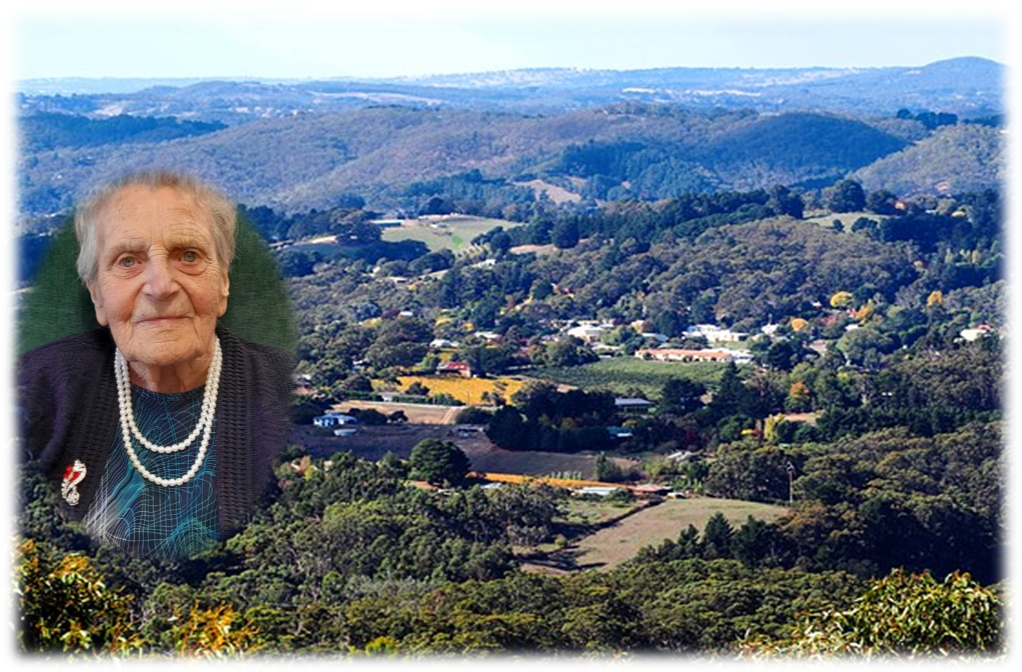
Today the Ryle clan gathered on Kaurna Country at Mt Lofty overlooking Piccadilly Valley to scatter the ashes of our beloved matriarch, my mother. It would have been her 101st birthday. Not all could make it, but all were in some way present.
Ode for Marjorie Isobel Ryle
At Mt Lofty, overlooking Piccadilly Valley Here, where the wind sings through stringybark and gum, And the valley opens its arms in quiet reverence,| We gather to release what remains – Not to forget, but to remember more deeply.
From Birkenhead’s sunlit shores she came, Where seagulls cried and blue skies bore witness To a girl of grit and grace, Who laboured with laughter in Adelaide’s heart, And loved the boy next door with a devotion that endured.
She raised three children – Dennis, Janet, Alan – In a home where wisdom perched like a talon, And love rang like a bell through every room.
She led with light in the Girls Brigade, A beacon for the young, And in her church, she stood firm – A pillar of faith, a wellspring of patience.
Now, her ashes return to the earth, Scattered like seeds upon this sacred ridge, Where mist meets memory, And the valley below cradles her legacy.
Let the wind carry her story. Let the hills echo her laughter. Let the soil receive her strength. For she is not gone – She is woven into the breath of this place, Into the roots of every tree, Into the hearts of those who carry her name.
So we release her, not in sorrow alone, But in gratitude – For a century well-lived, For a lineage of love and grace, For the girl from Birkenhead Who became a matriarch of kindness.
Rest now, Marjorie, In the valley’s hush and the mountain’s embrace. Your life was a blessing. Your memory, a song. Your spirit, forever part of this land.
I have fought the good fight, I have finished the race, I have kept the faith. 8Now there is in store for me the crown of righteousness, which the Lord, the righteous Judge, will award to me on that day—and not only to me, but also to all who have longed for his appearing.
We went because the call came – a need, a name, a dose to deliver. No invoice, no ledger, just the quiet urgency of breath.
The growth economy would chart it: kilometers driven, time logged, value exchanged. It would ask: Was it efficient? Was it scalable?
But then – quite unrelated, unasked, unearned – a cob of fruit sourdough, still warm, cradled in hands that had no part in the medicine run. No algorithm predicted this. No KPI measured the yeast of kindness rising in a neighbour’s oven.
This is the share economy: where gifts ferment in silence, where abundance is not hoarded but handed over, where the crust cracks open to reveal a sweetness no market can price.
We delivered medicine. We received bread. And somewhere between the two, a covenant was baked – not of profit, but of presence.
Out past the scrub where the mulga grows, And the cockatoos wheel in flight, Ten blokes camped by the river bend, Kept clear of towns by law and fright. Their skin was rough, their spirits worn, Marked by a curse they couldn’t shake, But word came down from a drover’s mouth: “There’s a healer near the Break.”
So up they stood, all ten as one, And hailed him from afar: “Oi, Jesus mate! We’re crook as dogs— Can you fix us where we are?” He didn’t touch, he didn’t preach, Just nodded toward the priest, “Go show yourselves,” he calmly said, And turned his gaze due east.
They shuffled off through spinifex, And as they walked, they found Their sores were gone, their limbs were strong, Their health was safe and sound. Nine kept on toward the town, To claim their clean-skin fate, But one bloke stopped, a foreign chap, A Sammy from out of state.
He turned around, came back full tilt, And dropped down at the feet Of Jesus, crying, “Thanks, old mate, Your mercy’s hard to beat.” Then Jesus said, “Where are the rest? Weren’t ten of you made whole?” But only this bush stranger came To thank me heart and soul.
“Get up,” he said, “Your faith’s the thing = It’s made you truly well.” And the wind blew soft through the desert grass As the grateful stranger fell.
This is one of my go-tos when I’m on the road and its time for a quick lunch between commitments – it’s light yet filling.
Lately, it’s what I’m eating in my dreams.
When I shared this yesterday with a group of friends who know me well, they laughed tellingly.
“You are both a bit of a jester and a stockman who rides around with an eye for detail and putting out fires,” they suggested.
I reflected that, within my organisational life, I have generally been a bit of a boundary rider, seeking to open closed gates from within rather than without. This has often required some wit and wisdom.
I celebrate with a haiku:
Jesters Stockman’s pie Sustaining kind change within and welcome without
Let no decree declare the mind askew, Whose stars align in constellations rare. The world is wide, and thought has colours too – Not all must march in lockstep with greatest care.
What some would mend, we name as sacred fire: A pulse of insight, fierce and uncontained. The diff’rent child, the stimming, bright desire Not broken, but uniquely unrestrained.
Their art is not a puzzle to be solved, But living script that dances off the page. In every echo, brilliance is evolved, A different drum, a deeper kind of sage.
So let no power claim what must be cured; The flame of difference is to be endured.
Occasionally, I dabble in verse. Rising to the challenge to write about my hair using a Scottish Burns stanza, I came up with this:
A number one cut hides history My follicles are mystery Dark colour faded so swiftly Now blinding white And standing on end all bristly O what a sight!
Okay, right number of lines, syllable count is fine, rhyming sequence correct – what does it lack? I asked Co-Pilot, my AI on-hand critic, how to improve it, give it that genuine kilted Scottish flair. It was merciless! It used five A4 pages to excoriate and educate me on the finer points of Robert Burn’s literary techniques. Then it rewrote my offering thus:
My bonnie pow—aye shorn sae bare, Whar raven tress lay thick wi’ care, Now bleached like snaw, nae dark remains there, White as the drift, Each bristle stands in winter air— Och, what a lift!