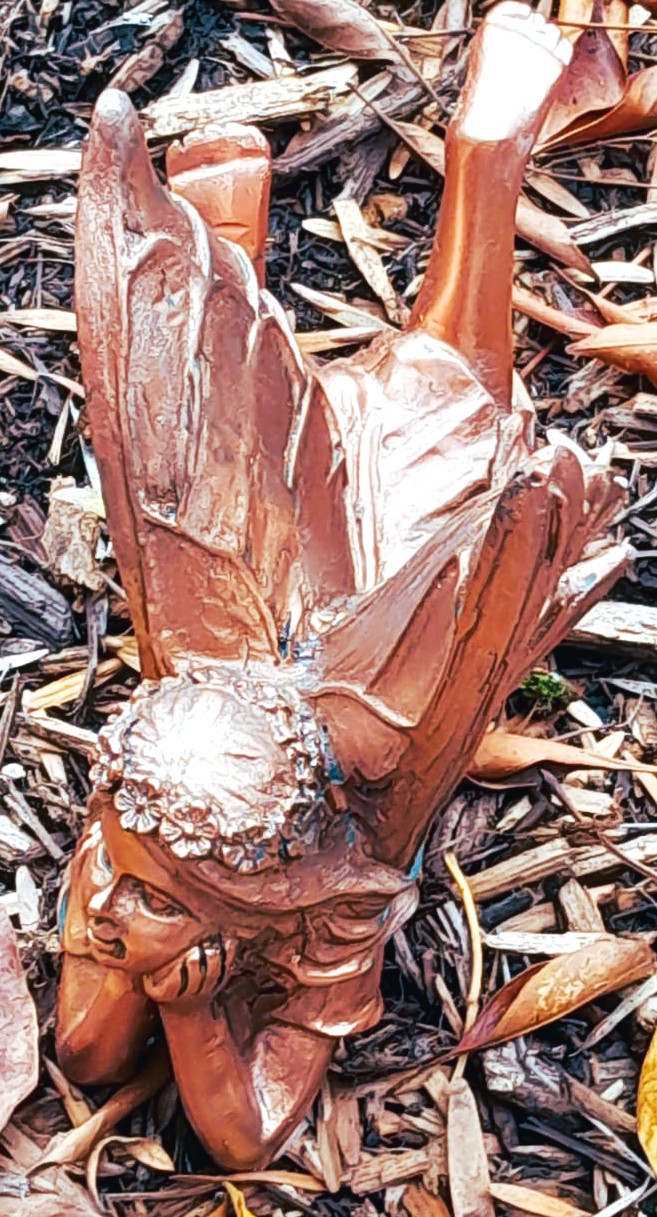
A faerie has appeared in the garden at Resthaven, where my mother passed away earlier this year. It takes its place among other memorials, a perpetual reminder of my late mother’s imagination and her faithful journey towards the Tree of Life.
As the eldest of three, I scoffed when my mother alluded to “faeries at the bottom of the garden.” Was she simply passing on generational folklore from the old country? Was it a subtle control technique that kept us kids mystified? Was it just some fun, sharing a little magic from her childhood?
The notion grew when grandchildren came along. In her later years, she moved to a rented senior’s unit. In a corner of her backyard garden, Mother created a “faerie circle” with miniature paving stones. She repurposed a clay letterbox as a faerie cottage. Visitors, tiny and grown, were enthralled when they called by. The garden prompted the telling of imaginative stories and stimulated creativity.
The folklore surrounding faeries goes back to Celtic times, when such creatures were feared more than admired. They were fickle, powerful beings, otherworldly, who had the power to bless and curse at whim. They were found in wild and untamed forests and bleak, uncultivated wastelands.
The romanticism of Victorian times clothed them in a more delicate and whimsical respectability. The neatly curated garden became symbolic of controlled nature and innocence. Adding faeries was a way of suggesting hidden magic just beneath the surface.
Deep down, does this hint at a primordial nostalgia for a paradise lost? Does it feed an innate wish to return to Eden, a place of wonder and innocence?
The Christian story addresses such hunger by inviting engagement with Christ. It calls for participation in the building of Shalom, the realm of God where all finds its completion. The Tree of Life (Revelation 22:1-9) becomes accessible in the great restoration of the New Heaven and the New Earth.
Mother was able to integrate both the magic of her imagination and the steady conviction of her Christian faith. I am sure she has passed this on to her offspring!
Photo by u0412u0430u0434u0438u043c u041cu0430u0440u043au0438u043d on Pexels.com
Meta’s suspension and the loss of 15 years’ worth of Facebook networks has driven me into the wilderness of social media. I emerge intending to build on Substack and WordPress. Join me for a yarn at Pilgrim’s Rest.
As I read through Luke’s gospel, I try to see in myself how one thought leads to another. I don’t know that this was Luke’s process, for he begins his work by stating his intention to set out an orderly account “of the things that have been fulfilled among us, just as they were handed on to us by those who from the beginning were eyewitnesses and servants of the word.”
We see the story of Jesus and his community unfolding and expanding, how Jesus appears as the fulcrum of a new age, long anticipated by prophets and expressed in the teaching and activity of Jesus and, importantly for us, those whom he inspires and empowers.
We’ve been following this narrative and particularly appreciating fresh insights and applications through the teaching of our own New Testament scholar, Steve Young, who drew our attention last week to the focus on the one thing chosen by Mary, and available also to Martha (and us!) if she could lay distraction aside. The text, typically and maddeningly, doesn’t say what the one thing is. I circle back through Luke to sharpen my perception of that one thing, and it seems to have something to do with joining Jesus in word and action in implementing the reign of the kingdom made visible in giving sight to the blind, relief to the captive, and proclaiming the good news of jubilee. See Luke 4:16-21.
And now Luke introduces us to Jesus’ teaching about prayer.
I was in my mid-thirties when I began to understand a level of prayer that went beyond simply “saying prayers” or composing prayers for church services. It was during my tenure as part of an innovative team approach, where I was responsible for outreach ministries at four of our Canberra churches. I had creative license to take the church into the marketplace.
Apart from managing a kaleidoscope of activities including public school ministries, refugee resettlement, pioneering thematic bible study courses in the secular adult education system, part-time university chaplaincy, and planning joint church development, it was my task to represent our churches whenever the government and parliament called for religious input.
Receptions on the embassy circuit, meetings with politicians, organising the first parliamentary prayer breakfast and joining dialogue with the Dalai Lama on his first Australian visit were the order of the day.
This circuit of much activity eventually left me feeling dry and heading towards burnout. My inner prayer practice was almost non-existent. It looked good on the outside, but just an echo chamber within.
Then I came upon Eremos, a foundation established by Bruce Wilson, author of Can God Survive in Australia. Bruce had just moved to Canberra to take up his post as a bishop in the Anglican diocese there. He invited me on a retreat, and I discovered something quite alien to my head-focused habits – the age-old contemplative practices that joined the head to the heart, the prayers of silence that enables one to listen deeply to the divine. I was introduced to the practices of Lectio Divina (“sacred reading”), and meditation.
Contemplation became a part of my regular practice, balancing my activity and renewing and equipping my spirit for more focused ministry.
I thank Steve for presenting a view of the Mary and Martha story that is at variance with popular renditions. I have been reflecting on the challenge of dialoguing with the Martha within me, active, distracted and unfocused and the Mary within, focused on Jesus, seeking to orient herself to grow into the presence and disciple action of the jubilee that Jesus proclaims. Focus for holy action, I think this is the one thing.
And now we have the disciples asking Jesus to teach them to pray. We are given the Lord’s Prayer. Notice the orientation to the familial relationship with God “Our Father (our provider, our protector).” Notice the call to focus on the kingdom that implies its already here inviting us to practice it, and the kind of practice that invites confidence in the daily provision of what we need, our hospitable and gracious stance towards others. Notice the call to maintain focus and resist the chaos and oppression of evil.
This is not simply a prayer for reciting in formal liturgy. Over the years, I have sometimes been taken to task. “Back in the day, we used to recite the Lord’s Prayer every Sunday. Why don’t we do that anymore?” I was usually tempted to respond, “We will when we are prepared to act on it!”
Note recent debates about the appropriateness of the long standing tradition of using the Lord’s Prayer to open each day’s session of parliament in both lower and upper houses.
Critics argue that the practice is outdated in a multicultural and secular society. Proposals have been made to replace it with a multi-faith moment or a period of reflection.
The Victorian Labor government previously considered removing the prayer but backed down after public petitions and interfaith support. Over 11,000 signatures and a joint statement from Christian, Jewish, Hindu, and Muslim leaders helped preserve the tradition.
Each group underscored that the Lord’s Prayer, while Christian in origin, expresses values that are shared across faiths and relevant to the ethical conduct of public officials. Their unified voice helped shift the debate from religious exclusivity to spiritual inclusivity.
For Luke however, this is a pattern of prayer given for the focused disciple of Jesus. It is to be prayed by the heart that is both troubled and intentional about engagement with the realm of God at large through the ministry of Jesus.
We followers are oriented to his manner and his ways and his relationship with God.
Are we troubled – yes.
When I pray “Give us this day our daily bread” – I am distracted by the children of Gaza whose plea for daily bread not only goes unheeded but is cruelly denied them.
How can I respond from afar except to join what little influence I have to those pleading with our representatives to press for the abandonment of using starvation as a weapon of war?
“Save us in the time of trial,” “Deliver us from evil” Robust discipleship will have us praying this often, and from a stance of forgiveness.
Remember Maxwell Smart and the cone of silence that descended whenever he wanted to talk in confidence with his boss? To pray in the pattern of the prayer that Jesus teaches his followers is to enter the cone of grace. It turns us to a stance that is bold and humble at the same time.
What follows is Jesus’ parable of the friend knocking on the door at midnight, rightly expecting a ready and hospitable response. He is indeed bold – asking not for just one loaf of bread, but three! Just how hungry is his visitor? His insistence wins compliance to his request, despite the inconvenience to the householder who has to disturb his whole family, and probably even light the fire and organise the baking of the flat bread to comply. The implication is that this is how much more we might pray, with bold expectation that we will be heard and answered, because what father, provider, protector will withhold what is needed from his child?
The applied lesson is to ask, seek and knock, not only with expectancy, but expectation of receiving, finding and transforming, and even more, the Holy Spirit! Alignment and infusion with the mission of Jesus!
I can’t say whether these teachings on prayer were deliberately set to follow the story of Martha and Mary, and before that, the Good Samaritan, and the scholars I’ve read seem divided.
One thing I can observe, though, is that the kind of praying we see in Luke 11 isn’t the listening kind we associate with the popular depiction of Mary.
It seems more like the kind of prayer we associate with Martha – asking, petition, expectation that my request will be immediately answered, even if it’s a poor request. But this is a focused Martha, the one we find at the tomb of Lazarus and who understands resurrection life. The one who asks with kingdom focus.
This goes a long way to meeting our protest of why our prayers aren’t answered.
The error is not in the asking; the error is in the distraction.
I ask and receive nothing. I seek and I find nothing. I knock, and the door stays closed.
What am I missing?
Perhaps it’s the one thing that Mary and, eventually, in John’s gospel, Martha chooses.
To ask is to come from a Jubilee position of openness, not complaint. To seek is to come from a Jubilee recognition of knowing what to look for, for the signs are all around us and, indeed, within us. To knock is to see the door open wide enough to summon us to walk through, leaving behind the baggage that prevents us and willing to grasp and be transformed by the Jubilee that beckons.
To pray like this is costly and can take us into wild and uncomfortable places. Such is the road that Jesus not only calls us to follow, but travels with us.
And to be open to the company of those we meet along the way.
Shared with the Church of Christ Wembley Downs, 27 July 2025
Fire, uncontained, destroys. Fire, contained and focused, creates, transforms, and welcomes.
As I approach the upper levels of my anticipated lifespan, I notice the extent to which rage has lurked in my negotiations of life’s challenges and opportunities. Perhaps it began in the gritty arena of the primary school playground, where, at the tender age of seven, I attempted to channel the nonviolent spirit of Mahatma Gandhi amidst the type A brawls and schemes of my tormentors.
This month marks the seventh anniversary of my official retirement from pastoral ministry. Yet, while I’ve stepped away from formal contracts, my vocational engagement remains vibrantly intact across several church communities and projects.
So, where does rage smolder now? And where is there space for the sage to emerge?
Connie Sweiz, author of The Inner Work of Age: Shifting from Role to Soul, suggests three portals that emerge more prominently at this latter stage of life. We all pass through them eventually. How gracefully we pass through them will vary. Sweiz names them as – * Shadow awareness: the portal to depth * Pure awareness: the portal to silent vastness * Mortality awareness: the portal to presence
I recognise here how the fires of rage can feed either resistance or creativity, sometimes both at the same time.
The portal to depth is more familiar to me at this time. Over the last seven years, I have often commented that I may have retired from pastoral ministry, but not from serving my vocation. I enjoy having shed the responsibilities of tying the red tape of weddings, governance compliance, running safe programs and strategic planning. I am enlivened by simply being available to listen, encourage, teach and occasionally lead worship. I now have time to meditate, write, and dream. Passing through this portal allows me to carry much of what has been meaningful to me and express it in more expansive ways.
The portal to silent vastness does not loom large at this stage. I accept diminishing physical capacity. Cognitively, I remain as sharp as I have ever been, and my spirit feels ageless. I visit my doctor more frequently to monitor my hypertension and take some vitamin supplements that serve me well. My diet is modest, even though I am genetically disposed to obesity. Gradual loss of physical energy, rather than illness, points me toward this portal which, while not dominant in my awareness, is clear and beckoning. No rage here (yet)!
Mortality is just over the horizon, and the brochures are already here in the forms for guardianship and advanced care directives waiting to be filled. The will needs to be updated, along with my “What to do when I die” folder that contains all my passwords and essential documents. Oddly, Sweiz names this the portal of presence. Benedictine spirituality is constantly aware of the finiteness of human life and welcomes this presence daily in the prayers of the hours. I believe I, too, am aware of death’s presence in the context of the eternal Presence in which all cycles of life are called into their time of being and their return. I feel no compulsion to “rage against the night” as if it’s an enemy.
So my fireplace, for now, is well contained and comfy. I remain watchful and alert for the stray ember.
A sudden suspension notice severed my connection to over 15 years of meaningful conversations, collaborative action groups, and cherished interest circles along with an international web of contacts that, in some cases, spanned even longer. The abruptness erased a deeply interwoven digital history without warning. Several days of appeals with AI bots and the occasional human (for which I had to open and pay for a monthly subscription) advanced me no further. Some soulless robot has determined that my account has “breached community standards” and will delete it permanently after 180 days.
My old judo teacher taught me not to resist the energy used against me, but to enter its flow and use it to my advantage. Jesus taught a similar stance in the Sermon on the Mount (Turn the other cheek… go the second mile).
So I’m disengaging with Facebook/Messenger support services, and diversifying my online activity to X, Bluesky, Mastodon and Substack.
Each of these has a different purpose, and I’m yet to determine how to use them. Most of my “thinking” content, however, will be on Substack at Pilgrims’ Rest.
This deserves a haiku:
Facebook suspended What to do when appeal squashed? Breathe and make pancakes
In these days of chaos, I am traveling with the daily meditations of Matthew Fox and Richard Rohr. They give me occasion to reorient my questing heart to respond rather than react to each day’s rapidly unfolding events.
Today Fox draws our attention to the rising awareness and questioning about the antichrist. In simple terms, this figure pretends to be good and divinely appointed, but is deceptive, creating confusion and destruction. Whether this figure is metaphorical or attached to a particular historical person has always, in my experience, been open to debate. Fox, however, notes the reflections of 12th Century Hildegard de Bingen who painted her vision of the antichrist. In part, Fox describes her depiction.
“The antichrist is necessarily the opposite of interconectivity and compassion. Her painting of the antichrist borrows heavily from the Book of the Apocalypse and her sense of the End Times. In it, she pictures evil and the coming of chaos as the unraveling of the ropes of justice that keep order to society. In her painting, she features several beasts who are unraveling order by pulling on a rope. Chaos reigns with the antichrist.”
These beasts represent those who “bite at their own condition” and do not burn with justice, “warlike men” who wage wars without considering God’s judgment, those who put luxury living and their own selfish pleasure before the performance of worthwhile acts, rulers who create sadness and uncleanness in themselves and their subjects, and those who rob others. The black rope, she tells us, represents “the darkness that stretches out many injustices.” She pictures Christ as a young man, “who is the beginning of justice” and “a very strong warrior” who will “break the head of injustice.” Justice and beauty will triumph.
By honoring grief and healing, we re-member, and we put ourselves back together. We can make decisions about how to move forward from our core selves rather than our guarded hurts. The shape of us and our world is being reimagined in this process from a place that has a little bit more wholeness. When the past is offered healing, compassion, and forgiveness, the future will have good water to put our feet in.
We often avoid thoughts of either “antichrist” or “grieving.” Both are painful to face. When each is worked through, however, we come through to the other side standing on the promise of rock-solid assurance.
The traffic of my mind can get quite busy Pondering questions that leave me dizzy Does history repeat or does it rhyme? How many ways do we conceive of time?
Where do things begin and where do they end? Is space linear or does it somehow bend? How does my mind conjure such thoughts? And leave my reasoning tied up in knots?
Such is the mystery of a human mind Some would stifle it and think themselves kind Don’t ask questions and don’t fill your head With nonsense that leaves us irate with dread
Thinking of a Nazarene aged about twelve1 Visiting the sages with wisdom to delve The questions he posed that won him acclaim I wonder what they were? Could they have been the same?
A questing mind seems to me not to be wrong When centred and focused on a base that is strong To know deeply of Love as one’s underground stream Places one on par with the Nazarene’s dream!
Eco-philosopher David Orr describes hope as “a verb with the sleeves rolled up.”1
AI Image
We have our eye on the ball, nose to the grindstone, and shoulder to the wheel. It is cumbersome to keep working in that position!
Despite the wonder of mixed metaphors, each of these phrases speaks of focus and not giving in to distraction. They also avoid what the ABC names this morning as “time confetti.”2 On the other hand, the focused task in itself can divert our attention from something important. It can help us avoid something we don’t want to think about.
The 24-hour news cycle suggests plenty of issues we don’t want taking up rental space in our heads. So we choose a diversion. Something else to focus on, a project over which we have some measure of control.
But the idea of hope as a “verb with its sleeves rolled up” causes me to pause. In a world where polarisation and tyranny is gathering speed like a runaway train, expressions of hope seem futile. A children’s book is banned because it “wokenly” depicts a girl who accepts that freckles are part of her individuality.3 I am then tempted to focus on some activity that diverts me from such absurdity. Hope rolls its sleeves up. I can think of richness of diversity in my own context and ways that I can enhance and celebrate it. This is how it’s done!
Some walk the Camino de Santiago to focus in such ways. A pilgrim reports a challenge from a priest in a chapel along the way. “You are light. Go and be light to others.” Hope with its sleeves rolled up!
When I turned 18, the looming lottery of National Service was on the horizon. In the year males turned 20, marbles were drawn from some mysterious government barrel. If your birthday was on a selected marble, you were “called up” to be a Nasho. This involved 10 weeks of boot camp and two years of military service. It included the possibility of tours of duty in the controversial US war with North Vietnam. It was the era of “All the Way with LBJ.”
My calling to ministry was nascent but not yet formed, and my nature was pacific but not yet articulate. Nevertheless, my boyhood obsession with Mahatma Gandhi and his non-violent approach to peace-building lingered in my adolescent psyche.
I recall studying Bernard Shaw’s “Major Barbara” around the same time. Retrospectively I am struck by the similarity of the dilemma that the playwright explores. A Salvation Army officer’s ideals are in conflict with those of her wealthy arms-manufacturing father. His war profits are offered to fund her failing mission. Ultimately, Barbara transforms, realizing that her father’s power can be used for good. She decides to work with him to effect change from within the system.
I decided to take the passive-aggressive option of applying for a non-combative role in the Citizen Military Forces (CMF).
CMF was considered an alternative to National Service in Australia. Individuals might choose to serve six years in the CMF. This provided a part-time service option for those who did not want to commit to full-time national service. This allowed individuals to fulfil their national service obligations while maintaining their civilian lives and careers.
At the appointed time, I rocked up to the recruiting office. I submitted to physical and psychological examinations. They gave me a time to return to Keswick Barracks to complete registration and collect my kit with further instructions.
A nervous two weeks later I attended the barracks. Immediately, I was drawn aside by a crusty sergeant who said, “We are not proceeding with your registration. Go home, your eyesight is no good and you are colour blind. I don’t know how you can see to drive!”
Did I feel relieved or insulted? Perhaps a bit of both. Certainly bemused. Sure I wore coke bottle glasses but I could see perfectly well through them. And colour blind? I can see colours and shades that others are oblivious to! (I’ve discovered since that this may be due to an extra cone that expands my spectrum.)
The long arc of time reveals that my pathway to study for ministry was not impeded by the distractions of compulsory government obligations to which I had formed an ambivalent posture.
And today I have many words for conscientious objection. The purpose of this reminiscence however, is not to initiate an old debate, but to reflect on how unexpected twists and turns on our pathways inform and influence our destinies.








 Wondering Pilgrim