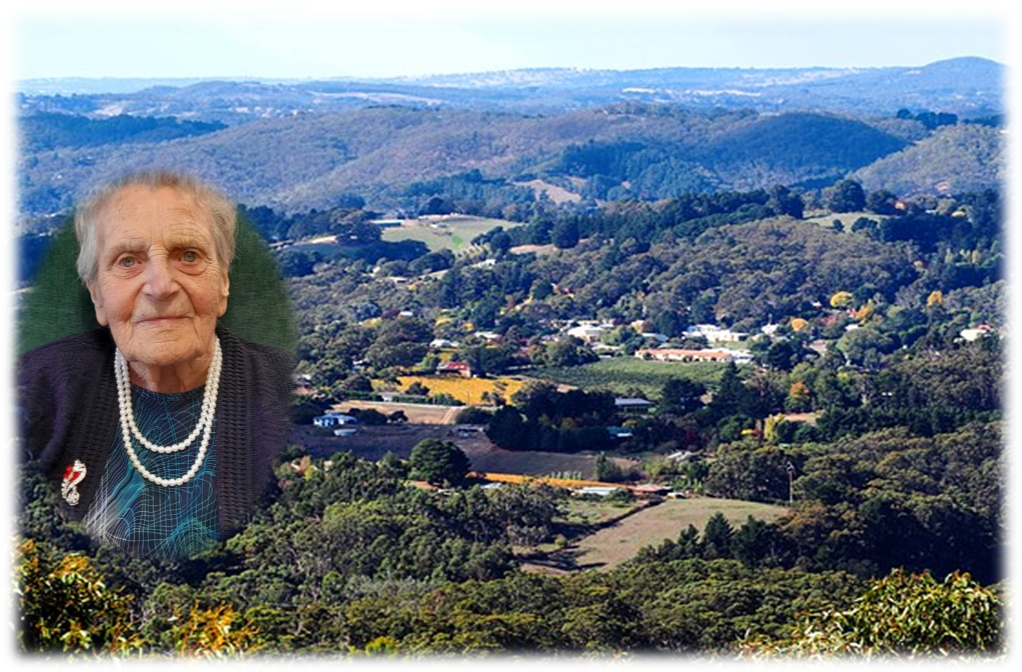
Today the Ryle clan gathered on Kaurna Country at Mt Lofty overlooking Piccadilly Valley to scatter the ashes of our beloved matriarch, my mother. It would have been her 101st birthday. Not all could make it, but all were in some way present.
Ode for Marjorie Isobel Ryle
At Mt Lofty, overlooking Piccadilly Valley Here, where the wind sings through stringybark and gum, And the valley opens its arms in quiet reverence,| We gather to release what remains – Not to forget, but to remember more deeply.
From Birkenhead’s sunlit shores she came, Where seagulls cried and blue skies bore witness To a girl of grit and grace, Who laboured with laughter in Adelaide’s heart, And loved the boy next door with a devotion that endured.
She raised three children – Dennis, Janet, Alan – In a home where wisdom perched like a talon, And love rang like a bell through every room.
She led with light in the Girls Brigade, A beacon for the young, And in her church, she stood firm – A pillar of faith, a wellspring of patience.
Now, her ashes return to the earth, Scattered like seeds upon this sacred ridge, Where mist meets memory, And the valley below cradles her legacy.
Let the wind carry her story. Let the hills echo her laughter. Let the soil receive her strength. For she is not gone – She is woven into the breath of this place, Into the roots of every tree, Into the hearts of those who carry her name.
So we release her, not in sorrow alone, But in gratitude – For a century well-lived, For a lineage of love and grace, For the girl from Birkenhead Who became a matriarch of kindness.
Rest now, Marjorie, In the valley’s hush and the mountain’s embrace. Your life was a blessing. Your memory, a song. Your spirit, forever part of this land.
I have fought the good fight, I have finished the race, I have kept the faith. 8Now there is in store for me the crown of righteousness, which the Lord, the righteous Judge, will award to me on that day—and not only to me, but also to all who have longed for his appearing.
We went because the call came – a need, a name, a dose to deliver. No invoice, no ledger, just the quiet urgency of breath.
The growth economy would chart it: kilometers driven, time logged, value exchanged. It would ask: Was it efficient? Was it scalable?
But then – quite unrelated, unasked, unearned – a cob of fruit sourdough, still warm, cradled in hands that had no part in the medicine run. No algorithm predicted this. No KPI measured the yeast of kindness rising in a neighbour’s oven.
This is the share economy: where gifts ferment in silence, where abundance is not hoarded but handed over, where the crust cracks open to reveal a sweetness no market can price.
We delivered medicine. We received bread. And somewhere between the two, a covenant was baked – not of profit, but of presence.
Out past the scrub where the mulga grows, And the cockatoos wheel in flight, Ten blokes camped by the river bend, Kept clear of towns by law and fright. Their skin was rough, their spirits worn, Marked by a curse they couldn’t shake, But word came down from a drover’s mouth: “There’s a healer near the Break.”
So up they stood, all ten as one, And hailed him from afar: “Oi, Jesus mate! We’re crook as dogs— Can you fix us where we are?” He didn’t touch, he didn’t preach, Just nodded toward the priest, “Go show yourselves,” he calmly said, And turned his gaze due east.
They shuffled off through spinifex, And as they walked, they found Their sores were gone, their limbs were strong, Their health was safe and sound. Nine kept on toward the town, To claim their clean-skin fate, But one bloke stopped, a foreign chap, A Sammy from out of state.
He turned around, came back full tilt, And dropped down at the feet Of Jesus, crying, “Thanks, old mate, Your mercy’s hard to beat.” Then Jesus said, “Where are the rest? Weren’t ten of you made whole?” But only this bush stranger came To thank me heart and soul.
“Get up,” he said, “Your faith’s the thing = It’s made you truly well.” And the wind blew soft through the desert grass As the grateful stranger fell.
This is one of my go-tos when I’m on the road and its time for a quick lunch between commitments – it’s light yet filling.
Lately, it’s what I’m eating in my dreams.
When I shared this yesterday with a group of friends who know me well, they laughed tellingly.
“You are both a bit of a jester and a stockman who rides around with an eye for detail and putting out fires,” they suggested.
I reflected that, within my organisational life, I have generally been a bit of a boundary rider, seeking to open closed gates from within rather than without. This has often required some wit and wisdom.
I celebrate with a haiku:
Jesters Stockman’s pie Sustaining kind change within and welcome without
Let no decree declare the mind askew, Whose stars align in constellations rare. The world is wide, and thought has colours too – Not all must march in lockstep with greatest care.
What some would mend, we name as sacred fire: A pulse of insight, fierce and uncontained. The diff’rent child, the stimming, bright desire Not broken, but uniquely unrestrained.
Their art is not a puzzle to be solved, But living script that dances off the page. In every echo, brilliance is evolved, A different drum, a deeper kind of sage.
So let no power claim what must be cured; The flame of difference is to be endured.
Occasionally, I dabble in verse. Rising to the challenge to write about my hair using a Scottish Burns stanza, I came up with this:
A number one cut hides history My follicles are mystery Dark colour faded so swiftly Now blinding white And standing on end all bristly O what a sight!
Okay, right number of lines, syllable count is fine, rhyming sequence correct – what does it lack? I asked Co-Pilot, my AI on-hand critic, how to improve it, give it that genuine kilted Scottish flair. It was merciless! It used five A4 pages to excoriate and educate me on the finer points of Robert Burn’s literary techniques. Then it rewrote my offering thus:
My bonnie pow—aye shorn sae bare, Whar raven tress lay thick wi’ care, Now bleached like snaw, nae dark remains there, White as the drift, Each bristle stands in winter air— Och, what a lift!
One of the things that amazed Jenny and I when we were living in Canberra was the attention paid to status. Many of the people we served worked for the government. One’s status was reflected by the designation and level within the department one served, and the suburb you were expected to live in commensurate with that status. If you were congratulated on a promotion, the next question would be, “And how soon are you moving?’ Anxiety levels were high when there was a change of government, as it often signalled the restructuring of departments, some of which might be merged, while others might be dismantled altogether. This would trickle down to a possible change of status, not always for the better.
One could be free from this phenomenon in the churches, where all levels and none gathered for worship and ministers, elders and boards worked hard at nipping status awareness in the bud.
I remember a major anniversary celebration at Ainslie Church of Christ, a cathedral site that had been generously allocated by the Federal Government. The final service was steeped in pomp and ceremony, with bishops and moderators from various denominations gathered as honoured guests and sitting in the front rows reserved for them.
Ainslie hosted a youth outreach venture, ministering to some of the city’s most disadvantaged young people. These kids were shepherded by a dedicated husband and wife team, streetwise and full of heart, who did not exactly prioritise the finer points of church protocol.
That night, they bused in about forty of their wild flock. The young ones filled the remaining seats in the sanctuary, a restless presence throughout the proceedings . As the service drew to a close, the organ thundered and the dignitaries began their stately procession down the aisle.
Just then, Colin—the youth leader, who was outside – called out, “Okay, all out! Hot dogs for everyone!” Instantly, the young mob sprang to their feet and surged through the surprised procession, eager to be first in line.
The image that stays with me is from a few minutes later: a bishop in full regalia, standing with his hot dog, chatting amiably with a tattered teenager. It was a moment of grace—status dissolved, hunger met, and communion shared in the most unexpected way.
I thought Jesus would approve!
This morning Luke invites us to the third dinner party hosted by a local religious leader with Jesus on the guest list — a sign of Jesus’ notoriety, but also a sign that members of the religious establishment, many of whom have become “hostile toward him,” are “watching him closely.” Read it here in Luke 14:1, 7-14
How is Jesus going to behave? What will he say? Will he observe the correct protocols? What will he do that we can use against him? How can we destroy his credibility and his following?
One of the earliest Christian hymns is recorded in Paul’s letter to the Christians in Philippi. The hymn’s lyrics describe Christ’s signature move as kenosis, emptying himself of divine attributes in an act of loving humility. The song goes like this: “though he was in the form of God,” he did not “regard equality with God as something to be exploited, but emptied himself, taking the form of a servant, being born in human likeness. And being found in human form, he humbled himself and became obedient to the point of death — even death on a cross. Therefore God also highly exalted him…” (Phil 2:6-9).
Luke’s story appears to echo this paradoxical celebration of humility and exaltation. Yes, it seems it is possible to hold both together when we understand that one is the pathway to the other.
But is Jesus being just a little mischievous? Maybe I’m projecting onto him some of the old laconic humour that came out of the Gallipoli trenches where the diggers lampooned their stiff British superiors. It appears Jesus knows how to play the crowd at the expense of those whose motives are toxic. I see him having fun here and enjoying the spectacle of a disturbed dinner party. But how quickly wit and humour become radical prophecy and an illustration of the essence of the realm of God.
I’m now drawing largely on commentary from the SALT Project and incorporating some reflections of my own.
It’s a dinner party, but for Luke, the atmosphere is tense. Some local religious leaders have already taken up a hostile stance toward Jesus, and they’re looking for a chance to trip him up.
This backdrop of tension makes Jesus’ actions all the more vivid and striking. After noticing how the guests “chose the places of honour” at the table, he brazenly offers them “a parable,” essentially a paraphrase of the advice in Proverbs 25:6-7 “Do not put yourself forward in the king’s presence or stand in the place of the great, 7 for it is better to be told, “Come up here,” than to be put lower in the presence of a noble.”
Jesus echoes what the devout would have already been taught:
Listen — if you really want to be honoured at a dinner party like this one, don’t go for the best seat right away, since someone even more honourable than you might show up and force you to give up your seat, and that’ll be embarrassing. Instead, take the lowest seat, and then your host might make a show of calling you up toward a better one. Then everyone will notice you, and you’ll be sitting pretty!
The Salt Project declares: How helpful! But there’s more here than meets the eye, for Jesus is subversively, deliciously skewering the honour hierarchy in at least three ways. First, any effective jockeying for honour in a social gathering needs to be covert; once it’s brought out into the open, it becomes tacky, cringeworthy, and therefore dishonorable. Exposure is precisely the effect of Jesus’ “helpful tip” for the ambitious guests. It’s a bit like your mother telling you, in public, not to chew with your mouth open. In other words, by publicly advising them in this way, Jesus is effectively calling them out!
Jesus then offers a sweeping aphorism: “For all who exalt themselves will be humbled, and those who humble themselves will be exalted.” This initially sounds like a straightforward call to humility — but, in the context of the dinner party and the advice from Proverbs, this summary creates a conundrum.
It reminds me of Charles Dickens’ character, Uriah Heep, undone, repeatedly protesting his humility as a cover for his prideful deviousness. And who can forget, Mac Davis’ hit of the 80s:
O Lord it’s hard to be humble when you’re perfect in every way I can’t wait to look in the mirror ‘Cause I get better lookin’ each day To know me is to love me, I must be a wonderful man O Lord its hard to be humble, I’m doing the best that I can!
Is strategically sitting at the “lowest place” really a case of “humbling oneself”? Isn’t it just another scheme, just another attempt at being “exalted,” at shrewdly jockeying for “the places of honour”? Thus, the whole idea of honour-manoeuvring is exposed as a sham and a shame.
Jesus immediately follows up with another recommendation, this time encouraging the dinner’s host to hold future banquets not for those who can return the favour down the road, but rather for those who can’t: “the poor, the crippled, the lame, and the blind.” Jesus paints a remarkable picture: imagine the ambitious status-seekers strategically taking the “lowest place” at the table — and thereby ceding the “places of honour” to those typically excluded from such events altogether. The tables are turned! The last shall be first!
Jesus, like a court jester, pierces and scrambles the honour hierarchy, calling out and confounding the prideful, and opening up the gates of acceptance, the gates of salvation, to the impoverished, the marginalised, and those left behind. God’s table overturns the world’s petty pecking orders. The privileged are summoned to do the same. Genuine humility doesn’t serve today for the sake of exaltation tomorrow. Genuine humility means getting out of the manoeuvring-for-exaltation game altogether, and building a more just, hospitable world.
Last week, Jesus warned us about how religious practices like sabbath-keeping can be distorted into self-serving parodies that blind us to the essence of God’s realm. Today, he shows that even commonplace events (like dinner parties) and laudable virtues (like humility) can be twisted into creating hollow schemes of higher and lower, insider and outsider. Attempts at “exaltation” come in all sorts of disguises.
It is feared that today’s protests, in contrast to last week’s, are heavily disguised by white supremacists using anti-migration as a rallying point for their cause of proudly preserving national identity. Ultimately, the call to unity is a virtue-signaling device that sows division. Sadly, many will participate, failing to see the interests that are being served.
The arrival of God’s dawning realm dismantles the status structures of the world. In God’s Great Banquet, the rich and powerful, the privileged and prestigious, won’t sit at the head table.
Rather, “the poor, the crippled, the lame, the blind” will sit there, the very people typically left out and left behind in worldly life, and indeed the very people to whom and for whom Jesus declares his inaugural good news of Jubilee. As Mary sang, the mighty will be humbled, and the lowly lifted up. The tables will turn and are turning even now!
How can we take part today in this table-turning revolution? Neither by seeking out the “places of honour” to be exalted now, nor by sitting at the “lowest place” to be exalted later. Jesus tantalisingly locks shut both of these doors and so sends us out on a different kind of mission with a different kind of spring in our step, a journey in which “being exalted” isn’t the goal at all. The goal is to honour and rejoice in the full presence of our Creator. The goal is to forget all the ego-stroking devices that we use to make ourselves feel significant. The goal is to truly love ourselves by fully loving God and fully loving our neighbour. The goal is love. But not just any love. Jesus envisions a love freed from all crass attempts at exaltation, at scoring points, at earning righteousness. A love for its own sake, without ulterior motive, without scheme or advantage, without quid quo pro. A truly generous love, a love that does not seek to be “repaid.”
Jesus stirs the pot in our everyday encounters. Not out of mischief, but as a demonstrator of the saturation and marination of God’s love for all.
I am often struck by how often the lectionary speaks into current events. This week Luke 13 gives a slant to the AFL (Australian Football League) Snoop Dogg Dilemma.
In Luke 13:10–17, Jesus heals a woman who has been bent over for eighteen years. He does this on the Sabbath, provoking outrage from the synagogue leader who insists healing should happen on the other six days. Jesus responds with piercing clarity, “Ought not this woman, a daughter of Abraham whom Satan bound for eighteen years, be loosed from this bond on the Sabbath day?” His rebuke exposes a system that prioritises ritual over restoration, and misinterpreted law over liberation.
Fast forward to 2025, and the AFL finds itself in a moral tangle of its own. Rap icon Snoop Dogg is slotted to perform at the Grand Final, despite a history of lyrics which are sprinkled with homophobic slurs and language that is at odds with the AFL’s own campaign against domestic violence. This comes just as Adelaide Crows player Izak Rankine is suspended for using a homophobic slur during a match. The AFL defends its choice, claiming Snoop Dogg has “changed” and that his performance will be “family friendly”.
So what does a Sabbath healing have to do with a football halftime show?
The Ethics of Timing
Jesus’ act of healing wasn’t just compassionate—it was confrontational. He chose the Sabbath precisely because it was sacred. By healing on that day, he redefined holiness as mercy in motion. The AFL, by contrast, has chosen entertainment over ethical clarity. To feature an artist with a controversial past at the very moment it disciplines players for similar offenses sends a mixed message: inclusion is conditional, and accountability is negotiable.
Hypocrisy and the Public Gaze
The synagogue leader in Luke 13 is not a villain, he’s a product of a system that values appearances. His indignation reflects a fear of disorder, of losing control over sacred norms. Likewise, the AFL’s defense of Snoop Dogg leans heavily on optics: his Super Bowl performance, his philanthropic work, and his status as a grandfather. But these surface credentials don’t erase the deeper question: what does it mean to platform someone whose words have wounded, especially when those wounds are still fresh?
Who Gets to Be “Set Free”?
Jesus calls the woman a “daughter of Abraham.” A radical affirmation of her dignity and belonging. In doing so, he restores not only her body, but her place in the community. The AFL, meanwhile, has yet to offer such restoration to LGBTQ+ fans and players. Rankine’s suspension is a start, but the league’s simultaneous celebration of an artist with a history of anti-gay rhetoric undermines its credibility. True inclusion requires more than discipline; it demands consistency.
A Call to Integrity
Luke 13 invites us to ask, “when is it right to disrupt tradition for the sake of healing?” The AFL controversy asks, “when is it wrong to prioritise spectacle over solidarity?” Both stories challenge us to examine the systems we uphold, the voices we amplify, and the values we claim to protect.
In the end, Jesus didn’t just heal a woman, he exposed a system. The AFL, if it’s serious about inclusion, must do the same.
The folk gathering for worship this morning were surprised when the power went out. They were left without lyrics and music or a public address system. Further, the church kitchen was out of order for the much anticipated post service pot luck. Our experienced worship leader (96 years young) handled the situation with ease. She rearranged the order of service while someone rushed home for a generator. She conducted communion, led prayers, and thoughtfully guided the church through prepared meditations. The theme from the Bible readings felt fitting: “Put in the hard yards of growing your faith. Be ready for the unexpected.”
Eventually, it was my turn to speak. I asked, “Am I able to look at the present events from a larger perspective? What does following Christ and his way of suffering and letting go tell me today? What about Gaza, Congo, Ukraine, the harsh ideological shifts in USA and Europe and our own country?“
My conclusions:
“Gardeners in the dark” are people who nurture love, truth, and justice during difficult times. This idea comes from Parker Palmer’s recent retelling of Joel Elkes’ words. It emphasises the need to stay committed even in uncertain times.
Abraham, Sarah, Joseph, Moses, and others can be seen as gardeners in the dark. They move forward in faith without full knowledge of what lies ahead, embodying trust and hope in God’s promises.
Jesus appears in today’s text as a rabbi and teacher. He uses stories and wisdom to guide us toward deeper understanding. He reinterprets Jewish traditions with originality and compassion, inviting followers to live with trust rather than fear.
Jesus calls his followers a “little flock,” emphasizing their vulnerability and cherished status. He reassures them, encouraging them not to fear because of God’s loving care. There is also the promise of the kingdom, shifting focus from material possessions (consumerism?) to the more lasting treasures of the heart.
Jesus’ parable of the master and the thief shifts pace to the unpredictability of Christ’s return. It is like a thief’s sudden arrival in the dead of night. Disciples are urged to remain watchful, ready, and faithful stewards of their lives and communities.
Jesus is both giver and disruptor. He comes to serve and bless. He also unsettles complacency, calling for readiness not based on fear but on trust in God’s timing beyond human schedules.
Faithfulness with alertness are the key takeaways. Gardeners in the dark!
I grimaced as he said, “I’ve got news – both good and bad.” My Cerato could be fixed, but the bill would make me sad. Still, hope returned; I give the car one final trusting thought, And reminisce on all the rides I had once proudly bought.
(All images on this page are representative and licensed under Creative Commons.)
At sixteen years I passed the test, a license in my hand, I scraped a hundred bucks together, dreamt of something grand. A forty-nine A40, rusted, proud, and bold, She wasn’t flash, but mate, she gave us stories to be told. My gateway from a loner’s world to mateship on the track, Carpool rides and youthful pride, no thought of lookin’ back. She rolled along through scrub and town, a freedom hard to earn, That dusty rig with stubborn charm taught me how my wheels could turn.
Two years on and fortune grew, I upgraded to A50, Yet what she had in function, she lacked in soul, not nifty. No tales to tell, no laughs or spills, no trips that warmed the heart; Just fuel and form without a spark, a life too prim, too smart.
When pennies pinched, I took to wheels – just two, not four in line, A Honda Cub became this traveler’s faithful sign. She braved the Adelaide-Melbourne stretch, on seminary quests, And carried me through weekends bound for student churching tests.
The youth I led were not impressed – they knew a bikie crew, I swapped the Cub for Beetle pride, a ’60 vintage view. Through sleet and snow past Macedon, and locusts thick as sin, She kept me warm and dry, until her engine gave in. Ordination night, the motor blew at Camberwell’s grand cross, Parents in tow and stranded there – she went out like a boss. Then Fremantle called my name, three thousand clicks away, But luck and grit provided wheels: the Crown would rule that day.
A seminary mechanic fixed the deal – a ’71 with fight, I swept up oil spills for coin, then drove into the night. Across the Nullarbor with heat, two tyres blew apart, And mice at border crossings gnawed through patience and through heart.
The Fremantle call was firm and clear -ministry’s fresh demand, No Crown would suit the wider work, no sedan’s steady hand. I sought a van both kind and stout, to serve the church’s need, A ‘68 VW Kombi—now that was built to lead.
She hauled the gear, she moved the folks, through mission’s weekly grind, Community and care aboard, no one was left behind. Each Adelaide retreat she rode, a faithful annual chore, Her engine hummed through desert heat, through dust and ocean’s roar. Then came a bride beside me there, and with her hand in mine, We crossed the Nullarbor once more, beneath the blazing shine. The Kombi bore our dreams and bags, through long and final bends, To Canberra’s fresh calling there – to churches, love, and friends.
To Canberra we came and swapped the van for trusty steed, A Datsun wagon, vinyl and gold, to suit our growing need. We scored her from a traveler, bound for lands afar, She purred along through family life – a quiet shining star. She hauled us then to Adelaide along familiar, winding track, With fam and bags and gathered notes all stacked upon her back. She asked for little, served us well, through city, coast, and scrub, A workhorse with a gentle heart – no flash, no pomp, no hub. But fate can turn on corners sharp, the Hills told such a tale, A T-bone crash brought curtains down, our hearts began to pale. Declared a write-off, gone for good… until one day I spied, That same gold shape on roads again- rebuilt, revived with pride. An enterprising wrecker’s work? No doubt they saw her spark; The best car that I ever had, still cruising through the dark. She lives beyond the paperwork, beyond the loss and claim, Her spirit in my stories rides, undaunted and untamed.
The Hills were steep, the corners tight – a zippy car was key, We found a Laser with modest frame, but heart as wild as sea. She hugged the curves, she climbed with fire, and towed a trailer proud, A quiet grunt beneath her hood that never cried aloud.
Her roof-rack high with books and gear, she faced the Nullarbor, And rolled us west with steady pace, through heat and open floor. That long stretch marked our final call, the post we’d hold for years— Where prayers and dust and faithful work met laughter, faith, and tears.
No flashy trim, no showy stance, just grit and holy grace, She served us well on many a road, in every sacred space. A Laser light through ministry, her strength behind the scenes, In winding paths and burning sun, she carried all our dreams.
Three Falcons came, each bold and broad, with wagoned grace and might, Successors to the humble spark that once tore through the night. A Mercedes, aged and lent by love, made one brief, stately stride, Its chrome a nod to borrowed time, a gleam before it died.
The Cerato rides in twilight – familiar, worn, and keen, Companion to these latter years, the miles that lie unseen. We eye each other, man and car, in quiet daily race; Who’ll fade the first? The road, she knows, and offers up her grace.
This ode concludes, the steeds all named, in memory lined with care, Their wheels have turned through faith and flesh, through dust and lifted prayer. From Laser’s leap to Kombi’s bulk, through gifts and gears long spun; A pilgrim’s fleet now rests in verse, their journeys gently done.


















 Wondering Pilgrim