This came across my screen a few days ago and I think it’s one of the more cogent opinion pieces I’ve seen in the media as the High Court hearing on government funding for National School Chaplaincy Program approaches.
Hurdle in church-state juggle – Opinion – Editorial – General – The Canberra Times.
Next month, of course, a decision will be made and there will be winners and losers.
This will be the real test of maturity for either side of the debate.
How well will either side handle a loss/win?
Nothing a 13 hour snooze can’t fix!
A few cough lollies, some aspro, heater turned up high and sweating it out through a 13 hour sleep helps chase the collie-wobbles away. The gentleness and considerations of a TLS (tender loving spouse) is also indispensable. I usually flee the scene on Sunday mornings when on leave (we live right next to the church), but I woke up just as the service was getting under way – no mood to flee anywhere. Slow breakfast, Sunday paper, and a good start on P D James “Death in Holy Orders” (what an apt title) saw us through to where I think I can grab the next few weeks’ leave by the tail and hang on!
Crook…
 … is Aussie vernacular for feeling off-colour. Happens commonly amongst people on their first day of leave. Anyhow, that’s the only nod postaday2011 is getting today!
Our need to know keeps us from learning so much…

Begin to care for nature and nature cares for you, in unsuspected ways – Bill Neidjie, Aboriginal elder and author of Kakadu Man.
On the eve of the climax of the great angst – the PM’s announcement of the details of the Carbon Tax package – we hear more wisdom from the earth’s indigenous peoples.
In our sophistication we need to know the “payoff” for each new initiative – even when returning to conservation principles. All our questions need to be answered.
Native Wisdom for White Minds makes the point that such questions never arise with indigenous peoples. Where the care of nature is concerned they simply start the necessary action. Our “need to know” often stops us from beginning.
First & Last Peoples
What is an Aboriginal view concerning asylum seekers? Ironically, while mainstream Australia quakes at the prospect of the “great invasion” by leaky boats, our first peoples (who have an outstanding and legitimate claim to having been invaded by “boat people”) are more accommodating. Here is a brilliant speech by Lowitja O’Donoghue: Return to Afghanistan: resettlement or refoulment?. Temporary Protection Visas are history now, but they are replaced by an even more draconian detention regime and the “Malaysian” solution which reignites the threat of dangerous refoulment (returning refugees to the place of origin).
Is it only those who have experienced oppression that can show compassion for the oppressed? I believe not – but in this NAIDOC week we can reflect on what makes us human together – and it often takes those whom we soporifically marginalise to wake us up.
Indigenous Australians taking the next step – Eureka Street
 Indigenous Australians taking the next step – Eureka Street.
Continuing reflections on NAIDOC week, this article describes a personal odyssey that reminds me very much of the ‘listening journey’ myself and some others undertook in the same region three years ago. Resilience and optimism against the background of the challenges of cultural deprivation and restoration had a strong impact on us. The NAIDOC poster for this year is powerful. We have several festooning the church hall right now.
Reflections on indigenous medicine…
Failure to appreciate the importance of indigenous belief and practice lies behind the limited success of various Western health interventions in the Third World.
– Cluny and La’avasa Macpherson (Samoa)
So reads this morning’s offering from Native Wisdom for White Minds. As NAIDOC week unfolds I reflect on the various indigenous remedies I have used to keep minor ailments at bay. Recently I have ministered to folk who are augmenting mainstream medicine for serious life-threatening illness with bush remedies that have stood the test of thousands of years – to good effect.
The reconciliation process presumes an openness to sharing wisdom. The heavy handedness of the Northern Territory intervention over recent years has failed to appreciate this. At least now there is an acknowledgement of the need to “consult” with eldership groups in remote communities. Whether this will allow enough space to listen to the Aboriginal wisdom of holistic approaches to indigenous health challenges remains to be seen.
Yarning over dot painting…
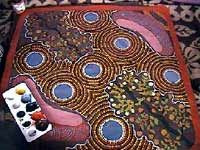 … is a pathway to reconciliation, according to Don, a Noongar artist working in the NAIDOC tent in the centre of Subiaco this week. This was in response to my sharing the information that my church was working with Reconciliation Australia on a Reconciliation Action Plan. I was fascinated with the intricately patterned painting he was working on. “The dots are like people” he said as he daubed a new row of white dots against a tawny red background. It occurred to me what a peaceful, meditative process this seemed. Also central and recognisable were the birds-eye view of adults and children sitting in a circle, telling stories and passing on lore.
Louise, a Wongai woman, was working on a vividly coloured painting. The central pillar of red and yellow flame were bound on one side by an azure blue and the other by a deep brown. Dots were being daubed along the separation of colours. “Its a corroboree I experienced when I was five years old,” she said. I remarked on the vivid colours. She told how a blind fellow participated in some classes she shared as a student. When asked how he could tell colours, he said he could tell by the vibrations. This made sense to me as someone who is partially colour blind and have to rely on a sixth sense when matching the clothes I wear.
This took place in the first lunch hour gathering in Subi this week. Each lunch hour for the remainder of the week will see sharing of Noongar language, gumnut painting, bush tucker and tapping sticks. More important, however, will be the opportunities for passersby just to pause and have a yarn over a spot of billy tea and damper.
Sinner and Saint
Well we got stuck into Romans 7:15-25 this morning.
It prompted Ken (second row on the right) to rise and recite something he knew by heart from G. A. Studdert Kennedy, a WWI army padre:
Sinner and Saint
A Sermon in a Billet
OUR Padre, ‘e says I’m a sinner,
And John Bull says I’m a saint,
And they’re both of ’em bound to be liars,
For I’m neither of them, I ain’t.
I’m a man, and a man’s a mixture,
Right down from ‘is very birth,
For part ov ‘im comes from ‘eaven.
And part ov ‘im comes from earth.
There’s nothing in man that’s perfect.
And nothing that’s all complete;
E’s nubbat a big beginning.
From ‘is ‘ead to the soles of ‘is feet.
There’s summat as draws ‘im uppards.
And summat as drags ‘im down,
And the consekence is, ‘e wobbles,
‘Twixt muck and a golden crown.
G. A. Studdert Kennedy
Battling the self within…
 One of tomorrow’s texts, Romans 7:15-25a, contains Paul’s self-revelation of the battle within. Like all of us, he so often fails to achieve the high ideals that he’s sold on. Woe is him! But it is his faith in Christ that rescues him from despair.
Nevertheless, the reality Paul describes readily attracts the label “hypocrites” upon those who seek to follow the Way. Why? In the eyes of some critics I have heard, it’s because followers can’t ever hope to live up to the kind of selfless love that Jesus inspires. Funny, I thought the word had more to do with its base meaning – “actor” thus “someone who pretends” they are something they are not.
I see Paul and most followers of my acquaintance doing the exact opposite – they are giving us the real deal – not some pious showmanship. The faith in Jesus that Paul says rescues him from despair is not some magic bullet either. It’s hard work focusing attention and awareness on what the desert guides of the third century of the Church called logismoi (literally “self-talk”). Continual focus on the call of Jesus helps us to discern, question and challenge the “self-talk” that leads to multiple defeat.
Whether we are hypocrites within or without the Church, such self-attention is indispensable firepower in the constant self-battles we face.

