Reflecting on Maundy Thursday…

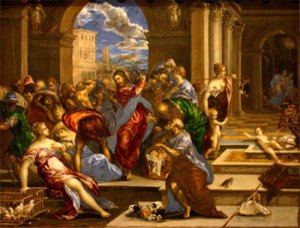
Christ washing the feet of the Apostles, by Gi...
Image via Wikipedia

When I was a schoolboy somewhere back in the last millennium, there were class monitor jobs that were much sought after – cleaning the blackboard, feeding the gold fish, collecting the lunch orders. The one no-one enjoyed was emptying the rubbish. Things haven’t changed that much – I asked the school kids the other day which monitor jobs were popular and which were the least enjoyable. Some tasks have changed in this high tech era (there is an energy monitor), but someone still has to put out the rubbish! The students agreed however, that the least enjoyable jobs were important. Someone had to do them.

I guess foot-washing was on the list of least desired tasks amongst Jesus’ contemporaries. It was the task of the least influential person in the household to wash the dust and animal dung from the feet of weary travellers as they reclined at table.  When Jesus gave one final demonstration to show how the economy of the Kingdom worked by washing his disciple’s feet in preparation for the last meal they were to share, the disciples were somewhat disconsolate. Not that he was calling them to serve, but that Jesus, their teacher and mentor, the honoured one, was performing this lowly task on them!

The foot-washing became an entry point for much that Jesus had to share over that meal – the total giving of himself – reinforced in bread and wine that his disciples would eventually come to understand as a way of recognising when Jesus would continue to be amongst them – in serving one another and in table fellowship.

Some of the lousy jobs ascend to the highest order!

Reflecting on Holy Wednesday…

The woman pours expensive perfumed ointment over Jesus’ head. It was worth about a year’s wages. The critics kick in: “How extravagant!. The money for that could have been used to to feed the poor.”

Jesus defends her against the hypocrisy of her attackers. She knows what he’s about – they don’t. The challenge of his way will be too much for his opponents and they will use their temporal power to be rid of him. In the best way she knows how, she prepares him for burial while affirming her allegiance (is this what really drew the criticism?) “Truly I tell you, wherever the good news is proclaimed in the whole world, what she has done will be told in remembrance of her.”

Having attended on Holy Monday the funeral of my former seminary principal, I reflect on certain associations with this passage on how the good news is proclaimed. This is compounded as I prepare to take the funeral service of a foundation member of my church tomorrow, Maundy Thursday.

One a renowned scholar and shaper of our movement, the other a quiet thoughtful man who preferred to keep in the background. Both “poured their ointment” in their devotion to the way of Jesus and their gentle humility “proclaimed good news” to all within their respective spheres of influence.

Today’s reflection leaves me with a challenge.

Reflecting on Holy Tuesday…

from Wikipedia

The Parable of the Ten Virgins (Matthew 25:1-13) finds its place in the Passion narrative of Matthew’s gospel. As the storm clouds of Jesus’ coming trial and crucifixion loom and gather, it is a reminder to those following the way of the peace of the Kingdom to remain alert and vigilant. Life and its events have a way of catching us by surprise. When awake and aware, we can savour and appreciate the fullness of what is taking place. We can be wholly present and wholly included in the gifts and graces of the occasion. If we are only half-awake or in a state of boredom, we not only fail to catch what others see, we might miss the boat altogether.

The parable is an invitation to savour with our whole being and full range of senses the events of our life, to discern where the Bridegroom is present and calling, to celebrate and not miss out through lack of focus.

Reflecting on Holy Monday…

Palm Sunday Peace immediately leads to confrontation. Jesus returns to the Jerusalem Temple and starts flipping over tables. He declares, “The Scriptures say, ‘My house shall be called a place of worship.’ But you’ve turned it into a place where robbers hide.”

The extortionate practices of exchanging Roman money for Temple money in order to purchase animals and birds for sacrificial rites was a long way from the kingdom of the heart and mind that Jesus was announcing. Such illustrates the continuing tension between Church and State, always an uneasy relationship.

The Church must necessarily don its institutional garb to negotiate with the descendants of Caesar. Sometimes it has sold its soul, and more often it has negotiated salvation for the common good in terms of public health, education and welfare.

This seems to work best when the relationship is collaborative rather than coercive – “wet” rather than “dry”. I note the contrast between the effectiveness of the earlier collaborative Community Refugee Resettlement Scheme and the failing draconian off-shore detention system. I note the Church, having been side-lined, is being called to the rescue as government authorities seek mainland accommodation and services for the overflow.

The Church is always going to be in the situation where it must decide to speak with the voice of the Temple or the voice of the Prince of Peace. When bureaucracy, institutionalism, and the “bottom line” are in the ascendancy, we hear the voice of the Temple. If the voices of compassion, generosity, courage, empathy and grace are to the fore, we can be sure we’ve heard the Prince of Peace.

Palm Sunday Reflections

The entry of Jesus into Jerusalem on Palm Sund...
Image via Wikipedia

I found that local primary school children were very quick to link the reign of the Palm Sunday “Prince of Peace” with the values of the Sermon on the Mount – the term’s lessons on generosity, forgiveness, trust and peacefulness. I recall my adolescent “aha!” experience when linking the Vietnam Conflict Peace Marches with the Palm Sunday rites.

As the drama of Holy Week, the period that begins with Palm Sunday and ends Easter Sunday, unfolds, it is instructive to allow the journey of Jesus to speak into our own journey. The Palm Sunday procession of welcome anticipates the hostility that arises when the implications of spending the currency of Christ’s reign begins to dismantle and threaten dehumanising but familiar, comforting  institutional structures. The irritant must be removed.  So “Crucify!” “Turn the boats back!” “Cut off their payments!”

But, in the meantime, “Hosanna to the Prince of Peace!”

Saturday Shenanigans

The garage sale went off like a shotgun. Hundreds of people moved through and we sold enough to go along way to meeting our mission commitments projections. It was a warm 34º C and the ambiance, free tea/coffee, and the mouth watering sausage sizzle meant that a lot stayed around to chat and pass the time of day. Packing up after lunch sees our siesta type sluggishness transform instantly to energetic and efficient movement. Almost ballet like, trolleys, boxes, tables and chairs waltz around customers looking for the last-minute mark-down. Within the hour – all is packed away and set up for Sunday church service. Of course, the local wag gets the last say at my expense. Grabbing the “crockery” sign, he made a slight change, then stuck it to my study door. I intend to leave it there (for a while, anyway).

The Great Aussie Garage Sale

Today is the day before. An army of volunteers has arrived to strip down the church and set up the trestles. Poetry in motion – they’ve done this about thirty times before. Just as quickly tomorrow afternoon it will be returned to readiness for our Sunday morning communion and worship.

The painstaking stuff is happening now – every one of the thousands of items that have come in must be labelled and priced. There is a steady stream to my door as they ask me to check what is being charged at various on-line auction houses – mostly because we haven’t got a clue.

Tomorrow the local community, hot on the heels of the tinkers and traders, will visit us looking for a bargain. Our mission funding will climb and people will feel tired but happy, energised by the success and feel of a good old-fashioned community fair.

They wonder how much longer age and frailty will allow them to organise and run this annual event – but every year, volunteers appear out of the woodwork and the energy flows.

Time to stop writing now and attend to some minor repairs on some furniture that’s come in for recycling!

Universal truth or ultimate self-indulgence? (Finale)

We survived the panel! The three of us briefly summarised our previous presentations and then fielded questions, challenges and positions from the 40 or so gathered. These ranged from the philosophical to the pragmatic. 90 minutes later we had to draw a line under the energised and enthusiastic public discussion.
If it had an overall flavour, it was hopeful. Amongst the disparate views vocalised, there was a common returning reference point – the Christian hope in Jesus of Nazareth as the prototypical human in whom the human race finds its destiny. The boundaries of arenas in which this truth can be explored are limited only by our imagination and creativity. The conversation, of course, will continue…

Shopping ethically…

… almost requires a graduate degree in economics (another area I failed dismally in at high school). I can participate in Fair Trade campaigns and look to buy what is not necessarily cheapest and what seems to be a better deal to the producers, whether they be local dairy farmers or subsistence plantation workers in Brazil. But I find this Eureka Street article is somewhat daunting, even deflating … until I look at the last sentence: Cheap milk and supermarket ethics – Eureka Street.

Debating Global Warming…

Attribution of climate change, based on Meehl ...
Image via Wikipedia

… is not my favourite pastime as people’s minds are generally made up and difficult to sway. As a flunkee in high school physics I’m somewhat behind the eight-ball when countering climate skeptics’ arguments. What I can argue, however, is human responsibility to care for the planet. When someone gleefully seeks to trump this argument with the observation that the Genesis mandate is to “subdue” the earth (Gen 1:28), I can counter with a Hebrew word study that suggests “understanding” and “walking amongst” as a counterpoint to the violence we habitually associate with the word “subdue” – in other words it carries a benevolent relational flavour.

Anyhow Arguments from Global Warming Skeptics and what the science really says is a most excellent resource for scientific ignoramuses such as myself. I might just point my friendly adversaries there.