Reflections on indigenous medicine…

Failure to appreciate the importance of indigenous belief and practice lies behind the limited success of various Western health interventions in the Third World.

 Cluny and La’avasa Macpherson (Samoa)

So reads this morning’s offering from Native Wisdom for White Minds. As NAIDOC week unfolds I reflect on the various indigenous remedies I have used to keep minor ailments at bay. Recently I have ministered to folk who are augmenting mainstream medicine for serious life-threatening illness with bush remedies that have stood the test of thousands of years – to good effect.

The reconciliation process presumes an openness to sharing wisdom. The heavy handedness of the Northern Territory intervention over recent years has failed to appreciate this. At least now there is an acknowledgement of the need to “consult” with eldership groups in remote communities. Whether this will allow enough space to listen to the Aboriginal wisdom of holistic approaches to indigenous health challenges remains to be seen.

Yarning over dot painting…

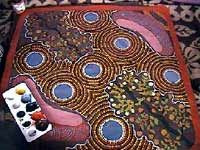
… is a pathway to reconciliation, according to Don, a Noongar artist working in the NAIDOC tent in the centre of Subiaco this week. This was in response to my sharing the information that my church was working with Reconciliation Australia on a Reconciliation Action Plan. I was fascinated with the intricately patterned painting he was working on. “The dots are like people” he said as he daubed a new row of white dots against a tawny red background. It occurred to me what a peaceful, meditative process this seemed. Also central and recognisable were the birds-eye view of adults and children sitting in a circle, telling stories and passing on lore.

Louise, a Wongai woman, was working on a vividly coloured painting. The central pillar of red and yellow flame were bound on one side by an azure blue and the other by a deep brown. Dots were being daubed along the separation of colours. “Its a corroboree I experienced when I was five years old,” she said. I remarked on the vivid colours. She told how a blind fellow participated in some classes she shared as a student. When asked how he could tell colours, he said he could tell by the vibrations. This made sense to me as someone who is partially colour blind and have to rely on a sixth sense when matching the clothes I wear.

This took place in the first lunch hour gathering in Subi this week. Each lunch hour for the remainder of the week will see sharing of Noongar language, gumnut painting, bush tucker and tapping sticks. More important, however, will be the opportunities for passersby just to pause and have a yarn over a spot of billy tea and damper.

Sinner and Saint

Well we got stuck into Romans 7:15-25 this morning.

It prompted Ken (second row on the right) to rise and recite something he knew by heart from G. A. Studdert Kennedy, a WWI army padre:

Sinner and Saint

A Sermon in a Billet

OUR Padre, ‘e says I’m a sinner,
And John Bull says I’m a saint,
And they’re both of ’em bound to be liars,
For I’m neither of them, I ain’t.
I’m a man, and a man’s a mixture,
Right down from ‘is very birth,
For part ov ‘im comes from ‘eaven.
And part ov ‘im comes from earth.
There’s nothing in man that’s perfect.
And nothing that’s all complete;
E’s nubbat a big beginning.
From ‘is ‘ead to the soles of ‘is feet.
There’s summat as draws ‘im uppards.
And summat as drags ‘im down,
And the consekence is, ‘e wobbles,
‘Twixt muck and a golden crown.

G. A. Studdert Kennedy

Battling the self within…

One of tomorrow’s texts, Romans 7:15-25a, contains Paul’s self-revelation of the battle within. Like all of us, he so often fails to achieve the high ideals that he’s sold on. Woe is him! But it is his faith in Christ that rescues him from despair.

Nevertheless, the reality Paul describes readily attracts the label “hypocrites” upon those who seek to follow the Way.  Why? In the eyes of some critics I have heard, it’s because followers can’t ever hope to live up to the kind of selfless love that Jesus inspires. Funny, I thought the word had more to do  with its base meaning – “actor” thus “someone who pretends” they are something they are not.

I see Paul and most followers of my acquaintance doing the exact opposite – they are giving us the real deal – not some pious showmanship. The faith in Jesus that Paul says rescues him from despair is not some magic bullet either. It’s hard work focusing attention and awareness on what the desert guides of the third century of the Church called logismoi (literally “self-talk”). Continual focus on the call of Jesus helps us to discern, question and challenge the “self-talk” that leads to multiple defeat.

Whether we are hypocrites within or without the Church, such self-attention is indispensable firepower in the constant self-battles we face.

Beginning of the Great Revival – a movie review

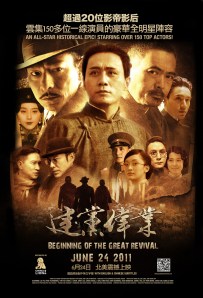
This Chinese blockbuster had only one patron in the large Cinema 4 at the local multiplex this morning. This is the second time in a few weeks where I’ve been the sole customer – it says something about my choice of movies, I suppose!

Large attendances in China, I am led to understand, are manipulated by the temporary banning of other new releases and enforced attendances by schools and other groups. The acting is stiff and the story line disjointed, presupposing knowledge of the details of the historic fall of the last imperial dynasty (1911) and the official birth of the Chinese Communist Party (1st July, 1921). What a coincidence to be watching this in such solitary fashion on its 90th anniversary, for which the film was commissioned!

The ideological irony of such cinematography is highly apparent. Much was made of the education and the student basis of the revolution and the injustice perpetrated by the power brokers to suppress the freedom being sought. Fast forward to Tiananmen Square six decades on and we see the liberated repeating history, but this time as oppressors.

I appreciated a greater understanding of the Japanese role in China during this time and the significance of the Shandong problem in the Treaty of Versailles, something I had been vaguely aware of but not had a complete handle on. But, as I say, one needs to come to this movie with some historical appreciation – first, to be able to fill in the gaps in the jumpy story-line, and secondly, to be able to filter what many would see as little but propaganda.

Won’t give it a score as unfavourable reviews are blocked in China!

Time for something light…

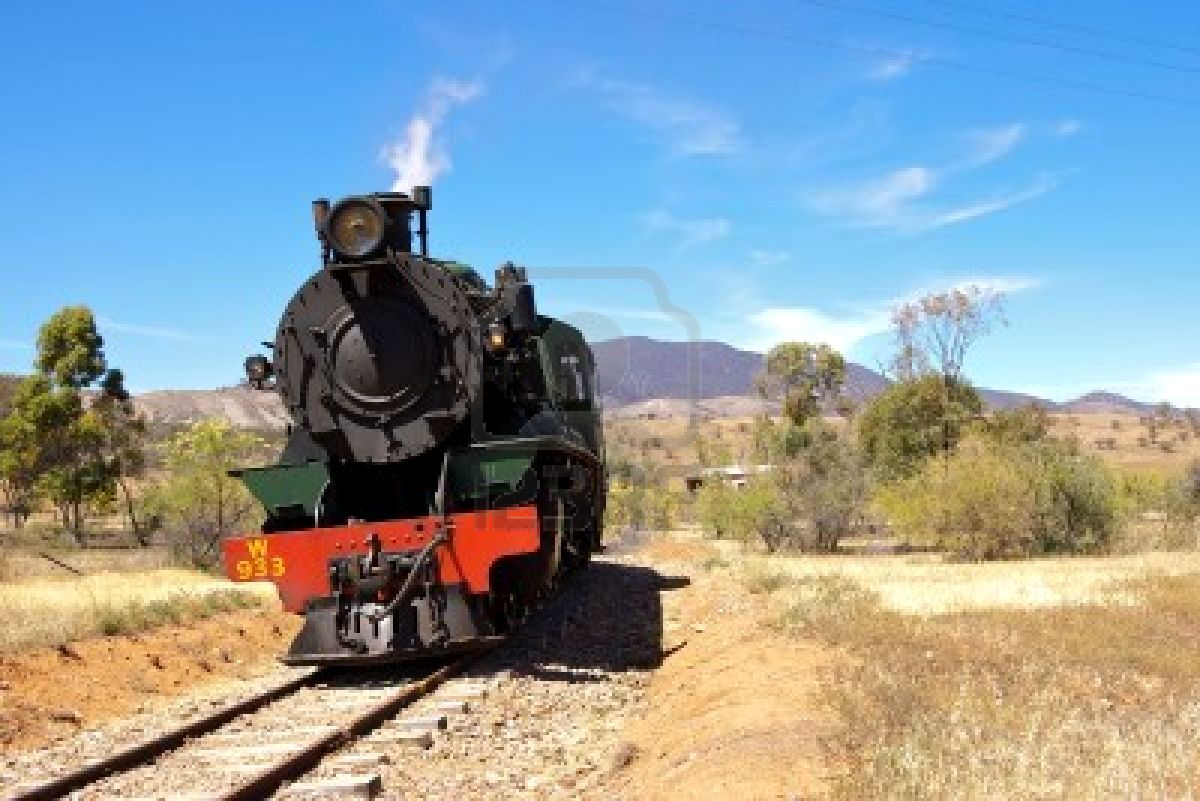
Lawyers for the Department of Transport were busily preparing their case in defense of the charge relating to the station owner’s lost prize Brahman bull. It had gone missing around the same time that the weekly train had gone through and, as far as the squatter was concerned, there was only one conclusion.

The government’s young top gun lawyer swung a deal, and the station owner was willing to settle out of court for half his claim. After he had signed the deal and the cheque was in his hands, the brash young lawyer, proud of his efforts, said, “Well, I can now tell you, off the record, that the driver had dozed off and the stoker was attending to something at the back of the tender!”

The squatter replied, “Crikey, and here was I worried about how I was going to say to the court that my bull came home this morning!”

A Thousand Splendid Suns – a book review

This morning brings the news of a Taliban raid on an international hotel in Kabul. Innocent lives lost have added to the growing tally that amounts to the tortuous agony of Afghanistan. It takes a book like A Thousand Splendid Suns, however, to reveal the complexities of a society that lives with violence almost every day. Tribal factionalism, domestic oppression, international politics, resource exploitation, religious fanaticism and climate extremes – all are potent ingredients in themselves, let alone when mixed together and baked. Khaled Hosseini, also author of the well-acclaimed The Kite Runner and himself an Afghan refugee, traces thirty years of recent history through the eyes of two women almost literally thrown together by arbitrary acts of war. From the Russian invasion and expulsion, civil war, the rise of the Taliban and the American led “war on terrorism”, Mariam and Laila survive on their wits. At the same time, readers are afforded the opportunity to glimpse the aspirations and beauty of Afghan culture, albeit through the fog of war. Beautifully and sensitively narrated.

Report on Children in Immigration Detention


The government proposed deadline for removing children from immigration detention centres is only 2 days away. In March, The Minister for Immigration told parliament all was on track for this to occur. A more recent report by the Australian Government to the UNHRC admits that this deadline will not be met.

ChilOut, a citizens’ group campaigning on behalf of children in immigration detention, has just launched a report into detention conditions on Christmas Island, No Place for Children.

It is chilling reading. Concerned citizens need to keep speaking up. These places are highly inappropriate for the locking up of children whose only misdemeanor is to accompany those fleeing persecution and danger (not that they are not at risk anyway). It is time this mandatory detention regime ended for all asylum seekers.

Solar rocks!

This is a cropped version of :Image:Zonnecolle...
Image via Wikipedia

Even on this cloudy day, the church’s newly installed solar energy system is neutralising what we are currently taking from the grid. (It is a low activity day with just the office and kitchen fridge consuming power). Nevertheless, did you know that one unit of energy will:

  • drive a car (@ 6 litres/100km) 2 km
  • heat 20L of water 42°C once @ 100% efficiency (no losses)
  • heat a room 3.2m x 3.3m x 2.3m by 5°C once @ 100% efficiency (no losses)
  • lift 650L of water 600m (Perth water from Yarragadee aquifer @ 100% efficiency)
  • run a pool pump for 1 hour (750 watt pump + salinator)
  • run a big plasma TV (500watts) for 2 hours
  • run a small TV (50 watts) for 20 hours
  • run a twin outdoor security lamp for 3 hours
  • run a small fridge for 1 day
  • run a pond pump (50 watts) for 20 hours
  • run an electric resistance heater for half an hour
  • run a reverse cycle air conditioner (small – 1 large room) for 1.25 hours
  • run an evaporative cooler (whole house) for 1.5 hours
  • keep an old 60W incandescent globe on for 17 hours
  • keep a 15W fluorescent globe on for 67 hours
  • keep a 7W LED globe on for 143 hours
  • keep a 15W standby load standing by for 67 hours
  • collect, produce, deliver and treat (as waste water) 1000L of Perth drinking water
  • add 1kg of greenhouse gas to our atmosphere if obtained from fossil-fueled electricity as our coal and gas fired power stations provide
  • add ~250g of greenhouse gas to our atmosphere if obtained from natural gas
  • be produced in 1 hour by full sun shining on a 1kW photovoltaic system (with near zero greenhouse gas emissions)

Fallout from today’s harangue

Contemporary stained glass window at the Melki...
Image via Wikipedia

Well, no-one said that preaching on Genesis 22 would be easy – YHWH tests Abraham’s faith by calling on him to sacrifice his son Isaac then stops him mid-strike of the knife.

The story contains all the things that shock and offend modern sensibility. We find it almost impossible to get beyond the ancient patriarchy, child sacrifice, and seeming divine capriciousness  that are the hallmarks of this narrative.

We either flee from this story or fight it hard. Its so-called testimony to Abraham’s “blind faith” seems disingenuous. Better to strive with the human dilemma of long awaited realised hope challenged by unimaginable choices and a trust that comes through struggle. These are themes that find expression in stories people have told me this week and which are present in the Abraham story.

This morning I told a story of a preacher who, in wrestling with this text, found nothing beautiful and uplifting in it, and could only weep before the congregation. In doing so she gave them permission to embrace their own lament and find a place where their faith spoke of providence. Indeed this was good news.

Feedback over coffee was varied and vigorous. There were those who wanted to defend Abraham as someone who was on a learning curve. There were others who felt a connection with the struggle and who could begin to name the tensions between hope and ultimate trust, even when facing some significant blows.

Maybe not much was resolved, but there was some significant engagement.

In the end, Abraham and Isaac on Mt Moreh is a Hebrew story – and such narratives are invariably open-ended, inviting us in. Maybe that’s why they’ve been around for a long time!