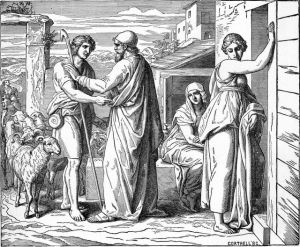
Holy skulduggery

By the end of Genesis, one could be forgiven for thinking that the Divine only favors scoundrels. Jacob, already a fugitive from the consequences of fraudulent behaviour in impersonating his brother, Esau, is outdone by his prospective father-in-law, Laban, who passes the less desirable daughter, Leah, off as the promised bride, Rachel. Ultimately, Jacob scores both, so he and Laban can congratulate each other in their mutual trickery and call it a day as far as kicking off one of those interminable family feuds.

This is only the climax of a great intra-clan drama that has unfolded over the middle 23 chapters of the first book of the Bible! Dig further back for scandal, intrigue, one-up-manship, near infanticide and cruelty since Abraham began his great journey. Yet the overall message seems to be that a Divine plan is unfolding through this whole morass of misanthropy.

A conundrum for those of us who defend the inspired nature of the holy text and also for those who dismiss the Genesis narrative as fairy tale. Neither party can fall back onto some idealised vision of human nature – because there it is – in your face – full and rough and gutsy! On the strength of these stories the Divine might have abandoned this universe long ago – but the testament is that not only the presence, but the purpose, of the Holy One is to be discerned in the unfolding drama.

Getting antsy…

Adrenaline
Image via Wikipedia

… two weeks leave are drawing to a close. I’m back on deck Monday and getting fidgety and restless. Even wrote my annual report today because the deadline’s tomorrow, though I could have gotten away with waiting until Monday. Funny thing is I now feel quite relaxed now that the report is out of the way – as if there’s one thing less to do when I’m back. Maybe, the old adrenaline factory was just getting in a trial run to see if it still works!

When the public is accountable

This article illustrates well the burden of my post yesterday: Consumers rule in Murdoch’s evil empire – Eureka Street. We (the general public) have far more access to the tools of journalism than we used to. No matter how amateurishly we wield them, the results carry great impact – for good or ill.

The birth earlier this year of the Arab Spring with all its risk and promise was largely eased by popular access to Twitter and the web. For the first time, there is a hint that power is capable of shifting from despotic rule to the hands of the people. I sat up way past my bedtime last Tuesday morning to watch the Murdoch appearance before the British parliamentary committee, and I concentrated hard on the content of the line of questioning and the answers.

To read the next morning’s papers, however, was to be led to the belief that the only thing that happened of substance was the foam pie incident. Pundits suggest that it was the immediate prolific tweeting of the so-called “Twitterverse” that swung editorial decisions to focus on this “exciting” piece of vaudeville rather that the boring and exhausting detail of history in the making.

We, the public, it appears, got what we deserved. Of course, there are a range of sources from which to gain the detailed journalistic analysis that we might seek. But so much sand to sift to get to the gold!  In the meantime, public opinion is swayed and shaped by the banal and deliberately inaccurate (think Australia’s current carbon tax debate).

Manufactured consent


What a worthy phrase to describe the juggling act between advertisers, politicians, the public and the media. Worth reflecting on in the current focus of interest on the Murdoch empire. Justin Glyn’s article Getting the media we deserve – Eureka Street is something to chew on. To what extent does one participate in the “consent” that leads to the daily offering on the newsstand? How vigorously do we question, challenge, and research the assumptions that select what is newsworthy and how its presented? What courses in journalism do we need to take to even understand how and where to begin?

In the face of the overwhelming nature of such questions do we retire into defeated cynicism, seek to pick up engaged skepticism or adopt selective activism? Or is it a mix of all of these? Just wondering!

Smiley day today

What else can you call it when this stares at you from the bottom of  your coffee cup in the mall?
One can tell that the effect of some annual leave is setting in when…
… you don’t mind traipsing around clothing shops with your SO
… you can relax when standing  in a long Medicare queue
… while standing in the same queue you can notice and appreciate the sheer enjoyment of a four year old’s interaction with his father who is carefully giving a lesson on telling the time.
… You’re not fitfully looking at your watch wondering if you’re going to make the next appointment on time.
… you can hear a phone ring and not rush to answer it.

And there are a few days to go yet!


Is atheism boring?

This was one proposition on Q&A last night – and it wasn’t posed by a “religionist”! The politician-free panel comprised a spectrum of faith and non-faith stances and there was a full ranging discussion in which each panelist acquitted themselves respectfully and well. Interaction was free and relaxed, even when touching on the thorny issue of religious education.

Well worth a look at http://www.abc.net.au/tv/qanda/vodcast.htm

The God complex…

… is alive and well, according to economist Tim Harford.  It’s the idea that problems can be reduced to the kind of manageability that can be addressed by a single series of solutions – all within the province of a particular discipline. Far more effective, standing the test of time, and far more prolific in everyday life, is the humble trial and error approach.

As a bumbling, manufacturer’s manual avoiding,  “let’s see if this works”, negotiator of 21st century challenges, both technical and social, I am encouraged by what he says.

Here’s his talk: Tim Harford: Trial, error and the God complex | Video on TED.com.

Stand-up comedians at prayer

Wagging it from church while on holidays, we turned to what other waggers often confess to me – that’s right “Songs of Praise“.
A stand-up comedian was being interviewed on the role of her faith as she laboured on a demanding routine of gigs. I was intrigued – I see many similarities in our respective crafts – gauging an audience and holding it, ascertaining whether material is “connecting”, knowing when to finish – and yes, dealing with the occasional heckler!
She spoke of the place of the ministry of the arts – something that has been on the periphery of my particular tradition but which is now enjoying a more central place as different Christian traditions blend and celebrate rich diversity.
The court jester, in medieval times, was often the one with keen powers of observation, witty commentary and sage advice. No wonder the sovereign kept him handy when the intrigues of court became dangerously complex.
Yep, could be a place for some sound stand-up comedy in church!
And if any members of my congregation are lurking on this, no promises – I’m just thinking out loud!


Seabird…

… is the name of a nifty little coastal hamlet just off the new Indian Ocean Drive. We ducked in there to grab a bite on our way home. A hefty sou’wester was blowing, but the place seemed so quiet and peaceful. The general store come post office come cafe does a friendly steak sandwich and cappuccino. Apparently this used to be the inaccessible place up the north coast where you could go and build a beach shack from corrugated iron and driftwood. Not any more, although you can still see some relics in the sand-dunes. Real estate is just as expensive here now as in the big smoke. It won’t be long before places like Seabird are caught in the urban sprawl.