Spanning pain and love


From Wikimedia Commons

Romans 8:1-27 is its own commentary

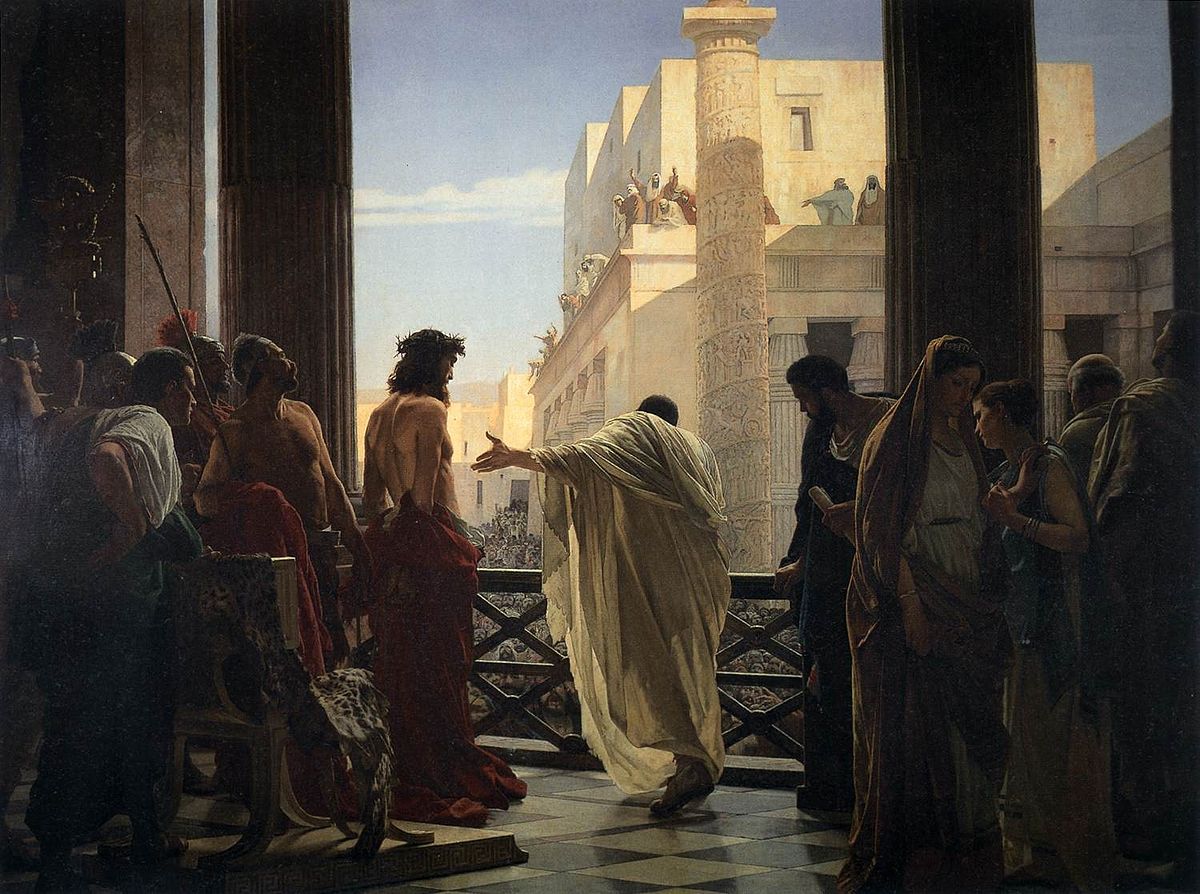
It speaks cosmologically of the restoration of all creation and how the followers of Christ are called to emulate him in, as N.T. Wright says, standing “between the pain of the world and the love of God,” not as a wall or barrier, but the span of a bridge, or a linking arm.

This ultimately is what the cross of Christ stands for. It is transformed from a shameful and cruel instrument of execution to a symbol of transforming love.

Zesty Zeke…

Ezekiel's vision from Wikimedia Commons
Ezekiel’s vision from Wikimedia Commons 

When the molasses are thick, what keeps some folk swimming while others succumb?

Ezekiel seems quite upbeat in the midst of most depressing circumstances. He is a welcome guide as we tread the heavy Lenten journey to Jerusalem and the cross. Todays text, Ezekiel 37:24-28,  holds out to exiled Israel a beatific vision of a restored and unified realm. No wishful thinking or trite optimism here. Ezekiel grasps the desperate reality of his current circumstances. Rather than sink, however, the troubles become a foothold for hope.  His grasp of the faithfulness of God’s intentions is so strong he can only see the fulfilment of a process towards the realisation of “rightness.”

Victor Frankl observed similar phenomena as a survivor and observer of the Holocaust, resulting in his well known “Man’s Search for Meaning” and the practice of logotherapy.  A relentless sense of purpose can see a person survive the most dire situations. Zesty Zeke helps lead the way.

The next blockbuster?

Ezekiel by Michelangelo - from Wikimedia Commons
Ezekiel by Michelangelo – from Wikimedia Commons

Now that Noah has wowed the big screen, will Ezekiel be far behind?

Ezekiel was a multi-media entrepreneur. As our current Lenten guide, he uses the stuff Hollywood loves to use to relieve the burden of getting his message across – the triumph of God’s love expressed through people so oriented in a desolate and barren landscape. Yesterday it was the vision of reversed decay as a battlefield of skeletons is revived to full vigour and strength.

Today is a simple object lesson performed with two sticks joined together, symbolising the re-unification of a divided people. See Ezekiel 37:15-23.

The over-riding themes and visions of Ezekiel point to the power of God’s Spirit to revive, enliven, embolden and inspire when all around seems hopeless and in despair.
The big screen seems to reflect the mood of the age.

Some producer somewhere may well be contemplating an Ezekiel blockbuster.


What dry bones hide…

40 daysAs our Lenten journey draws closer to climax, we find the path winding through Ezekiel’s valley of dry bones. We don’t have to look far around us to see our own dry bones… empty promises, bored transactions, indifferent encounters, and defeated dreams.

We are called to Ezekiel’s vision that ”even these dry bones can live”. Somewhere the Spirit blows and is waiting to come and enliven what is dead and barren. Somewhere there are people who still love and care and are driven by the will to be part of society’s relentless push for transformation. Followers of the Way of Christ remain focused on such a vision and are alert to the signs of life and vitality that dry bones hide. May Ezekiel’s vision inspire us today…


Shining light into dark places


from Wikimedia Commons

Government leaders need to be careful of hubris when talking about requiring the community to shine light into dark places.

They might find someone has already claimed that function. On a well-noted occasion, it resulted in clear sight and clarity of mind for someone unintended by those who believed themselves in charge.

Those ruling held an inquiry, calling forth witnesses, including the now sighted man’s parents, who felt the weight of the inquisition and deflected the questions that were being asked – unfounded questions based on faulty suppositions, seeking scapegoats and blame.

When you throw the light into dark places, one cannot “un-see” what is seen.  Be careful when you shine the light into those shadowy corners.

The story is in John 9:1-23. It’s the Gospel set for this Sunday in all churches that follow the Revised Common Lectionary. More tomorrow.

Mutual Submission


Agape Feast - the Eucharist models mutual submission for the sake of Christ - from Wikimedia Commons
Agape Feast – the Eucharist models mutual submission for the sake of Christ –  image from Wikimedia Commons

Ephesians 5:21-32 is one of the most manipulated texts for those misguided enough to champion male domination in marriage. Many camels swallowed here while straining at gnats. The kernel of Paul’s argument is mutual submission to one another out of respect for the Way of Christ. No room for misogyny and domestic oneupmanship here. The principle can be extrapolated into our whole network of human relationships.

This week’s parliamentary debate around “freedom of speech ” would be a non-event if mutual submission to one another was to the fore. The discussion wouldn’t even be necessary!

What are the marks of mutual submission?

Let’s try:

  • preparedness to really listen to the other
  • readiness to speak our mind clearly, honestly and respectfully
  • willingness to seek mutual goals and solutions
  • a heart for the well-being of the other

That would be a good start in any setting – be it family, work, or politics.


Light’s offspring

The national discourse does not currently inspire much hope. Hope is to be found in the values espoused by such passages as Ephesians 5:1-14, today’s Lenten text. If one is patient enough to sift the ancient language and thought forms, one discovers some evocative phrases.

For example, the exhortations to live as “a fragrant offering” and as “children of light.” These call to the fore some senses that are often secondary to the way we habitually process thought, but now the senses of sight and smell become primary as we imagine our way through the confusion and cacophony of the claims of contemporary life.

How might followers of the Way sniff their way through the multiplicity of aromas and stink of daily life. Even more, how might they allow the all subsuming aroma of self-giving to the greater vision of God’s all-consuming love to affect daily conversation and action?

How might followers of the Way reveal themselves as offspring of Light in the dark corners of our community conversation?

Improving Hansard…

from Wikimedia Commons

Behold a life coach’s pep talk: Ephesians 4:17-32

While our contemporary politicians fight to enhance the right to insult and offend, the writer to the Ephesians appeals to those practices and behaviours that enhance our life together. If there’s a handle to grab, in this wall of text, you can do no worse with this one: Let no evil talk come out of your mouths, but only what is useful for building up, as there is need, so that your words may give grace to those who hear. (v29 NRSV)

Imagine if Hansard was remarkable for this fact alone!

Seeing differently…

Samuel anoints David from Wikimedia Commons
Samuel anoints David
from Wikimedia Commons

What happens when a popular and influential leader loses his/her way? The MSM (MainStream Media) and alternative sources are forever keen to assist our views – either manipulatively or informatively!

Powerbrokers know when to make their move, no less the prophet/king-maker Samuel. King Saul was on the nose, and secret arrangements for his succession became necessary. It all sounds too familiar given events in our national parliament over recent years. There is nothing new under the sun.

Yet Samuel now takes on the guise of our Lenten guide. Even in the murky world of politics, he invites us to see through different eyes as he selects the next candidate for Israel’s monarchy.  Through Samuel’s selection process,we first hear the well known words, “…the Lord does not see as mortals see; they look on the outward appearance, but the Lord looks on the heart. ”

The story is in 1 Samuel 16:1-13

David, Samuel’s secret candidate, was by no means unflawed, but he became the epitome of the aspirations of his people, so much so that the messianic dream was built around his reign. It only needed Jesus of Nazareth to give it complete expression.

But for now, Samuel invites us to look beyond popular wisdom and convention and to see as he sees.

Attitude of Gratitude

From Wikimedia Commons

Today’s Psalm 95 begins on a high note but descends into minor chords of melancholy.

How odd!

Songs of praise are traditionally upbeat, giving expression to high emotions associated with relief and exuberance, assured of the benevolence of a Creator who has offered provision and protection even in tough times.

The composer of this Psalm however, remembers that the Holy One is not impressed with such gestures. Lives, attitudes and actions in the world need to be consistent with praises in the Temple.

His sombre plea as his song closes is that the people do not repeat the bitter mean-spiritedness of their ancestors who complained in the desert, even though God’s provision and protection were daily evident.

Strive to live an attitude of gratitude could well be his meaning.