Multiverses and God

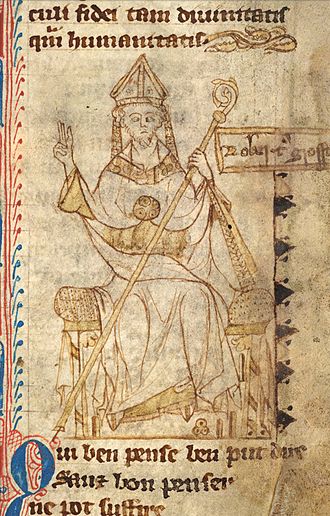
330px-Grosseteste_bishopThe lead story in New Scientist (22 March 2014) explains the physics behind the concept of multiverses and how such an understanding might be enhanced by the discovery that week of a method of peering even closer into the slivers of a second after the big bang . My poor head spun as I tried to get my mind around unfamiliar patterns of seeing, but I gather that observable distortions of wave patterns are now known not to be caused by gravity of other galaxies or telescope errors.

Accordingly, the pattern of these gravitational waves strengthen the idea that the universe is constantly giving birth to smaller “pocket universes”within an ever-expanding multiverse.

So where does one begin to think theologically about this?  I looked no further than the same issue to discover that a 13th Century theologian, Robert Grosseteste, had written a treatise, De Luce, about the properties of light. “The work built on Aristotle’s idea that the motions of the stars can be explained by embedding Earth in a series of nine concentric spheres that make up the universe.” He proposed that the universe began with a flash of light, pushing everything out from a tiny point to a big sphere. He assumed a coupling of matter and light, with the density of the matter affecting waves of “inwardly propagating matter” thus resulting the form of the nine spheres.

Applying modern mathematics, a team from Durham University modeled Grosseteste’s process and found the multi-nested universe he postulated – thus also supporting the possibility of a multiverse.

Science and theology in apparent collusion in ways undreamed of in our post-Enlightenment era. Exciting!

A Million Year Mind

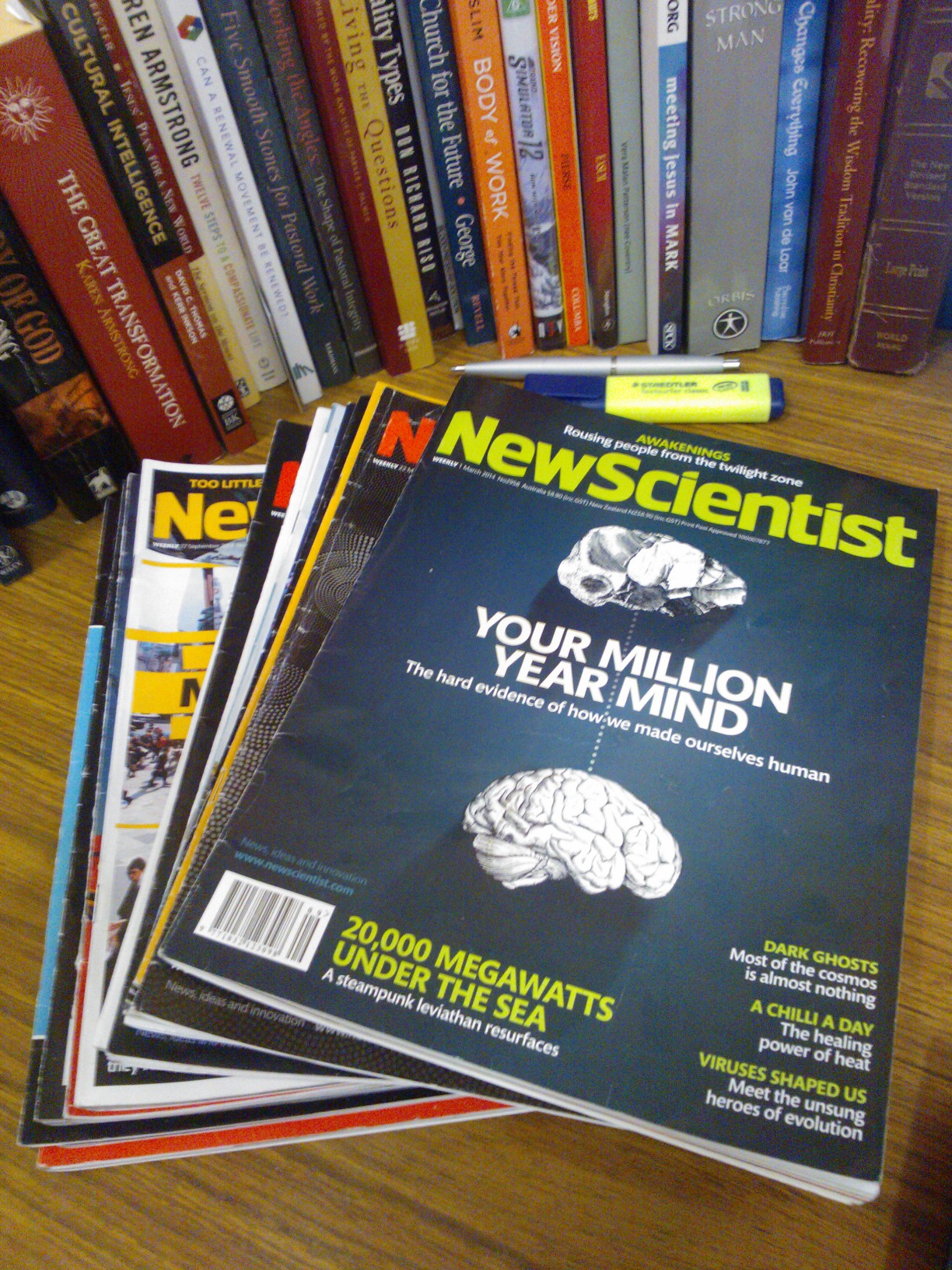
brain1Let’s kick off the Physicists & a Parson Parley series with a look at the lead article in New Scientist (1 March 2014) – “Your Million Year Mind.” (I keep catching myself reading it as “your million dollar mind” – how conditioned am I by the prevailing culture of economic rationalism?)

In summary, the piece explores how the measurable development of stone tools enables us to “look inside the heads” of those who made them. Drawing on research from Bruce Bradley’s Learning to be Human Project, the article tracks the progression of neural pathways that control basic dexterity and motor control through to advanced language, visual imagination, hierarchical thinking and improved memory. In short, it is a fascinating story exploring our cognitive evolution.

As a poetic parson, my mind naturally wanders to other tangents, looking for points of connection (apparently I’ve been able to do this since the days of Homo heidelbergensis or 600,000 years). The emergence of a capacity for visualisation and symbolism must have given rise to the first apprehensions of gods and the forces, visible and invisible, behind the universe. In western traditions, these emerge in a sophisticated form in creation stories like the Mesopotamian Gilgamesh Epic, refined  by the Hebrew post-exilic reflective correction that we know as the first chapter of Genesis. It is the difference between experiencing existence as chaotic and meaningless or ordered and purposeful – an ongoing discussion for our own times.

The documented order of the evolution of the neural pathways of the human brain in this project are not inconsistent with the ordered purpose of the Genesis creation story, which remains open-ended, with humanity, male and female, climaxing the narrative as co-creators and stewards with God.

One wonders what the next 600,000 years will bring.

Physicists and a Parson Parley

New ScientistThere’s a heap of New Scientist magazines on my desk. Scientists of various disciplines, some at the peak of their field, have always been present in the various faith communities I have served. To varying degrees, conversations between faith and science have been mutually rewarding. All have eschewed the alleged dichotomy advanced by fundamentalists of either religious or atheistic persuasion.

Back to those magazines which, I confess, attract and, at the same time, daunt me. As an arty type, I never did well in maths or any of the sciences at school. One of my congregants faithfully passes these magazines on to me, so I feel I should engage them. My intention now is to feature some conversations from topics raised in these magazines. Perhaps, following some decades of dialogue with my physicist parishioners, I can bring some insights that I would not have been capable of earlier.

A neighbouring colleague is a scientist who came to faith and ministry mid-career. She has sometimes mentioned the trepidation of that journey. So here’s me, having reached the notional age of retirement, attempting to do something similar in reverse!

Blogging 101: considering a blog title & tagline

After several years of blogging in fits and starts, I’ve signed up for the basic course at WordPress Blogging 101. Today’s exercise is to consider my blog’s title and tagline and whether its time to change it.

I quite like the current title and find it quite suitable for my purpose. It carries a question within it that reflects my ambiguous nature. Does he really mean “wondering” or perhaps “wandering” – a gift to my critics who have, at times, accused me from wandering off course. What glee!

Of course – it is “wondering.” My contention is that when we arrive at a place in our pilgrimage where we cease to wonder, we cease to live. And if this means “wandering” around before returning to things you are certain of, so be it.

The tagline may need some attention: the ramblings of a perambulent and often distracted sojourner. It’s possibly a bit obscure and loquacious for a casual reader.

It doesn’t point the way to specific content and leaves the field quite open. I am asked about my audience – who am I trying to attract. The answer is anyone who stumbles upon it and cares to linger. I guess I’m the first audience, as this is where I think out loud. Sometimes a reader will open some dialogue, and this is great. The blog is kind of an open journal that I don’t mind people reading, but equally, I don’t mind if they don’t. So I might keep the tagline too, but am open to suggestion.

Possible alternatives?
the mutterings of a curmudgeonly old sociopath
thinking out loud on life’s mysteries
musings of a muddle-headed wombat

None of these really appeal to me! So no change at present.

The twelfth day of Christmas… Epiphany!

Magi by Brian Whelan, This work is licensed under the Creative Commons Attribution 3.0 License.

Tradition usually has the visit of the magi with gifts of gold, frankincense and myrrh on the final day of Christmas, heralding the season of Epiphany, the celebration of a manifestation, that in Jesus, all that needs to be known about God is revealed. The gifts of these 12 days comprise this epiphany. The challenge now is for someone to set them to the metre and music of the familiar “Partridge in a Pear Tree” carol which has its own debated symbolism.

On the twelfth day of Christmas, God gave humanity:
12 Epiphany
11 Auld Lang Syne – connection
10 Word dwells among us
9 Deep wisdom
8 Fresh start
7 Visionary hope
6 Cosmic outlook
5 Unconstrained love
4 Thankful hearts
3 Wedding clothes
2 Completion
1….and peace on earth to all.

Now there’s a start!

On the eleventh day of Christmas … Auld Lang Syne

The gift of connection. The final days of Christmas coincide with New Year celebrations and reflections. As the calendar turns over to the new year, Robert Burn’s Auld Lang Syne rings out through the gathered crowds. It is a song of connection and Christmas is about God’s ultimate gift of connection in dwelling amongst us in Jesus of Nazareth, who became known as the Christ for this very fact.

Scotland has sent an invitation to the world to join them in a universal singing of Auld Lang Syne. You can see details here. Our congregation decided, in the name of connection, to join in, and they are sending this video clip to (hopefully) be included.

The tenth day of Christmas… Word dwells amongst us

Nativity
“Adoration of the Shepherds” by Gerard van Honthorst, 1622, Public Domain

Sometimes a gift takes more than one day to unwrap, so we continue to reflect on the implications of deep Wisdom (the Word) taking on flesh in Jesus of Nazareth and dwelling in our midst. A gift is not always well received – look at how busy the “Returns” counter is at the Boxing Day sales. John’s Gospel tells us “… the world did not know him…” and “… his own people did not accept him… ”

Unwrap and engage the gift completely and – voila! – “… to all who received him, who believed in his name, he gave power to become children of God…”

That’s what happens when the Word dwells among us and we pay attention!

On the ninth day of Christmas – Deep Wisdom

Personification of wisdom (in Greek, Σοφία or Sophia) at the Celsus Library in Ephesus, Turkey. photo by Radomil talk 21:21, 30 November 2005 (UTC) http://creativecommons.org/licenses/by-sa/3.0/

There is a deep wisdom behind the universe. It is beyond knowledge – knowing how things work. It is beyond mysticism – trusting how things work. Yet it involves and transcends both. In the Jewish and Christian traditions, this deep wisdom has a central focus. Hebrew tradition personifies wisdom as a woman practical and present at Creation, most famously portrayed in Proverbs 8. The epiphany of wisdom here  earthy, pragmatic and full of common sense. She became known in the Greek tradition as Sophia, and there is a strong strand in traditional Christianity alluding to the femininity of Wisdom.

John’s Gospel reflects its Hellenistic context. Here the more abstract term Logos – (reason) comes into play. It is the instrument through which the universe comes into being and is identified as being both with/of God and, indeed, God as well. The Logos took flesh and is recognisable in Jesus of Nazareth. Hence, Jesus is revered as the Word, the wisdom, of God. Both Sophia and Logos refer us to the deep Wisdom behind all things, and they are today’s gift.

On the eighth day of Christmas … a fresh start

Why is New Year’s Day so evocative of lists to improve and enhance our personal and communal living? Life is comprised of cycles, and somehow, deeply embedded in our collective psyche, a New Year (always capitalised!) marks that part of the cycle where we take a deep breath and start all over again. The gift of Christmas’s eighth day underlines this in the text from Ecclesiastes 3:1-13 with its sage exhortation to attend to the seasons and not sweat the small stuff! And if you’re not inclined to look it up, you can hear the late Peter Seeger, age 93, get his audience to help him pump it out.


On the seventh day of Christmas… hope that envisions a new heaven and a new earth.

800px-Justice_statueThis morning another eight Christian leaders face court in Perth on charges of trespass, a result of advocacy for asylum seeker children in the face of political intransigence and obfuscation. A particularly disturbing feature of the incidents of these arrests was the decision by the police, for the first time, to introduce strip-search procedures, evidently designed to intimidate and deter further protests. A year of like protest actions has turned a dark corner. However, those charged would still direct our thoughts to those languishing in detention in the tropical hell-holes of Manus and Nauru, where minors fear for their lives and remain devoid of hope. Christmas has something to do with the climax of the apocalyptic terror in John’s Revelation where a new heaven and a new earth are revealed. Revelation 21:1-6 is replete with prophetic imagery of hope realised. For two millennia, it has sustained the hopes and aspirations for followers of Jesus, the Alpha and Omega, contained for a while in a vulnerable infant. It is the vision and hope of a redeemed society that drives the thrust for mercy and justice behind the #lovemakesaway advocates who stand before our land’s magistrates. Such a hope, such a vision, is a gift of the seventh day of Christmas.