Breakfast with BJ

gmp-breakfast

Part of the Saturday morning crowd with BJ and Chipo Mpofu (right)


Folk from over half a dozen Perth western suburbs churches gathered for an early Saturday morning breakfast with BJ & Chipo Mpofu.

Under his role as President of World Convention of Churches of Christ, BJ opened the proceedings with a celebration of the Lord’s Supper, a reflection of the anticipated Great Communion event on 4th October commemorating 200 years of the Stone Campbell movement around the world.

Later, BJ addressed the gathering, thanking them for their support of aid projects in Zimbabwe, where he and Chipo play an important role in leading and encouraging churches through ministry training and community development, including the negotiation and distribution of emergency aid.great-communion3

Access to clean water has played a crucial role in protection from cholera, particularly in rural communities, BJ said. One had the impression that, while media reports from Zimbabwe highlight real and desperate problems, there is a positive will and strength within the churches to improve living standards and rebuild sound community structures.

BJ and Chipo, under the sponsorship of Global Mission Partners, continue their busy itinerary in Australia and then in the USA over the next two months.


200 years

Things are beginning to happen amongst the individual and diverse communities of what began to emerge 200 years ago as the Restoration Movement and ended up under a plethora of monikas covering most of the countries of the world – variously Churches of Christ, Disciples of Christ, the Christian Church, churches (small c) of Christ. This movement for Christian unity and church restoration has a chequered history, sometimes punching above its weight in its impact on the wider church scene, but often falling into the bitter divisiveness its origins abhorred. This is us warts and all!

This year sees calls from all streams of the movement to a rediscovery of our common roots and the passion evoked in the hope of a transformation of current vision. Study groups, web-sites and publications are beginning to appear – all with good stuff. It remains to be seen whether this anniversary will have any effect on our self-understanding as a whole. Will it pass like a summer storm with a bit of dampness but little lasting effect? Or will we see some drenching, saturating rains that will bring fresh, verdant growth and a fecundity of wisdom and understanding to contribute to the wider church and the world at large?

What might be possible in this year of  The Great Communion?

Looks like the South Australians are kicking things off with a series of provocative essays.

On Saturday, we host a breakfast attended by B J Mpofu, Zimbabwe Churches of Christ leader and President of World Convention of Churches of Christ. Responses from a few churches are starting to come in.   Maybe a cloud, the size of a man’s hand, is beginning to form on the horizon.

Chaotic hotels of radical hospitality

Disasters bring out the worst and the best in us. Have a look at Mark Riessen’s blog for a discussion and an exhortation. There is talk in the back rooms asking how local church communities can best respond to disasters that occur on such a large, gut wrenching and life altering scale. Disaster response strategies have their specially trained support personnel for community members and service providers and these include chaplains, but what about the otherwise unaffected who simply want to do something practical apart from donations and prayers? If you’re part of the affected community, (and who is unaffected now?)  nothing can go past the “incarnational” presence, the shoulder to cry on, tle listening ear, and the practical thoughtfulness that can take respectful and non-intrusive initiatives.

Last night, I sat with a group of people and watched “The Spirit of St Paul’s” – on a DVD brought back by a traveller. It concerned the actions of the people of St Paul’s Chapel in the vicinity of New York’s World Trade Centre in the aftermath of the attack of 9/11. Ther church community became a “chaotic hotel of radical hospitality”, breaking all its rules and preconceived notions to respond to and provide what was needed for a devastated parade of rescue workers and survivors. Many found comfort, support and the ability to go on because of what ordinary people provided in the aforementioned “incarnation” of practical compassion. Maybe this is the stance local church communities should have at all times. Perhaps it’s those that do that come into their own when extra measures are called for.

Bushfires

Fire is one of the banes of this country. The nature of our landscape and weather patterns provides an ogoing banquet of fuel for this red marauding beast. Nevertheless, we live with it and many, over time, have died with it. It has ever been in the background of my awareness. As a kid I most enjoyed holidays with family in the Adelaide Hills. You could see the escarpment from our house down on the plain. Scarcely a year went by when you could not be aware of  the smoke on the horizon and we would wonder if the fires were “anywhere near Uncle Ron’s place.” I recall leading a youth camp where fire from an exploding kerosene fridge leveled the kitchen and main hall in five minutes flat. Fate or fortune or providence had us all down at the river at the time. One bushfire we scarcely noticed was the one razing the mountain behind the Ainslie manse the day we brought our infant son home. We were somewhat preoccupied that day. The years we lived in Bridgewater – again in the Adelaide hills – had us well tuned into the fire season with our action plans ready to go if needed. My sister’s place a few ridges away came dangerously close to being burnt out one year. 

The Victorian fires this weekend have a strange “here we go again” feel. Amongst the angst and the despair that is in the air, even on the West Coast that is as far from the fires as you can get on this big island, there is a sense of resignation. You can fight nature, but you can’t master it.  One thing you can do is to tap into the community spirit that rises above the devastation and loss and seeks practical ways to give muscle to hope. Not Pollyanna “everything’s going to turn out alright” hope – but the kind that grants a due and respectful acknowledgemt to the grieving process that must yet unfold, a sifting of memories from which can be extracted the values and inspiration that have survived, and using these as building blocks for a new thing.

We’ve had a lot of experience in this land of doing just that. There’s no reason why it won’t happen again in the months and years ahead for the communities destroyed in the weekend’s fires.

Riding the Atheist Bus

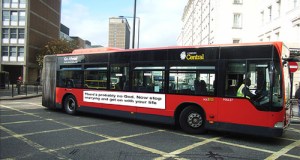
bus-mockupThere’s a little bit of a storm in the Old Dart over the  British Humanist Association advertising campaign that has a fleet of London buses carrying the slogan “There’s probably no God. Now stop worrying and enjoy your life.”  See BBC news story here. This has sparked off a blog war (based on responses such as here and here) to which I am loathe to contribute energy, but because I have been asked to comment, here I go.

The reason, I suppose, I lack energy for the debate is because it is predicated on the false dichotomy between faith and reason. Both sides of the debate, having driven each other to the stockades, are to blame.

One side emphatically concludes that the integrity of logic and rational process excludes claims based on faith (although the bus campaign tempers the emphasis of this assertion with the word “probably”). To them the idea of God has to be proved scientifically to be viable.

On the other side, many defenders of the faith play into the hands of their opponents by responding emotionally, defensively, and from a limited and little supported assertion that faith eclipses reason – a puzzling  stance that is unsupported by the weight of Christian scholarship and tradition.

I hold the position that faith is eminently reasonable, and this is perfectly consistent with that part of the Christian spectrum that has nurtured and formed my thinking and being over the years. For those whose faith is informed by reason, there is some common ground for dialogue with those whose reason leads them to an anti-faith stance. To borrow from a recent image, this common ground forms the “no-man’s land” which invites a Christmas truce to be declared so both sides can come out of their trenches and meet each other beyond the labels with which a polarised warfare approach has a vested interest.

It is in the spirit of informed and respectful dialogue that those called to always be  “prepared to make a defense to anyone who asks you for a reason for the hope that is in you…” (1 Peter 3:16) can contribute to a worthwhile discussion.

So, while I have little energy for an epithet hurling debate, I have plenty for a good well-rounded, respectful – maybe even a spirited – discussion!

“Illegals” no more!

Media Release from SafeCom

West Australian Daily sets national tone on ‘Illegals Tag’

“The West Australian, WA Newspapers’ flagship, is setting the tone for the nation in the new year by firmly committing itself to scrutinise and edit Letters to the Editor so no references to “illegals”, “illegal immigrants” or “illegal refugees” will make it to its print or online editions, and it’s a long hoped-for and terrific initiative that came about on New Year’s Day last week,” WA Human Rights group said this morning.

“The move was confirmed on the first of January by the West’s Readers’ Editor David Hummerston in communication with Perth rights advocate and Project SafeCom member Ross Copeland, who was the initiator and catalyst of our long-term campaign dubbed “Catching Illegals Down Under”, which we started in 2003,” spokesman Jack H Smit said.

Last week Mr Copeland wrote to the West Australian:

“I am sure that the West Australian is aware that refugees and asylum seekers are not “illegal immigrants”. The right of anyone to come to Australia, regardless of how they arrive, and make a claim for refugee status is established under Australian and international law. It follows that asylum seekers, even boat people, are not illegal – they have breached no law.

“I am also sure that the West Australian is aware of the Press Council Guideline No 262 (June 2004) on this issue. In general, I believe that the West Australian complies with this guideline editorially and in its reporting. However this good work is severely undermined by regularly allowing letter writers to refer to asylum seekers as “illegal immigrants”. I don’t need to refer to particular letters as they appear almost daily.

“It would not be acceptable to categorise any other group in our community who have broken no laws as “criminals” which is what “illegal immigrants” implies. Why should it be accepted in the case of asylum seekers who comply with the law.

“I urge the West Australian to cease allowing letter writers to use the term “illegal immigrants” in published letters. Might I suggest also that you commission an op ed piece by an appropriate lawyer with experience in this area or by the Human Rights Commission which would set out clearly that asylum seekers are not illegal, which could be backed up by a policy decision by the West Australian that “illegal immigrants” will not be accepted in published letters.

In a reply on the same day, Readers’ Editor David Hummerston wrote to Mr Copeland:

“The editor, letters editor and I agree with you. We will ensure any future references to “illegal immigrants” in letters to the editor are changed to asylum seekers or boat people.”

The first of several pages connected with Project SafeCom’s campaign, in which many hundreds of human rights and refugee advocates took part, where they would write a letter of complaint to the journalist who fell foul of the error in their writings and call asylum seekers ‘illegal entrants’ or ‘illegal immigrants’, and send a copy of their complaint to the relevant Editor as well as the Secretary of the Australian Press Council, is here:

http://www.safecom.org.au/illegals.htm

The national campaign eventually resulted in Rulings and Adjudications by the Australian Press Council when complaints against a newspaper were eventually upheld.

“Coming to Australia by boat to seek asylum is never “illegal”, but the ghastly myth of vilification became widespread during the Howard years, and even now, several conservative MP’s and Senators who happily peddled this myth since the Tampa election in 2001 – such as WA Senator Don Randall – still firmly believe that Australian law stipulates that it is illegal to sail to our shores to seek asylum – incorrectly, because no such law exists,” Mr Smit said.

“We applaud the West on the initiative,” Mr Smit said, “which clearly seems to confirm a new direction that started when former editor Paul Armstrong was stripped of his editorial powers in December 2008: on the day Mr Armstrong was demoted, the West ran a front page story about the Christmas Island detention centre as well as a two-page spread detailing how John Howard’s politics of fear around asylum seekers was still playing out amongst the population of Christmas Island.”

“Clearly, the West is “normalising” its reporting on immigration issues and the place of boat-faring asylum seekers after years of not reporting – or reporting in such a way, that it seemed to support the notion that there is a notion of illegality, unlawfulness and “queue-jumping” attached to those asylum seekers who sail to our territories and do so using their international right to seek asylum.”

“This is a story of ‘How the West Was Won’, and the way The West Australian now deals with reportage on this as well as many other issues, may well erode the nickname the WA paper has held for a long time in the Eastern States, where the paper is often called “The Worst”, Mr Smit said. “We warmly congratulate our newspaper with its new directions.”

For more information:

Mr Ross Copeland, Carine WA, phone 08- 9447-1906

Jack H Smit, Project SafeCom Inc.
Office 08-9881-5651 | mobile 0417 090 130

Gaza

The conflict between Israel and Hamas and the terrible suffering in the overcrowded territory of Gaza is very much on our minds. As Trish and the Nazareth Work Party continue their voluntary maintenance work at Nazareth Hospital, we are aware of the terrible conditions with which the hospitals of Gaza are contending just a few hours’ drive further south.

Media blackouts in Gaza make it difficult to comprehend the enormity of what is taking place there, but a respected colleague has drawn my attention to a letter regarding the Anglican Ahli Arab Hospital in Gaza, addressed to its American supporters.

Dear Missioners,

I was able to speak to Suhalia Tarazi , Director of the Ahli Arab Hospital in Gaza this morning.
I took notes and I am sharing with you as best I can her situation in Gaza.

” The situation is terrible. The injured are in their homes  and unable to get to the hospital and the International Red Cross can’t reach them. Gaza is now divided into three areas. 20% of the staff including 2 doctors are now unable to get to the hospital.  Unfortunately a bomb went off in Jerusalem Square, right outside the hospital ,  only 30 meters away and it blew a hole in the hospital wall.
One of the aid’s husbands  was unable to reach his children. Later he discover that  1  child died and  other members are all injured because  a bomb destroyed a neighboring building.
The 19 year old son of one of the surgeons  volunteered to work in the government ambulance. He was killed when his ambulance was hit by a missile. Three ambulances have been  hit by Israeli missiles , five have died.
There is no electricity and  no water. Fortunately the International Red Cross has provided Ahli Hospital with some food.
It is terrible and not safe to walk on the street.
After the invasion , Ahli Hospital on Sunday received 17 cases. Twelve  were admitted to the hospital and  2 to government hospitals.
Today Monday morning 5 cases were received with  4 admitted for surgery. One doctor has slept  in the hospital for the  last 4 nights. Our staff is now working  2 -12 hour shifts, two shifts no days off. Streets are covered with blood. – bloody time.
Staff members have taken people in their homes, with  20-30 people for refuge.  The ambulance driver has 80 living in his home.
We all have received leaflets and telephone calls ” you have to leave your home, we will attack it”  Where to go for the 700,000 people in Gaza City?”

I feel very fortunate  and blessed to be able to speak to Suhalia and I have promised her that I will tell her story and the story of the innocents.  Thank you for all you are doing to circulate these messages. Please feel free to forward them the family and friends.

I offer her  hope and encouragement and our commitment to help, with prayers and financial support. Remember tax deductible gifts may be sent to the American Friends of the Episcopal Diocese of Jerusalem, PO Box 240, Orange, CA 92859, or on line at www.americanfriends-jerusalem.org  

I will continue to keep you up to date on this catastrophe happening in Gaza.  If I can be of help please don’t hesitate to call or email me.

Peace, Love and Joy ,

Charles 

The Rev. Charles Cloughen, Jr.
President Emeritus, American Friends of the Episcopal Diocese of Jerusalem

Many people I speak to about this situation feel so utterly helpless. There is so much darkness and so few candles. Yet light the candles we must. For Trish, it is wielding a paintbrush in the name of peace. Others of us, far removed and remote, yet stirred deeply within, must find ways to light candles as well.