Prayers & Smoking Ceremonies

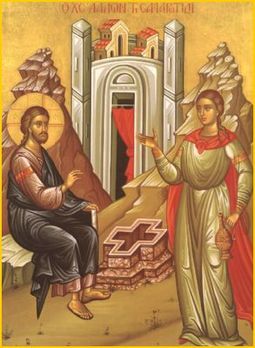
St Photine255px-St_Photina, as the ancient church has named her, continues to guide this part of our Lenten journey. Yesterday I was invited to conduct a house blessing on a women’s and children’s shelter. It was a multicultural context and included a smoking ceremony conducted by a Noongar elder (a smoking ceremony involves using the smoke from smouldering indigenous plants to ward off harmful spirits). Rather than conduct Christian prayers in isolation from the welcome and cleansing rites of our ancient aboriginal culture, we consulted to see whether our rites could be enacted in a visible and explicit complimentary manner. And so we did, teaching and explaining as we went. As each area was cleansed with the smoking ceremony, so Christian prayers invoked the comfort and protection of the One who creates and recreates, Father, Son and Holy Spirit.

…the hour is coming, and is now here, when the true worshippers will worship the Father in spirit and truth…“, said Jesus to Photine, who was grappling with cultural differences about how Jews and Samaritans approached worship rites.

I think those who were gathered there entered such an experience. Not on this mountain or that – but in spirit and truth.

Well, well, well…

The nameless woman at Jacob’s Well is our Lenten guide today. Read her story at John 4:5-30

One spectrum of Christian tradition dwells on the early part of the conversation – Jesus offering “living water” to one parched by errant ways.

Another spectrum of the tradition celebrates the outcome – this woman becomes the first apostle, an announcer of good news as, refreshed by the lure of being able to worship in spirit and truth – personal, gender and cultural barriers washed away – she runs into her Samaritan village to announce the good news of One who is making all this happen.

This tradition even gives her a name – St Photini.

Can I embrace this conversation in its completeness?


Lent partners International Happiness Day???

120px-Smiley.svgHaving dipped my lid to International Happiness Day and listened to the top ten pop “happy”songs, I now turn my attention to the phase of the Lenten journey that draws alongside.

Today’s sacred text is Romans 5:6-11 – often interpreted as the necessity of the sacrifice of Jesus as appeasement to an angry god to effect the salvation of us sinners! This popular characterisation is gold for preachers who wish to hold the wrath of God and the misery of sinners like a rod of chastisement over their flocks, but they miss the nuance which is Paul’s real message and is hidden in verses 10-11.

Using a verbal judo style technique, it seems that Paul cedes territory to the prescriptive but inadequate substitutionary atonement model, as if to say “Okay, if that works to your understanding of what happened at Calvary, let it be so – but consider this… Even more, eclipsing this, is how Jesus’ LIFE reconciles humanity to God … even more than his death! And even more than that, such reconciliation creates a boldness in  renewed relationship with the Creator through living the Way of the Life of Christ.” Paul was a rhetorician and his technique of ceding territory in order to gain what he really wants to say is classic.

So what at the beginning looks like an antithesis to the themes of International Happiness Day, through careful analysis, becomes a pointer to how happiness through fulfilment of destiny might be addressed.

The United Nations, the birthers of today’s world day, point to a number of happiness indicators such as food security, health access, safe housing, and gainful employment. A full index can be found at such sites as the Sustainable Development Knowledge Platform.  Sounds dangerously like shalom, the reign of the love of God feted by Jesus, the fulfilment in reconciled relationship with the Creator that Paul talks about.

One way of seeing Lent is about engaging the struggle with Jesus to get there. International Happiness Day is a shared dream of fulfilled hope.

What’s the use of suffering?

from Wikimedia Commons

An old criticism of the Christian way is a perceived emphasis on suffering. Gaunt pictures of self-flagellating, hair-shirted, monks and nuns in cold, dank cells lend credence to the view that the Christian faith appeals to the masochistic spirit that seeks ecstasy in pain and self-degradation.

While anyone can employ a religious motif to their own end, pathological or otherwise, this is not what the Apostle Paul speaks of in Romans 5:1-5 (NRSV) where he says…we also boast in our sufferings, knowing that suffering produces endurance, and endurance produces character, and character produces hope, and hope does not disappoint us, because God’s love has been poured into our hearts through the Holy Spirit that has been given to us. (vv3b-5).

Anyone knows that when one’s eye is fixed on a goal, it’s going to lead to a denial of living a lifestyle to the course of least resistance. One has to dig a channel according to the desired end, whether studying for a degree, saving for a home deposit, or training for a sport qualification. Blood, sweat and tears are involved – suffering for a purpose (and not for the self-gratification that agony might satisfy!).

This is no less the case when living life according to a defined purpose. The apostle says that when that purpose commends and exemplifies the Way of Jesus, any resulting suffering pays dividends, simply reinforcing the transcendent purpose of the Way as resilience builds.

Suffering is not to be sought for its own sake, but nevertheless welcomed as a potential viable source for strengthening faith and allegiance to the end of the Good News for the world, the reign of love and its legacy at large amongst all peoples. Any suffering, it seems, is pointless unless creatively and intentionally directed towards this end, even when it takes a while for this realisation to dawn.


March in March & Moses

375px-Bacchiacca_002
from Wikimedia Commons

While we are travelling with Moses it would be interesting to draw some comparisons between this two-man (himself and Aaron) movement and the March in March of the last weekend that saw thousands of the disaffected gather nationwide in protest against Government policies that have been swift and draconian in their implementation. 

Both were bids for release – Moses to free his people (good to see Andrew Forrest’s success in picking up the anti-slavery mantle) and March in March to free a range of policy areas from cut-backs and unseemly intervention. There is a difference though – Moses’ was a courageous stance against institutionalised tyranny and….. March in March …. which lens do we look through? One lens sees it as healthy and robust exercise of the democratic right to speak to our government representatives. Another lens might see it as a brave voice of dissent against the real powers that rule over us – namely global corporations that muffle the voices of the people. 

It was no surprise that the March in March protests went largely unreported in the mainstream media. The talkback radio I heard the following day seemed to reflect a concerted campaign to malign the protesting crowds by focusing on radical fringe groups that were present, ignoring the majority of ordinary families that had come out for the day. Maybe the peoples’ protests have more in common with Moses than is immediately apparent.

Lent calls us to constant awareness in the struggle to live for the common good. Exodus 17:1-7 sees that even Moses had trouble holding his people together for common purpose. His new found identity as a leader following “I Am  Being Who I Am Being” saw him through a series of confrontations and challenges with the Pharaoh, ultimately defeating him. He barely survived the bitterness and quarreling of those he led. 


A strange parley

Moses_bush
From Wikimedia Commons

The conversation between an ageing shepherd and the voice of the Holy One manifested in a burning yet unconsumed bush in the desert is not what one might expect.

Moses emerges as our next Lenten guide… and he does not hang back when called to account by the same urge that pulled his ancestor Abraham forth. He had every reason to willfully ignore the glow that drew him to take off his sandals and stand on holy ground, ready to answer the call to …. to what? A refugee of some decades from Egypt’s justice system, a herdsman in the safe sanctuary of the desert, he could have lived his days out in a form of peace. But now here he is, arguing with a shrub!

How long had the seed of Moses’ destiny laid hidden within him, awaiting the day it would sprout with awareness of a particular calling? What prepared Moses for that day of receptivity to a summoning voice announcing the maturation of that calling: “Go to Pharoah and tell him to let my people go!”?

How do we begin to understand that encounter with the Holy One is never static, but always in motion. For Moses learns the true name, the real nature of the Summoner – “I Am Being Who I Am Being…”? And that Moses (and anyone who encounters the true name and nature of the Holy One) can only complete their identity by responding to the call?

No wonder it is traditional in the Judaic traditions not to mention the name of G-d!  Moses embarked on a fearful but glorious journey with his people.

Be ready for an interesting ride when a bush calls you to parley!

Falling behind in Lent…

WP_000939This is a catch up post for three missing days of Lenten reflections. No-one said this would be easy. The gentleman to the left typifies the kind of journey we are contemplating. He can be seen as part of Sculptures by the Sea at Cottesloe. So we quickly pass by the Apostle Paul and his continuing postulations of the nomad Abraham and how merely his “faith was reckoned to put him right.” (Romans 4:18-25) We travel into Psalms 120 and 121 which reveal a turn of phrase – “Faith wasn’t meant to be easy!”

Psalm 120 expresses the woes of those who yearn for peace in the midst of an alien culture of war and aggression.Psalm 121 fixes the focus on the One who guards the well-being of the faithful. “The LORD will keep your going out and coming in from this time on and forevermore.”

Think of the various contexts in which these two psalms vie for the attention of the faithful – a hospital cancer ward, a refugee camp on the borders of Syria, a worker receiving a redundancy package…

Yeah, these circumstances call for the muscular faith of Abraham…


That Born Again Meme

Jesus and Nicodemus, Crijn Hendricksz, 1616–1645. (from Wikimedia Commons)

Today’s Lenten text (and Sunday’s Gospel for those churches on the Revised Common Lectionary) is John 3:1-17

What does being born again really mean?

Maybe Nicodemus knew all along – maybe he was just playing dumb. Jesus says “You’re a teacher of Israel, and you don’t know what I’m talking about?”

Some commentators note the terminology was quite current in post-exilic Judaism and that a “leader of Israel” would certainly be familiar with the terminology Jesus was using. The problem seems as though it was not one of understanding, but volition. Nicodemus did not want to leave the womb of familiarity, respectability and status  to go on the risky road of fulfilment with Jesus. The Spirit had led him to this place of readiness for rebirth, but Nicodemus is baulking – he is not ready.

Fair enough – being born can be a long drawn out process for both the birther and the birthed. It doesn’t always go smoothy and is inevitably downright messy.  And then there’s the whole process that lies ahead on the journey to maturation – feeding, changing, weaning – indeed many stages of development before one is even walking. This being “born again” business is not for the faint-hearted. Who would want to go through this whole journey from infancy to adulthood over again? No wonder Nicodemus baulks.

The literary devices in John’s gospel employ key characters as representatives of humanity in general. Nicodemus is us, and this is evident in the way Jesus’ particular address to Nicodemus morph’s to a more general address to all hearers. It’s difficult to discern where in the text this actually happens, except in the original language where the singular form of “you” becomes plural (verse 11). In this almost kaleidoscopic shift we are suddenly where Nicodemus is – we understand the question, but do we really want to risk the changes that such understanding implies?

A good Lent question for on the road to Jerusalem and Easter!

Missing woman unwittingly joins search party looking for herself

Sometimes newsfeed headlines grab your attention. This one just did.

Apparently a tourist left her group to change clothes while in the midst of a stop. She was deemed missing and joined the search looking for herself, quite unaware she was the subject, even after hearing the description of herself. No-one from her party recognised her as the missing person either. Here’s the story: Missing woman unwittingly joins search party looking for herself | Weird | News | Toronto Sun.

Today’s Lenten reflection takes us into the Apostle Paul’s efforts for us to “find ourselves” on faith’s journey. Romans 4:1-5, 13-17 simply mirrors the fact that Abrahamic faith, not slavish adherence to the letter of the law, does the job. Paul counts Abraham, even with all his demonstrated human flaws, as the epitome of human aspiration – simply because of what he continually and intuitively risks on trust in the mysterious God who calls him forth. In such he finds his true self. The stumbling, the losses, the humiliation along the way are inseparable from the accomplishments, the gains and exhilaration, and must be owned as part and parcel of our completion.

The messiness of faith and sibling rivalry

Sarai Is Taken to Pharaoh's Palace - by James Tissot. (Wikipedia)
Sarai Is Taken to Pharaoh’s Palace – by James Tissot. (Wikipedia)

Lenten reflections take us a little further into Abram’s epic but troubled journey. Genesis 12:4b-20 –  the patriarch eventually finds himself in Egypt and, for cargo and self-preservation, makes his presumably comely wife (Sarai) available to the Pharaoh. Hardly a salubrious beginning for the father of the world’s three major monotheistic faiths!

Stories of faith are inevitably messy affairs. We wonder how its going to end up for Abram (yet to be named Abraham), the great epitome of faith, when he gives in so readily to fear and expediency – especially when anxiety and the desirability of the quick fix are at the source of many of today’s woes, personally and politically.

Today’s Huffington Post nevertheless repeats a story that has been on this blog before – and it points to a legacy of the kind of faith Abraham eventually inspires amongst his “children,” particularly when sibling rivalry has surpassed its most dangerous point. Read it at  A pastor and an imam once tried to kill each other — now they work to heal Nigeria | Public Radio International.