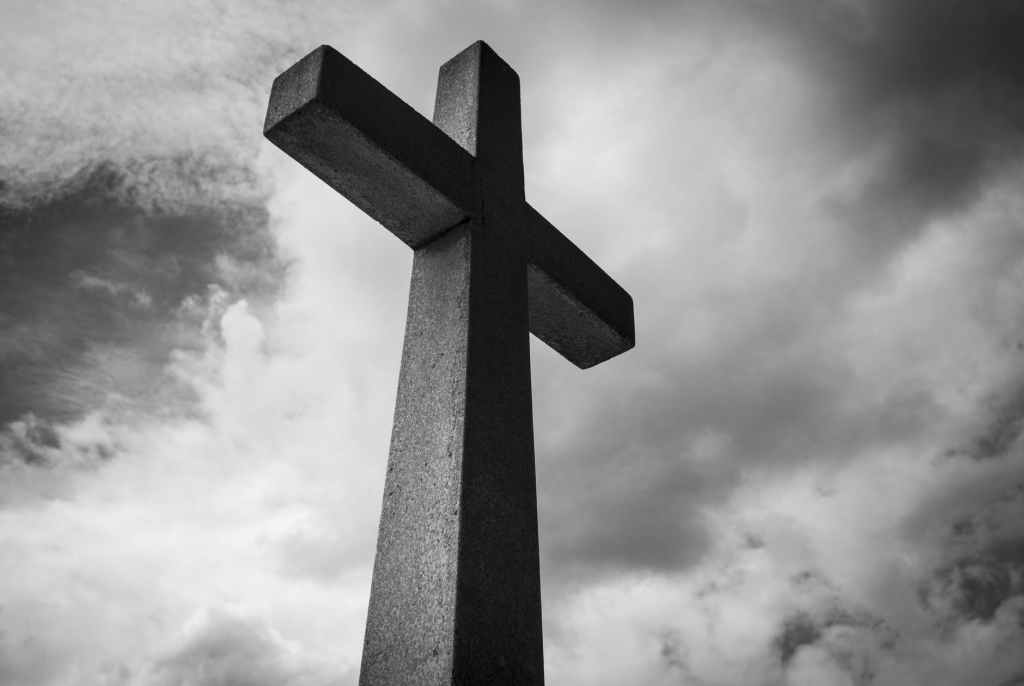
Hitting Holy Saturday “Pause”

Those who have travelled the Christian journey for two thousand years know that the Easter Saturday Pause is a mere interlude between Good Friday lamentations and Easter Sunday celebration of raised life.
Prescience prevents us into entering the utter despair and hopelessness of those who experienced the first Easter. There was no expectation of dead Jesus’ resurrection even though he had provided his closest companions a heads up on several occasions. “What now?” would have been the big question emerging from the funk of overwhelming grief.
Something like the perpetual “Holy Saturday” that now has the whole world in its grip – the one called COVID-19. Will there be an Easter Sunday and, if so, when?
Let’s take a cue from the lived out Christian tradition which now confidently embraces Holy Saturday as a time for pause and reflection, trusting that a time for joyful celebration of union is next on the agenda.
Why “Good Friday””

“Why is it called Good Friday? What’s so good about it?”
All the years I taught Religious Education in public schools, I could lay bets on some student asking this question. By and large, the kids I taught were engaged with the stories of Jesus – enough to be dismayed and offended at the accounts of his arrest, trial and crucifixion. In this secular age, many had not come across these stories before.
In true pedagogic fashion, I always answered the question with a question. “It comes from when it was originally called God’s Friday? Why do you think this name was used?”
Discussions would arise that theologs might identify as atonement theorising. Did our classroom reflections reflect Anselm or Abelard, or even the more complex but apt Girard?
They ended up more ANZAC. As Easter almost always fell in close proximity to their ANZAC Day studies we segued to the oft appropriated quote “Greater love has no man than he lay down his life for his friends.” Students were surprised that these words are taken from John’s gospel and refer to the action of Jesus on this day.
It led to more visceral, reflective responses – more appropriate to this day than our poor efforts at theorising.
The Power of Basin & Towel

I’ve often wondered how different church history might have been if its universal symbol was a basin and towel rather than a cross.
Today, on the eve of Good Friday, Christians commemorate the Last Supper at which Jesus, having taken a basin and towel, washed his disciples’ feet, saying “By this, all will know that you are my disciples, if you have love for one another.”
Symbols are powerful and the first Christians used a variety of them to recognise one another in secret circumstances, often under state oppression. The cross eventually emerged “officially” under the auspices of Emperor Constantine and world history tells of its continuing use, yes, for inspiration, but also for oppression by the powerful.
The events commemorated today suggest followers of Christ will be recognised, not by the cross, but their loving service in the manner of Christ who abandons seemliness to wash the feet of others in service.
“This is my commandment, that you love one another, as I have loved you.”
Do jewellers make basin and towel pendants?
Spy Wednesday

Who knew this was a name for the Wednesday before Good Friday? It brings in the Judas principle. He was the bean-counter for Jesus’ inner circle of twelve – the one who objected to Mary’s extravagant anointing of Jesus with expensive perfume which could have been sold and the proceeds given to the poor. From that time, we are told, he colluded with the authorities to turn Jesus over to them. Ancient church rites weave this occasion in to the Passion story of Holy Week.
It is telling how Jesus accommodated Judas in the whole episode – even to the embrace with which Judas eventually identifies Jesus to the arresting temple police.
We all live with a Judas principle – something primitive within that rebels against the common good and team goals. Jesus did not oppose Judas, carpet him, or cut him off. He did reveal his knowledge however, when at the supper before his arrest he said to Judas “Go and do what you have to do.” Somehow he wove Judas’ machinations into his strategy while allowing Judas the freedom to pursue his own dark lights.
Again, it seems a bit like dancing the Tango and my old judo teacher’s advice to not resist the force but to move with it to your advantage.
Perhaps this says something about how to manage polarities brought about by opposing passions in community life. Right now our country is divided over a legal decision of the High Court that yesterday led to the acquittal of Cardinal George Pell – relief for his supporters; despair and angst for the many victims of childhood sexual abuse, particularly by religious institutions. The finer points of the difference between legal and moral arguments are lost in the rawness of reaction.
How does Spy Wednesday speak into this angst? Like the poor, human dysfunction will always be with us. Jesus models a way, not of accommodation but costly acknowledgement – a crucifixion lies in the pathway. But so does a resurrection, ascension and Pentecost that, through Christ-filled community, transcends all things.
For both victim and ambassador, the pain and struggle of living the Christ life under the shadow of its defiled and disgraced institutional expressions will continue for some time. Spy Wednesday says, for now, embrace this reality as we walk the path to Good Friday in full hope of vindication beyond.
Beating Holy Tuesday Blues

Retirement was meant to be easy and simple. Instead, for the last ten months, we have been involved in a battle of wits and wisdom with the powers and principalities of Australia’s labyrinthine financial regulatory system. In seeking redress for a failed retirement “lease for life” scheme, our cohort of some 105 retirees plus their landlords and investors have encountered lies, chicanery, buck-passing, evasion, entrapment, and ducking and weaving while dealing with august institutions charged with consumer protection. When principals (and principles) are not held to account, Australia’s apparent reputation as the seat of the crime capital of the world is well deserved.
Honesty, candor and transparency seem to have little skin in this game.
As our campaign continues, it is instructive to reflect on some of the ancient Christian commemorations of Holy Tuesday that focus on Jesus’ encounters with the ruling elite of the Temple. They use sophistry and trickery to entrap this dangerously popular teacher. In the end, their hypocrisy is exposed as they take and dispose of him by force. In argument, however, Jesus is always one step ahead of the game, and his integrity is ever intact.
The events described in the gospels are not meant to be analysed chronologically, but reflected on for meaning and application. Here is a simple summary for those inspired to continue.
According to common interpretation of the Bible, Holy Tuesday is when Jesus was issued various challenges by the Pharisees and Sadducees over subjects such as marriage in heaven, paying taxes to Caesar, and the source of His authority (Matthew 21:23—23:39; Mark 11:27—12:44; Luke 20:1—21:4). By this same interpretation, this is the day Jesus commented on the widow’s donation (Mark 12; Luke 21) and was approached by a number of God-fearing Greeks (John 12:20–36). Tuesday would also be the day Jesus spoke His eight “woes” against the Pharisees (Matthew 23:13–36) and the evening on which He delivered the Olivet Discourse (Matthew 24—25; Mark 13; Luke 21:5–36).
from https://www.gotquestions.org/Holy-Tuesday.html
The commemoration of Easter events does not stop with Good Friday or even Easter Sunday. Jesus’ story of resurrection goes on, equipping his frightened disciples with fresh courage and understanding . He ascends and then returns in the form of Spirit at the feast of Pentecost, outpouring on all flesh, equipping the receptive with the means to build a new global community imbued with compassion and creative boldness.
No tricks can stand against such a reality.
Turning the tables over

COVID-19 has certainly turned the tables over economically. “Free market” trickle-down philosophy has suddenly and seismically given way to billions of dollars worth of rescue to keep society viable. One can discern a palpable shift in many communities. Supermarket brawls that reflected neo-liberal “survival of the fittest” philosophy have given way to neighbours and strangers looking after each other. Imposed restrictions are giving rise to creative initiatives as people rediscover “the commons” – the way in which villages of old ensured everyone was “looked out for.” The miracle that no-one ever thought of is happening – a quiet socialist revolution under a strictly conservative government. As we continue to find ways of thriving while in danger, one ponders what will last, whether the new found good can remain sustainable or greed seek to take up the reins again.
The Monday before Easter commemorates the occasion of Jesus clearing the Jerusalem Temple of traders and money-changers – the one instance described of violent physical action on Jesus’ part. High level corruption had entered the holiest place and Jesus was having none of it. This action solidified the course for what many saw as his downfall and eventual trial and execution. They did not take into account the matter of resurrection, ascension and the pouring out of himself in Spirit when the world was gathered at Pentecost.
Corrupt systems have a finite shelf life. The human will to thrive in mutual community is forever.
Palm Sunday – A Highway to Hell?

Only four weeks ago Canning Highway in Perth was packed tight as thousands of fans commemorated Bon Jovi and AccaDacca’s “Highway to Hell” famous signature song vibrating from bands on a fleet of tray-top trucks as they rolled from Canning Bridge to Fremantle.
Four weeks later Perth’s highways are all but deserted as we self-isolate in a mass attempt to avert the worst effects of the Covid-19 corona virus.
Some would point to the “Highway to Hell” celebrations as a harbinger of doom, but Covid-19 was already well established in some pockets of the globe and well on its way here.
And now Palm Sunday is upon us. An occasion to reflect and reminisce on past Palm Sunday processions with Sunday School kids waving palms as they usher the congregation into services. Some brave churches even commandeer donkeys (well fasted!) to be ridden up the aisle of the sanctuary. The socially conscious rally outside city cathedrals to march for peace – taking their cue from the one who they named the Prince of Peace.
Perhaps only Jesus, the focus of the original procession, knew what a highway to hell he was travelling. A few short but long days of passion, betrayal, trial, abandonment, torture and suffering to beyond the point of death lay ahead – and he knew it. He had a purpose beyond our ken however – Christian scripture and tradition refer to the Harrowing of Hell performed by Christ between Good Friday and Easter Sunday. You can read about it here.
Tango with the ‘Rona

Waking dreams are the most interesting to ponder (even if they are the only ones I can now recall). This morning’s had the words in the title. What on earth was running through the caverns and labyrinths of my wild unconscious before it succumbed to its waking tethers?
A brief research of the origins and history of Tango on Wikipedia suggests the dreaming link might have something to do with a defiant response to a dominant threatening pandemic akin to the relationship of slavery, conquest and colonial powers.
My uneducated notions of the Tango seem to match this impression. Oppressed peoples succumb to the power of their overlords with a kind of matched syncopation that requires cooperation with the imposed restrictions. But there is a background defiance that finds creative expression in both music and movement.
I recall my early teenage judo lessons that taught me not to resist the power that is being wielded against you, but to move with it in such a way that it becomes your ally.
It seems to me that this is what many of us are attempting as we live in the isolation imposed on us by an invisible pandemic. We set up neighbourhood email networks, streets organise driveway happy hours, and apartment blocks sing from balconies. In Oz we have even taken to naming our nemesis “the ‘Rona.”
It seems we, as left footed as we may be, are learning to tango.
Djilba flora around the corner
Djilba is the local indigenous season that roughly coincides with late winter/ early spring and it’s when the native flora appears. I found these within a five minute walk from our place.