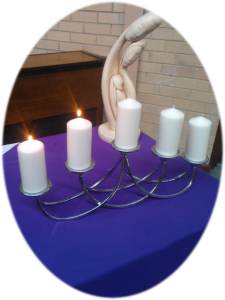
Advent Voices: a manifesto against our latest law

Isaiah 61:1-7 is repeated in Luke 4 by Jesus when he announces the blueprint of his operations.
It is the antithesis of the Immigration Bill allowed by the Australian Senate last Thursday night.

It is a strong Advent voice that calls the Australian people to account.
It comes not as warning, but as proclamation of the inevitable, in spite of our mean machinations:

Good news is there for the oppressed;
Binding is present for the broken-hearted;
Liberty for captives is proclaimed, as is release for prisoners!

Australian people, get on board and stop fighting the inevitable! This legislation is a feeble whimper against the storm of goodwill and compassion that our population will find once again because the unspeakable horror that this law exposes us to will wake us up.


Second Sunday in Advent – Peace

wonderingpilgrim's avatarWembley Downs Church of Christ

Advent 2As it is written in the prophet Isaiah,
‘See, I am sending my messenger ahead of you,
who will prepare your way;
the voice of one crying out in the wilderness:
“Prepare the way of the Lord,
make his paths straight”

Isaiah’s oracle is how Mark’s Gospel begins – straight into a face off with the powers of the land. Isaiah’s prophecy finds flesh with the arrival of John the Baptist.  He calls the people out of their day to day stupor – out into the wilderness to face the challenge of renewal of heart and mind and a new beginning. In this way, they prepare for the coming of One who will unite them into a new way of community where the Hebrew gift of shalom can find full expression.

No more dissemblance from political ivory towers, no more cheating, no more cruelty, no more cheap bartering with human lives…

View original post 35 more words

Advent Voices – Peter

St. Peter Preaching the Gospel in the Catacombs by Jan Styka, Public Domain

In a world that is growing increasingly dystopian, the realisation of the realm of shalom ushered in by Jesus seems to be getting further and further away, or perhaps being driven further underground. “Patience!” counsels Peter to his persecuted community: “with the Lord one day is like a thousand years, and a thousand years are like one day.”

In the meantime? “Strive to be at peace, without spot or blemish.” Maintain focus on the Way you have been called to walk, no matter the obstacles, distractions and disappointments. Cultivate patience as part of the process towards the sacred vision that awaits fulfilment.

Advent Voices – John’s cousin

Puvis de Chavannes, The Beheading of St John the Baptist, c. 1869
Puvis de Chavannes, The Beheading of St John the Baptist, c. 1869, Public Domain

John could not go around saying the things he was saying without attracting the attention of the authorities and he ends up in Herod’s dungeon. By now the one to whom he had been pointing, his cousin, Jesus of Nazareth, is traveling the land, teaching and healing in the manner that John had predicted. Even strong voices can falter under stress (as seen in our own Senate last night), and Jesus, having reassured the wavering John, impresses John’s pedigree upon the crowd. “Don’t lose focus,” he virtually says, “you received the integrity of John’s message then – nothing has changed. Regardless of what you perceive to be happening, the implementation of the reign of God is on course.”

Advent Voices – John the Baptizer

Pieter Brueghel the Elder (1526/1530–1569) [GFDL (http://www.gnu.org/copyleft/fdl.html) or CC-BY-SA-3.0-2.5-2.0-1.0 (http://creativecommons.org/licenses/by-sa/3.0)], via Wikimedia Commons
Pieter Brueghel the Elder (1526/1530–1569) [GFDL (http://www.gnu.org/copyleft/fdl.html) or CC-BY-SA-3.0-2.5-2.0-1.0 (http://creativecommons.org/licenses/by-sa/3.0)%5D, via Wikimedia Commons
Zechariah’s son certainly made up for his father’s speechlessness before John’s birth! John’s call is to repentance – an intentional reorientation of heart, soul, mind and action. Zechariah’s silence had been the stillness before the storm that sweeps clean. Such was John’s magnetic appeal that crowds went out into the wilderness to hear him. His advent voice was a true call for preparation – we need to be “tuned in” and receptive to truly appreciate what is about to happen in our midst.

Advent Voices – Mute Zechariah

GHIRLANDAIO, Domenico Zacharias Writes Down the Name of his Son Fresco Cappella Tornabuoni, Santa Maria Novella, Florence. Public Domain

Can the voiceless speak? Zechariah was struck mute when he questioned the veracity of an acutely personal Advent vision while he was performing his set priestly duties in the temple. Luke 1:5-17. (Never say serving on a church roster is boring and humdrum!)

Apparently so. We read on and find that when he emerged from the sanctuary, people wondered at his speechlessness and realised he had been visited by some divine encounter. He kept serving the temple in silence until it was time to return to his home – to await the birth of his son whom the angel, Gabriel, had directed him to name John – already marked as special by Zechariah’s community because of the speechless father that had emerged from the sanctuary that morning.

Advent Voices – Elijah the Tishbite

Russian icon of prophet Elijah. Илия пророк с житием и деисусом. Икона из церкви Ильи Пророка в погосте Выбуты, близ Пскова (Public Domain)

‘Tis the season of obscure voices from long ago that speak into our contemporary scene – voices that call us to wake up and pay attention!

The Hebrew reading set for today is 2 Kings 1:2-18 – a confronting tale of a prophet, Elijah, who exacts some considerable collateral damage in awakening a king. The hapless Ahaziah is belatedly re-oriented to the faith narrative he is called to represent. It is too late for him, but his successors surely get the message!  Responsible leadership cannot take its eye off the ball or the people perish. A sobering thought for a democracy such as ours where our leadership is ultimately our responsibility, not just at the polling booths, but in our continuing dialogue with our parliamentary representatives.

Advent is the season that calls us to wakefulness. Listen for the voices that call us to alertness. There is much in contemporary life that distracts and diverts us from whatever high path we have chosen. For followers of the way of Jesus, this season is a reminder that our ancient faith calls us whatever our current preoccupation to focus on the meaning of his coming amongst us – then, now and yet.

An Apocalyptic Advent to You and Yours

livingthequestionsonline's avatarLiving the Questions

“Apocalyptic Awakening”

By Bruce Sanguin (from If Darwin Prayed)

O Holy One,
we are a sleepy lot,
slow to stir to the calling of the cosmos,
deaf to the cries of the Earth
and the forgotten ones,
human and other-than-human.

We distract ourselves
with trivialities that have become idols;
while the sun and the moon darken,
and the stars fall from the skies,
we are mesmerized by the market’s alluring power,
eyes unflinchingly fixed upon the naval of our own net worth.

“O that you would tear open the heavens and come down,”
cries the prophet,
or at least tear open our hearts, pry open our eyes,
and end this slumber that blocks out pain,
but with it, wonder.

Our hope, O Holy One, is found in eyes wide open,
in hearts linked in common cause,
in small gestures of compassion,
and in alertness to your coming,
again and…

View original post 127 more words

40 years ago today…

… I knelt on a Melbourne platform and was ordained a minister of Churches of Christ in Australia. 40

Today is an occasion of reflection of what it has all meant.

  • Historically my tradition has had an ambiguous stance towards the matter of “setting apart” or ordaining clergy. After all, are not all ordained and set aside for Christ’s work at baptism? An emphasis on mutual ministry  and the priesthood of all believers  has negated the need for a separate clergy class. The local congregation can equip and appoint people to perform any of the tasks a traditional minister can –  counsel, preach, teach, baptise, preside over communion – so why ordain? On the other hand, churches, in order to thrive, have benefitted from those with particular training and honed skills to lead and “equip the saints for ministry.”
  • My ordination culminated four years of intense study, formation, reflection, prayer and “hands on” work amongst local congregations. It involved dropping a career in retailing, self-funding four years of residential college and tuition, learning to become a student at tertiary level having dropped out of secondary school, and adapting to living in close community. It marked the emergence of a different person than had entered training, and a recognition by the wider church that such preparation had been worthwhile and adequate for the task ahead.
  • There is an “on-going-ness” in the act that took place on that Melbourne platform. Formation and learning continue, formally and informally. In a way, seminary continues in the local congregation. Seeds mutually planted in my churches at Fremantle, Canberra, Modbury, Aldgate Valley and Wembley Downs took root and grew and yielded fruit. To sit at the 40 year marker and gaze back down through the decades is an exhilarating and humbling experience.
  • My stance to ministry and faith has changed over the years. It has become deeper and more expansive. Labels and categories don’t bother me anymore – I can move freely through progressive, contemplative, charismatic, sacramental and evangelical fields of thought and being in my conversations and relations with others. Inter-faith possibilities I find inviting and engaging, where once I might have found them frightening and threatening.
  • The last few weeks have seen efforts to trace and reconnect with those who shared the four year journey – the “Class of ’74.” We are far flung and have only had spasmodic contact over the years. Like an expanding universe, our individual trajectories have been vastly different and unique. Not all will be marking an anniversary of ordination, but all will attest to the transformational nature of the journey we shared. Our efforts to organise a reunion are a work in progress, but the negotiations and conversations by email, SMS and phone have that endearing and enduring quality of resuming an interrupted conversation that can easily be picked up again.
  • The 40 years marks the time when my culture and economy says this is when one should draw up a pension plan and retire. 40 years is also the biblical “generation” suggesting that its time to pass the baton. I find myself resisting – not from denial of time’s relentless march – but from a sense of a task not yet complete. There is still fire in the belly and unfinished projects to see through to completion. There is also an openness to respond to whatever “new thing” emerges from current engagement. This momentary reflective pause is simply a “coffee break.”  (Which is now over – so back to work!)