In seeking to revive some wordsmith skills, I intend to irritate my readers with some 5/7/5 syllable poetic reflections after the Japanese haiku style. I have already learned of a school of thought that asserts that English iterations of this style tend to do little justice to the beauty of classic Japanese literary rhythms. Instead, it is suggested that fans employ the 17 syllable “American Sentence.” I’ve marked this for further exploration, but am happy for the moment to keep trying the traditional three liner. It appeals to me for its invitation to
immediacy
discipline
context friendliness
contemplation
So let’s start a “Twelve Days of Christmas” series. Yesterday we did Christmas Aussie style – 43 Celsius (109 Fahrenheit) heat, air con blowing, too much turkey and ham, lots of salads, a swimming pool and a guest celebrating a first ever Christmas since leaving a 40 year membership with Jehovah’s Witnesses. Now to sum it up in a haiku!
First day of Christmas Sun, fun, family and guests Bright radiance birthed!
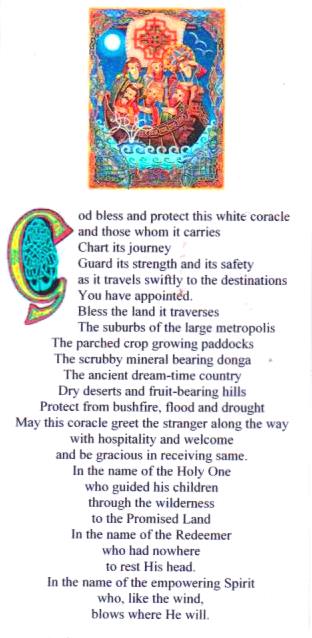
Cleaning up, I just found this laminated prayer that was fixed to the dashboard of our white Falcon on a road trip across the Nullarbor. I have just remarked to some friends that launching into 2022, because of personal and global circumstances, seems to be calling us to adopt the Celtic monk perspective of launching the coracle of our selves into indeterminate currents and trusting the wind of God to blow us where she will.
This will mean the difference between suffering as victims to forces beyond our control, the so called soul-sucking powers and principalities, or remaining awake, alert and attentive to possibilities and opportunities that reflect the deeper core of our being.
The white Falcon station wagon is long gone. The prayer still fits the blood and bone vessels that carry us!
This is a reflection of yesterday’s meetings called by the Chair of the Australian Securities and Investment Commission (ASIC), our peak financial regulatory body, to hear first hand stories of the victims of the 30 month old Sterling First retirement housing collapse. It was made clear that resolution of regulatory failure was not in ASIC’s hands!
The meeting ended with a victims’ walkout.
“Traditional haiku usually focuses on two very simple subjects while providing an interesting or unexpected perspective. Like a good joke, the first part can serve as the set-up, while the second part delivers the punchline.”
The feeling one has when struggle leads to a zenith that opens up three possible pathways – each fraught with cost and risk. Exploring the pros and cons of each that are contingent on their own imminent events. Gearing up ready to act on the opportunity that may suddenly present itself.
This reflection was delivered today at the Canterbury Classics Men’s Group at St Anselm’s Anglican Parish, Kingsley, WA.
Let me begin by acknowledging the people of the Noongar-Whadjuk nation and their custodianship of the land on which we gather. I pay respect to their elders past, present and future.
Thank you for inviting me to share an Advent reflection on our journey though the Sterling retirement housing collapse, currently under the scrutiny of a Senate Inquiry.
Whenever I am asked to reflect on this journey that we have now shared with over 100 abandoned tenants, I find it helpful to frame our story within the theme of the church calendar. The seasons of the church year constantly give us the themes of the big story that is the background to the rich variety of our own stories.
Advent thrusts us into the brave declaration of hope in the midst of chaos and destruction. Indeed, through the opening gospel of the season this week, we hear Jesus saying to his disciples “When these things begin to take place, stand erect, hold your heads high, because your liberation is near at hand. Watch yourselves, or your hearts will be coarsened with debauchery and drunkenness and the cares of life, and that day will be sprung on you suddenly, like a trap. For it will come down on every living person on the face of the earth. Stay awake, praying at all times for the strength to survive all that is going to happen, and to stand with confidence before the Son of Man.”
In these days of preparing for Christmas, we are given these apocalyptic images. Like the frog in the boiling kettle, we have become accustomed to the atmosphere of doom and gloom in relation to a global pandemic, climate change, financial corruption, the drums of war and the tragedies of those callously used as collateral by politicians and traffickers. To many, it is as if the four horsemen of the Apocalypse are already at full gallop through the regions of the world. The Way of the gospel is not to live in fear and trembling or resignation. It is to recognise that when fear either from our unconscious or the media or even our own personal tragedies seeks to manipulate us, we can choose the way of liberation instead.
The arc of the universe is long and bends towards justice. (MLK)
So let me share with you something of Jenny’s and my journey when confronted with our personal apocalypse.
There are events in life that thrust us into involuntary choices to sink or swim. On a Sunday night in June 2019, the week we were to fly out to Singapore to celebrate 40 years of marriage, we turned on the TV news and heard about the collapse of the Sterling group. It meant that we, along with 160 others, were notionally homeless, having sunk huge amounts of money into trust from which our rent would be paid through life-long leases.
Through a chance flick of the TV dial, we discovered that we had lost an enormous proportion of our life savings and the retirement accommodation it had provided. We were immediately plunged into our own personal apocalypse. Would we sink or swim?
The next day we contacted our property manager who confirmed that the trust had not paid our rent for several months. His advice was to contact the property owner and see what could be arranged to avoid eviction. We negotiated a holding pattern, a temporary reprieve, and flew out to Singapore to celebrate our ruby anniversary, the first overseas holiday we had ever shared, trying not to think of the conundrum that faced us on our return.
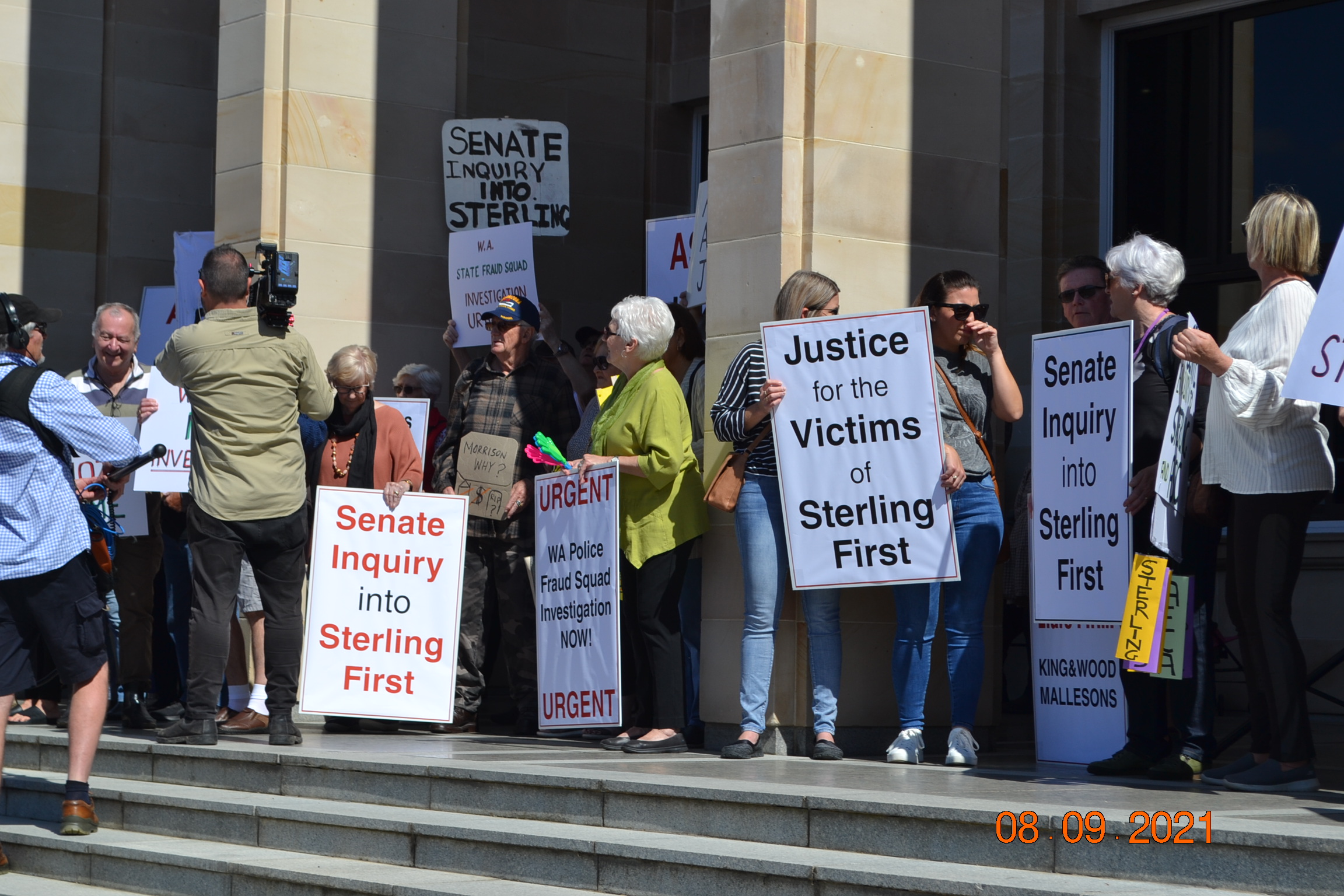
We were 12 months into retirement. My plans had been to rest, share company with Jenny, recover from the intensity of 44 years of public ministry, and do some writing. Instead I became an activist, helping organise rallies, lobbying and meeting with a range of politicians, and fighting a monolithic bureaucracy that had failed dismally in enforcing its own regulations. The grey army of Sterling fighters have become as familiar a sight on Perth Streets as the Hare Krishna devotees of the 60s and 70s. So much for a quiet retirement.
Sink or swim! Stay awake!
On return from our six days in Singapore, we soon found ourselves gathered with a capacity crowd at Peel Stadium in Mandurah. All had been affected in some way by the Sterling collapse – tenants, landlords, real estate managers, investors. Present also were local politicians, the current Consumer Affairs commissioner and last but not least, the invited guest, Denise Brailey, President of the Banking and Finance Consumers Support Association.
Denise is an accomplished fighter who has been on a 25 year mission to expose and transform the Australian Financial system. Her notable accomplishments include millions of dollars compensation for victims of the Westpoint collapse, the WA stockbrokers scandal and numerous individual cases where banks have been derelict in their obligations to consumers. She was instrumental in setting up the recent Royal Commission into Banking. At our rally, Denise was able to quickly identify the complex but fraudulent nature of the Sterling Rent for Life scheme, the negligence of the corporate cop, ASIC, and rally the crowd to a strategy for compensation.
Thus began a long 30 month journey of public demonstrations, letter writing, meetings with politicians and bureaucrats and strategizing that has eventually led to the current Senate Inquiry into the Sterling Income Trust.
At the spear head of the fight has been the group of approximately 100 affected tenants, many of whom are in their 80s or 90s. Street marches on the Perth offices of an unresponsive ASIC, a limited, somewhat helpful, but culpable WA Consumer Affairs, and the WA Police fraud squad have been marked by Zimmer frames, crutches and wheelchairs amongst the placards and whistles.
When we visited the Finance Minister’s office at the Perth Stock Exchange, he refused to receive the bundle of letters, instead calling six burly federal police officers down to deal with us. Thousands of unanswered letters have been written to the Prime Minister and Treasurer. Five of us attended a business breakfast at which we presented the Federal Treasurer with a bundle of 100 letters from victims and their families, asking him to read them on the plane home. After the same gathering, a chance meeting with the Assistant Minister to the Prime Minister won assurance that he would personally see that the Treasurer would read and respond to the letters.
In the meantime, powers from on high were working hard to discredit and divide our group. Political and media groups expected us to fade out, employing strategies that variously ghosted, ignored, or manipulated us towards false paths of resolution. Tenants by now were clogging the magistrates courts fighting notices of eviction. Cases were deferred again and again because of their complexity. Two notable and drawn out cases were heard and decided this year in the WA Supreme Court, resulting in evictions of the tenants on technicalities.
17 of our number have passed away, 6 are now in hospital as the result of stress induced illness. Many have been evicted, some have moved in with family members, others are couch-surfing.
The aptness of the apocalyptic imagery of Advent is not lost on us.
The whole is greater than the sum of the parts.
In spite of the opposition and white-anting that adversaries visit upon us; in spite of efforts to sow seeds of dissension within the group; there has been a growing appreciation of the bond that unites us. We celebrate birthdays, arrange picnics and attend social gatherings. Several of my neighbours, also Sterling fighters, have had to move from the properties they rented as their owners took possession. We are still in touch – we know each other’s children – we continue to share our dreams and aspirations.
The bond is such that when a rogue real estate agent jumped the gun and planted a “for sale” sign when she knew the tenant was in hospital, a dozen of us occupied the living space during the “home open.” It must have been one of the shortest home opens on record.
Daily social media is being used to encourage, console and inform our wide spread group. From my ministry background I’ve been able to offer a kind of chaplaincy role and resources and suggestions that assist its cohesion and direction. The leadership and strong advocacy of Denise Brailey has been a crucial factor.
She has a small guiding committee of six that she calls her “generals.” Denise is the field marshal expertly directing the campaign from her command post, a small cottage in the eastern wheatbelt.
The experience of union is not unlike that of a parish community and a sometimes disciplined army. It is strong, maintaining a resilience that can withstand the assault of discouragement and disunity. It is the seed-bed of reasonable hope for resolution.
Over 30 months the group has shifted its sole focus from a mere seeking of compensation, as important for survival as it is, to the more altruistic goal of reform of Australia’s financial regulatory system.
None of us were financially savvy when we entered the housing scheme. We relied on the guidance of accountants, financial planners, and lawyers, many of whom were blind-sided by the complexity of the companies involved and which should have been red-flagged by the corporate policeman, ASIC. Even the financial planning and accountancy witnesses who appeared at the recent Senate hearings admitted the days required to unravel the spaghetti like arrangements behind Sterling and its multiple entities.
Over the months we have discovered that ASIC, bound by a rigorous application of the government’s caveat emptor doctrine, has been so constrained that it can do little more, at great public expense, than act as a librarian to what one of its previous directors referred to as making Australia the white-collar crime capital of the world.
From bitter lived experience, the Sterling tenants join thousands of other retired citizens of Australia who have been stung by what amounts to a series of officially sanctioned Ponzi schemes amounting to $40 billion losses over the last 25 years.
As devastating as the details of this knowledge is proving to be, it also serves as powerful ammunition to work for change in the system for the common good of the Australian community – and abroad.
Sterling is the canary in the mine. It is also the David facing a huge Goliath. What hope has it to effect system transformation? Well, we know how the original story turned out for Goliath. And it is Advent, the harbinger of hope, peace, joy and love.
A close colleague, Brian Holliday of the Dayspring Community, this week drew my attention to something Evelyn Underhill said, “The world is not saved by evolution but by incarnation.”
Evolution is mindful of “the law of the jungle”; “survival of the fittest.” It is constantly at work in our world, and it drives our hard-liner economic systems.
But Incarnation is also at work, constantly happening through what Underhill calls the “perpetual advent” – God’s constant self-giving of Christ to the world – God’s stooping to be present amongst the powerless and downtrodden – God’s energy transforming creation. God with us.
When chaos thrusts us into times of forced transformation and suffering, may we also seek out the signs of union and opportunities for mature service that give expression to the power of perpetual advent – the living out of the presence of the ever-coming Christ in our lives.
One of the great things about absorbing an ecumenical spirit over a lifetime is the capacity to draw from streams of Christian tradition that are other than my own. My tribe within the Christian family has a very simple, lean, and adaptable loose-on-the-ground outlook, influenced strongly by the 19th century Second Great Awakening of the US frontier and the outcomes of the Wesleyan and Whitefield revivals of England. Catch cries and slogans like “Christians only, but not the only Christians,” and “no creed but Christ” mixed with sharp Lockean logic and sawdust trail evangelism marked us as suspicious of what was regarded as extraneous feasts and rites.
Hence the glazed over eyes and polite murmurings when I mention a desire to acknowledge All Saints Day – the day following Halloween (meaning “all saints eve”). My defense is a biblical one, taken from the Hebrews 12:1.
“Therefore, since we are surrounded by such a a great cloud of witnesses, let us throw off everything that hinders and the sin that so easily entangles, and let us run with perseverance the race marked out for us.”
A combination of my Celtic bones, researching family history and my septuagenarian awareness of my many mentors that are no longer physically present, having been promoted to glory, orient me to the worthiness of this ancient rite carried by other liturgical streams,
Hence, on the first Sunday in November, it was my practice in later years of leading congregations to lead rites of thanksgiving and reflection on the lives of church members, ordinary folk who had gone before us, commemorating their legacy and contemplating that which we would leave for those who came after. It was yet another avenue for honoring the eternal Christ who dwells in our midst.
And so happy All Saints Day! For a reflection that goes deeper, click here.
I responded to a version of this question a day or two ago. I would prefer to rephrase it “How do faith and politics mix?” It is being asked of our current Prime Minister and addressed this morning in an article by a previous one.
Most of my three years in retirement has seen me more active politically, out of necessity, as part of a badly regulated and collapsed retirement housing scheme. Together, with over 100 affected households, I have been writing, phoning and pressing the flesh with politicians from both sides of the political divide. Within my cohort, my function as a pastor has not been to the fore, but noted and occasionally drawn on. Yesterday a primary goal was reached, the launch in Federal Parliament of a powerfully appointed Senate Inquiry into the conditions surrounding the housing collapse that includes a focus on the role of the regulator.
Debate, discussion and strategising within the group has been rigorous, intense, and sometimes divisive, as one would expect amongst peers who are stressed, ill and cheated. As a survivor of decades of occasional ructions within faith communities, I trust I was able to bring a calming influence. Some insights into the manipulation and chicanery of the political machine also helped in matters of discernment and consultation with our joint leadership headed by seasoned campaigner and consumer advocate Denise Brailey, who fondly calls us her “generals.”
My answer to the question was “by applying the law of love to the law of the jungle.” It has to begin at a very personal level, and it is captured well in a prayer that came into my feed this morning and that I shared on social media:
May the Christ who walks on wounded feet, walk with you to the end of your road; May the Christ who serves with wounded hands, teach you to serve each other; May the Christ who loves with a wounded heart, help you to love each other; When you go out, may you see the face of Jesus in everyone you meet, and may everyone you meet see the face of Jesus in you. Amen
Whatever one’s faith stance, it will appear in our politics, for we have to live in community and how we live and think and act is our “policy.” The extent of self and other awareness we bring to life reveals how our politics and our faith function together.







 Wondering Pilgrim